
Adult Deformity
Relordosing transforaminal lumbar interbody fusion (TLIF) with deliberate release of the anterior longitudinal ligament using expandable interbody spacers – institutional comparative cohort study
- H-OCH Health Ostschweiz, Kantonsspital St.Gallen, St. Gallen, Switzerland
- HOCH Health Ostschweiz, Kantonsspital St.Gallen, St. Gallen, Switzerland
Abstract
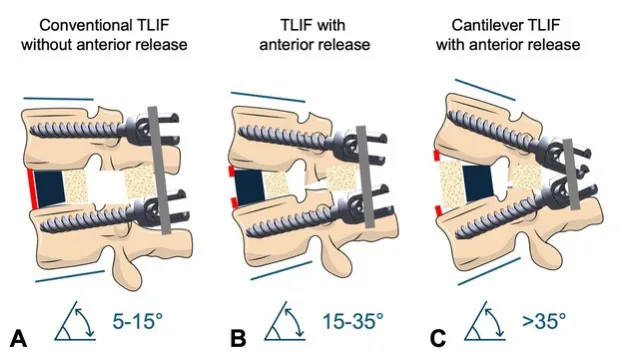
Transforaminal lumbar interbody fusion (TLIF) can be extended by transforaminal anterior release (TFAR), to open and distract degenerated segments and increase segmental lordosis (SL; Figure 1). We set out to determine spinopelvic parameters and clinical outcomes, as well as the rate, type and severity of adverse events (AEs) after TFAR compared to standard TLIF.
We reviewed consecutive patients treated with TLIF with expandable interbody spacers. TFAR patients with deliberate release of the anterior longitudinal ligament (ALL) were identified and matched 1:5 to a control group (conventional TLIF).
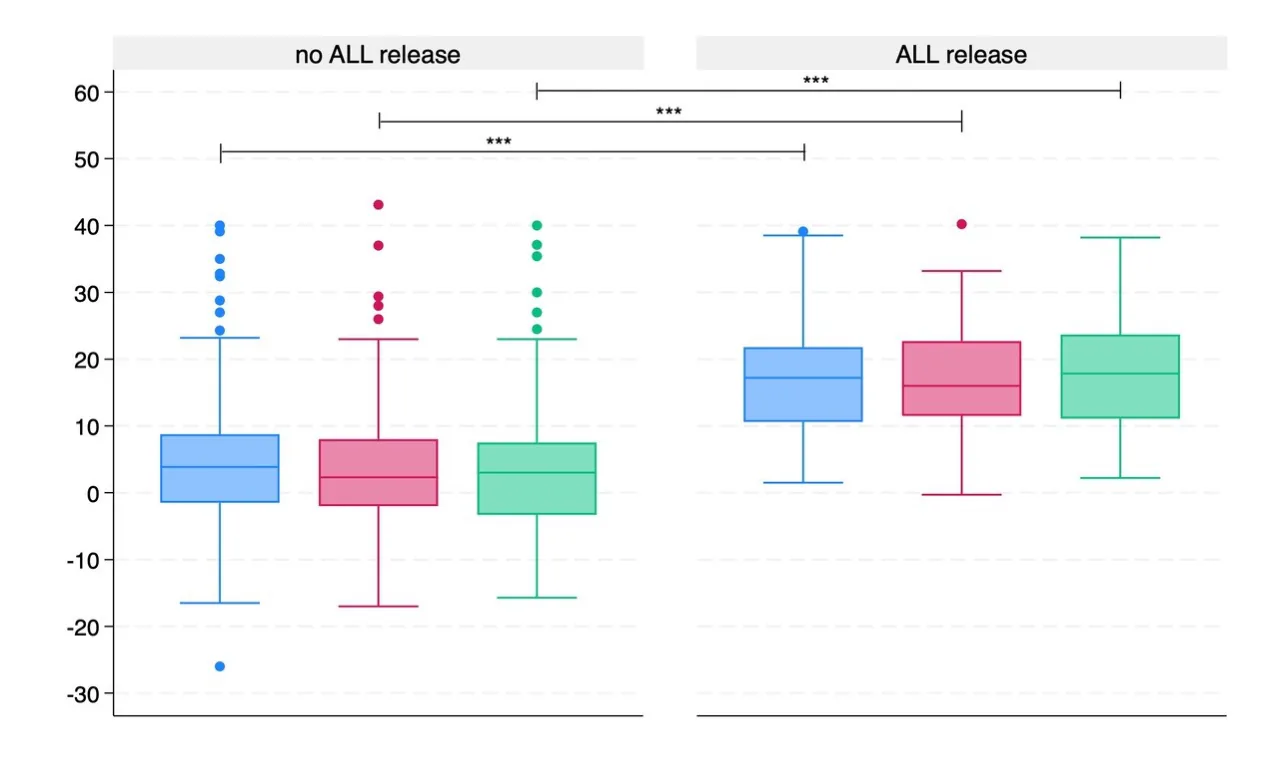
We identified n=435 patients (541 TLIF levels; mean age 65.2 years; 55.7% female), of which n=30 patients (39 levels) were assigned to the TFAR group and n=149 (247 TLIF levels) to the control group. TFAR procedures took longer (mean difference (MD) 86min, p=0.004) and had a higher blood loss (MD 463ml, p=0.022). In multivariable analysis, TFAR patients were more likely to experience intraoperative AEs (OR 3.49, 95% CI 1.47 – 8.31, p=0.005) and early postoperative AEs (OR 2.39, 95% CI 0.99 – 5.76, p=0.051), while the risk for further AEs at 90 days and 12 months was similar. Patients in the TFAR group were more likely to achieve a favorable 12-month outcome (OR 2.71, 95% CI 1.13 – 6.51, p=0.025). The pre- to postoperative gain in SL was 17.4° in the TFAR (p<0.001) vs. 4.2° in the conventional TLIF group (p<0.001) at time of discharge, 16.8° (TFAR, p<0.001) vs. 3.7° (TLIF, p<0.001) at 90 days, and 17.6° (TFAR, p<0.001) vs. 3.3° (TLIF, p<0.001) at 12 months (Figure 2). TFAR patients had consistently more SL during follow-up (12 month: 24.9° vs. 18.9°, p<0.001) and the pelvic incidence (PI)-LL mismatch was lower (0.4° vs. 7.2°, p=0.020).
We found a 3-fold increase in intraoperative and early postoperative AEs in TFAR patients, while the mid- and longer-term outcomes were similar or even slightly better than in patients undergoing conventional TLIF. TFAR constitutes an option to increase segmental lordosis via a posterior approach, especially in cases where anterior or lateral approaches to the segment may not be feasible.
Figures and tables
As submitted with the abstract. Tap a figure to open it at full size.