
Basic Science & Economics
Reliability and Validity of a Standardised Protocol for Trunk Extensor Strength with Isometric Dynamometry: A Single-Centre Observational Study
- Schulthess Clinic, Zürich, Switzerland
- Bern University of Applied Sciences, Bern, Switzerland
- Università e-Campus, Novedrate, Italy
- University of Zurich, Zürich, Switzerland
Abstract
Trunk extensor strength is an important parameter for rehabilitation, functional assessment, and treatment monitoring, and is often reduced in individuals with low back pain. Reliable and valid quantification of trunk extensor strength is essential, but standardised assessment methods remain limited. This study aims to evaluate construct validity and test-retest reliability of a standardised protocol for assessing trunk extensor strength in healthy individuals using an isometric dynamometer.
This single-centre observational study included 28 healthy adults (14 men and 14 women) undergoing trunk extensor strength testing in two sessions one week apart using a trunk-specific isometric dynamometer. Maximum voluntary contraction (MVC) torque was recorded. Lumbar extensor cross sectional area (CSA) was assessed using manual segmentation of MRI scans at the L1 level. Erector spinae muscle activity was measured using surface electromyography (EMG) with root mean square analysis. CSA and EMG measurements were obtained bilaterally. Test-retest reliability was evaluated using intraclass correlation coefficients (ICC) and standard error of measurement (SEM), with ICC [1,1] applied for reliability estimation. Construct validity was assessed by examining associations between MVC torque, CSA and EMG activity using linear regression analysis.
The mean ± SD age, height, weight and BMI of participants were 36 ± 9 years, 174 ± 10 cm, 70 ± 12 kg and 23 ± 2. Most participants were classified in the highest IPAQ-SF physical activity category (high: 19 [67.9%], moderate: 8 [28.6%], low: 1 [3.6%]). Test-retest reliability was excellent (ICC = 0.93, 95% CI: 0.88–0.96; %SEM = 7.05%). In linear regression analysis, both CSA and EMG activity were significant predictors of MVC torque (p < 0.001), with similar relationships observed bilaterally.
A standardised protocol with a trunk-specific isometric dynamometer demonstrated excellent test-retest reliability and construct validity for the assessment of trunk extensor strength in healthy individuals. These findings support its use in clinical and research settings. Further studies in patient populations and in additional planes of motion are recommended.
Figures and tables
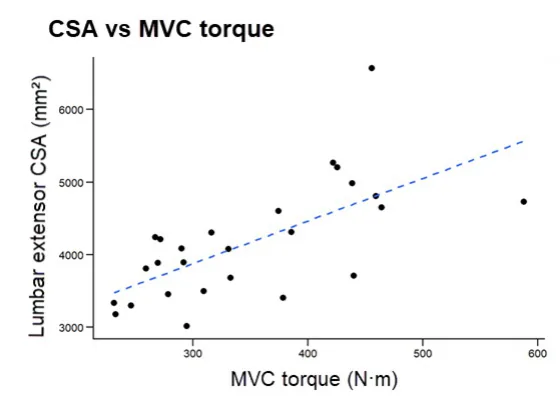
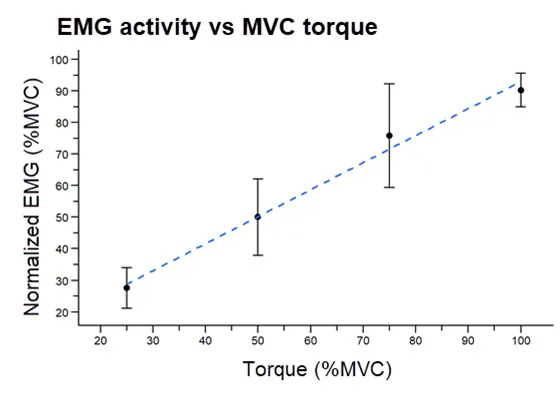
As submitted with the abstract. Tap a figure to open it at full size.