
Degenerative Thoracolumbar
Lumbar Pedicle Screws versus Cortical Bone Trajectory: A Systematic Review of Long-Term Outcomes
- Neurocenter of Southern Switzerland, Ente Ospedaliero Cantonale,, Lugano, Switzerland
Abstract
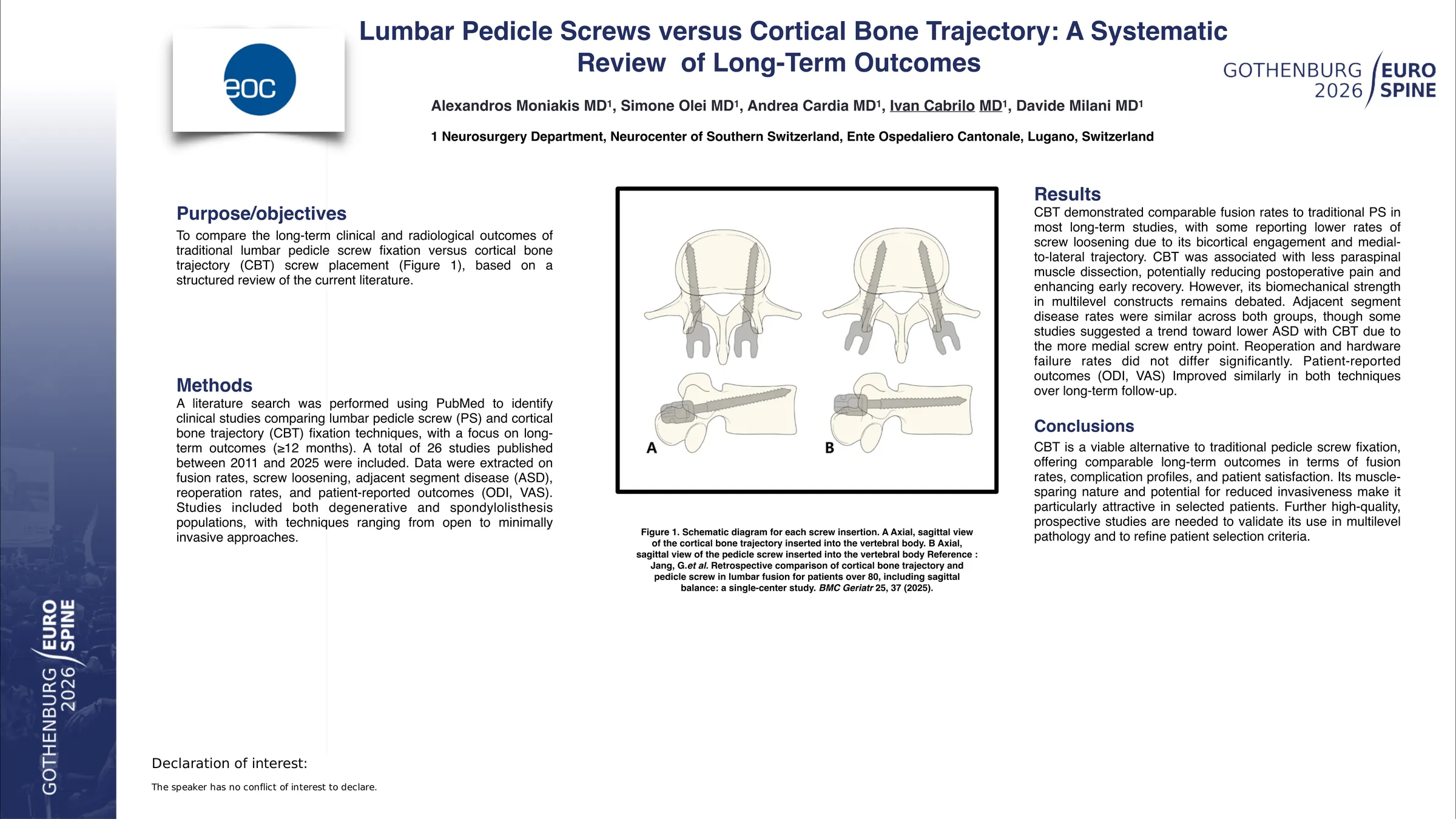
The aim of this study is to compare the long-term clinical and radiological outcomes of traditional lumbar pedicle screw fixation versus cortical bone trajectory (CBT) screw placement, based on a structured review of the current literature.
A literature search was performed using PubMed to identify clinical studies comparing lumbar pedicle screw (PS) and cortical bone trajectory (CBT) fixation techniques, with a focus on long-term outcomes (≥12 months). A total of 26 studies published between 2011 and 2025 were included. Data were extracted on fusion rates, screw loosening, adjacent segment disease (ASD), reoperation rates, and patient-reported outcomes (ODI, VAS). Studies included both degenerative and spondylolisthesis populations, with techniques ranging from open to minimally invasive approaches.
CBT demonstrated comparable fusion rates to traditional PS in most long-term studies, with some reporting lower rates of screw loosening due to its bicortical engagement and medial-to-lateral trajectory. CBT was associated with less paraspinal muscle dissection, potentially reducing postoperative pain and enhancing early recovery. However, its biomechanical strength in multilevel constructs remains debated. Adjacent segment disease rates were similar across both groups, though some studies suggested a trend toward lower ASD with CBT due to the more medial screw entry point. Reoperation and hardware failure rates did not differ significantly. Patient-reported outcomes (ODI, VAS) improved similarly in both techniques over long-term follow-up.
CBT is a viable alternative to traditional pedicle screw fixation, offering comparable long-term outcomes in terms of fusion rates, complication profiles, and patient satisfaction. Its muscle-sparing nature and potential for reduced invasiveness make it particularly attractive in selected patients. Further high-quality, prospective studies are needed to validate its use in multilevel pathology and to refine patient selection criteria.