
Adult Deformity
Understanding the Impact of Etiology on Mechanical Revision Rates and Patient-Reported Outcomes in Adult Spinal Deformity Surgery
- Rigshospitalet, Copenhagen, Denmark
- Rigshospitalet, Copenhagen East, Denmark
Abstract
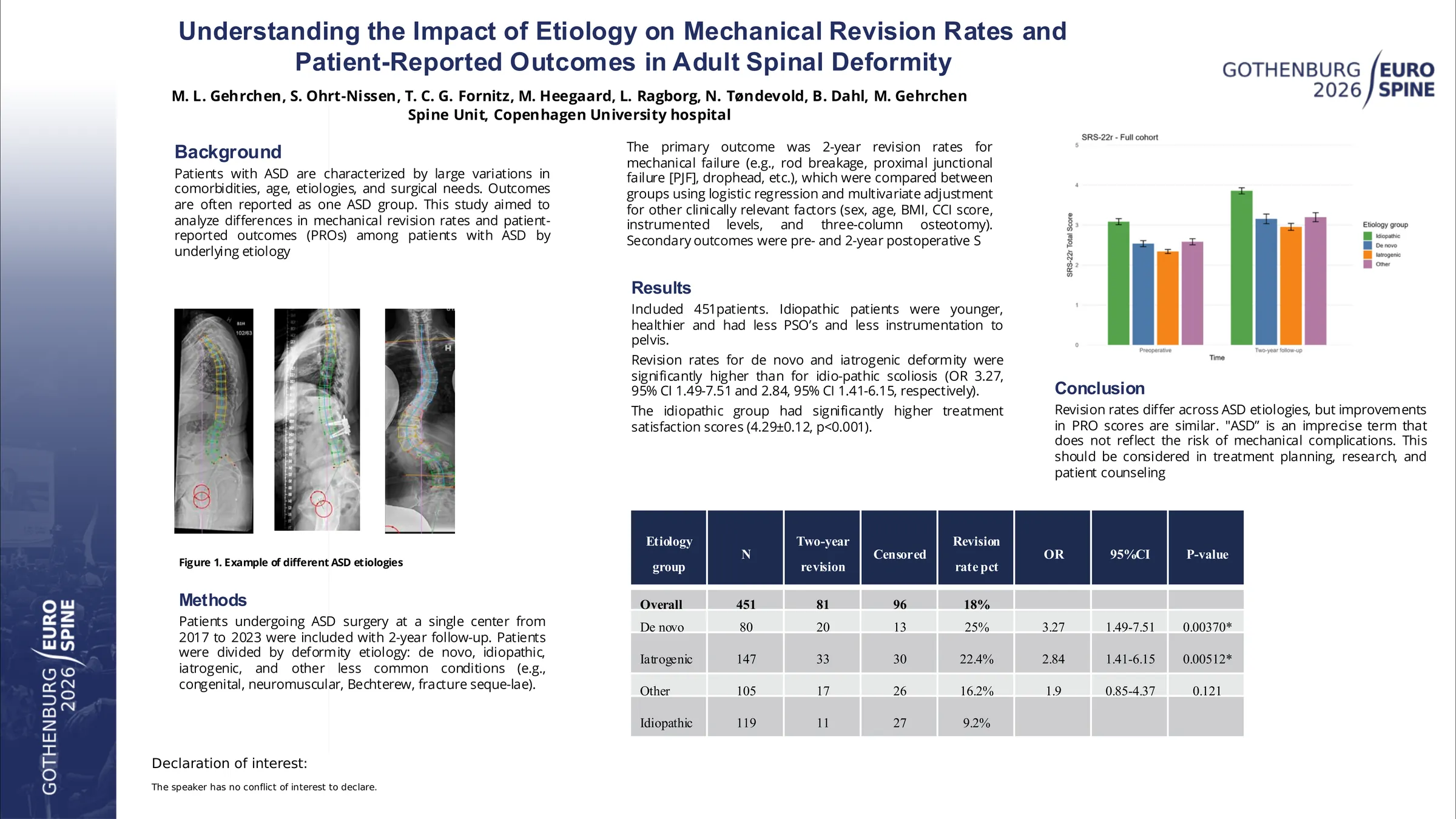
Adult spinal deformity (ASD) is a diverse condition that lacks a universally accepted classification system. Patient characteristics vary with respect to comorbidities, age, ASD etiologies, and surgical needs. Despite these differences, surgical outcomes are often reported as one ASD group. This study aimed to analyze differences in mechanical revision rates and patient-reported outcomes (PROs) among patients with ASD by underlying etiology.
In this retrospective, single-center cohort study, we included patients who underwent ASD surgery between 2017 and 2023 and had 2-year follow-up. Exclusion criteria were trauma, infection, and malignancy. Patients were classified by etiology of deformity: de novo, idiopathic, iatrogenic, and other less common conditions (e.g., congenital, neuromuscular, Bechterew, fracture sequelae). The primary outcome was the 2-year revision rate for mechanical failure, including distal junctional failure, drophead, misplaced implant, proximal junctional failure, rod breakage, screw breakage, screw loosening, and implant failure that was unspecified in the surgical note. Revision rates were compared between groups using logistic regression with multivariate adjustment for other clinically relevant factors (sex, age, BMI, CCI score, instrumented levels, and three-column osteotomy). Secondary outcomes were preoperative and 2-year postoperative SRS-22r scores, compared between groups using a mixed-effects model.
A total of 451 patients were included. The idiopathic group was significantly younger, healthier, with a lower BMI, and less extensive surgery. Overall, the mechanical revision rate was 18%, highest in de novo (25%) and lowest in idiopathic (9.2%). Revision rates for de novo and iatrogenic deformity were significantly higher than for idiopathic scoliosis (odds ratio (OR) 3.27, 95% CI 1.49-7.51 and 2.84, 95% CI 1.41-6.15, respectively). In the multivariate analysis, only the number of instrumented levels was significantly associated with revisions (OR 1.08, 95% CI: 1.01-1.15). Patients with idiopathic disease had higher preoperative SRS-22r scores, although no significant pre-to-postoperative change was observed between the groups. All groups improved significantly from baseline to 2 years postoperatively. The idiopathic group had significantly higher satisfaction scores (4.29±0.12, p<0.001).
Revision rates vary significantly across ASD etiologies, but improvements in PRO scores were similar. "ASD” is an imprecise term that does not reflect the underlying condition and risk of mechanical revision. This should be considered in treatment planning, research, and patient counseling.
Figures and tables
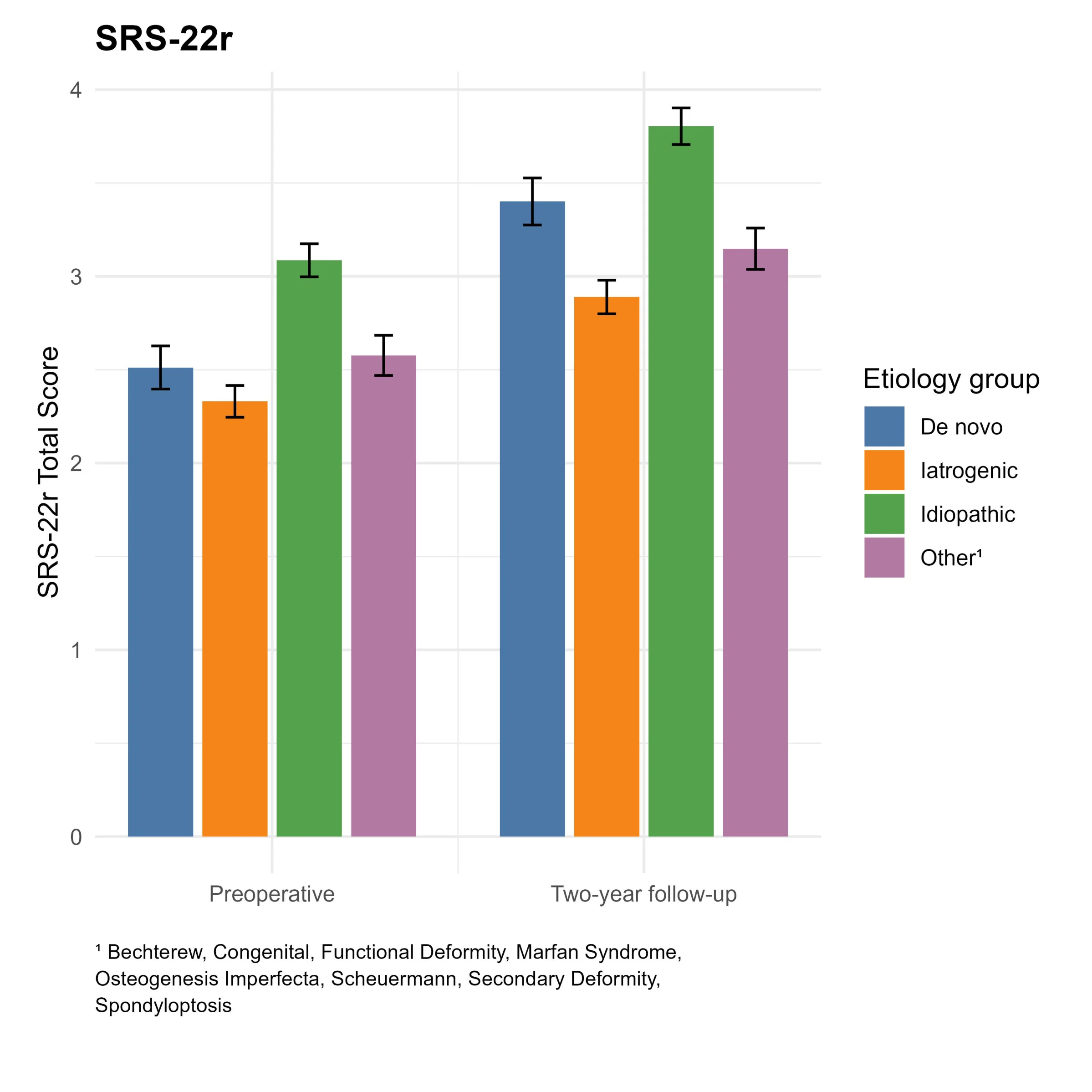
As submitted with the abstract. Tap a figure to open it at full size.