
Adult Deformity
Relationship Between Preoperative Cervical Muscle Morphology and Long-Term T1 Slope Progression After Lumbar Pedicle Subtraction Osteotomy
- Hospital for Special Surgery Main Hospital, New York, United States of America
Abstract
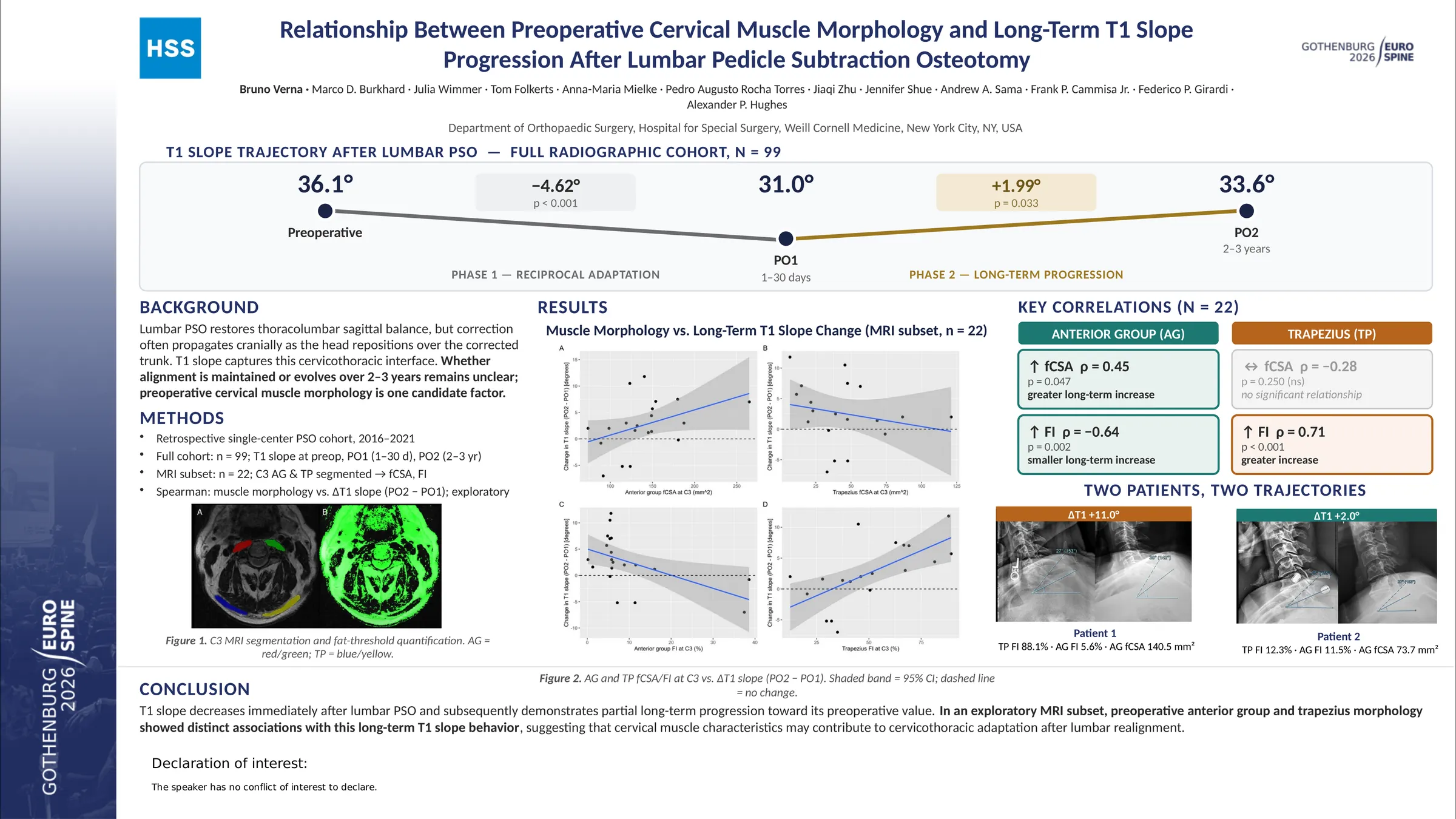
Lumbar pedicle subtraction osteotomy (PSO) induces reciprocal cervical alignment changes as patients re-establish global balance. While early postoperative cervical responses have been described, factors governing long-term cervicothoracic alignment maintenance or decompensation remain unclear. T1 slope reflects cervicothoracic orientation and has been associated with cervical decompensation and clinical outcomes. Given the role of cervical musculature in sustaining head and cervicothoracic posture, muscle morphology may influence long-term alignment behavior after lumbar correction. The objective of our study is to evaluate whether preoperative cervical muscle morphology is associated with long-term postoperative T1 slope progression following lumbar PSO.
Patients who underwent lumbar PSO with preoperative, early postoperative (PO1; 1-30 days), and long-term postoperative (PO2; 2-3 years) standing whole-spine lateral radiographs were reviewed. T1 slope was measured at all timepoints. In patients with available preoperative cervical MRI, muscle analysis was performed at the C3 level. Anterior muscle group (AG) and trapezius (TP) functional cross-sectional area (fCSA) and fat infiltration (FI) were quantified. Spearman correlation assessed associations between muscle morphology and long-term (PO1-PO2) T1 slope change.
Ninety-nine patients were included in the alignment analysis. Mean T1 slope decreased from 36.1° preoperatively to 31.0° at PO1 (-4.62°, p < 0.001), followed by a significant increase to 33.6° at PO2 (+1.99°, p = 0.033). Twenty-two patients had preoperative cervical MRI available for muscle analysis. AG FI demonstrated a strong negative association with long-term T1 slope increase (ρ = -0.64, p = 0.002), whereas TP FI showed a strong positive association (ρ = 0.71, p < 0.001). AG fCSA was moderately positively associated with T1 slope increase (ρ = 0.45, p = 0.047), while TP fCSA showed no significant correlations.
Preoperative cervical muscle morphology was associated with long-term cervicothoracic alignment behavior after lumbar PSO. The observed patterns suggest a balance between anterior and posterior cervical muscle function in shaping long-term alignment trajectories: greater TP FI was associated with progressive T1 slope increases, consistent with reduced posterior stabilizing capacity to sustain early postoperative correction, whereas greater AG fCSA appeared to influence a tendency for cervical alignment to return toward its preoperative profile over time. Together, these findings indicate that differences in cervical muscle quality, rather than size alone, may influence the maintenance or decompensation of reciprocal cervical alignment changes after lumbar realignment.