Cervical & Neural Pathologies
Fusion Assessment, Reoperation Rates, and Imaging Modality Agreement After Four-Level Anterior Cervical Discectomy and Fusion
- Hospital for Special Surgery Main Hospital, New York, United States of America
Abstract
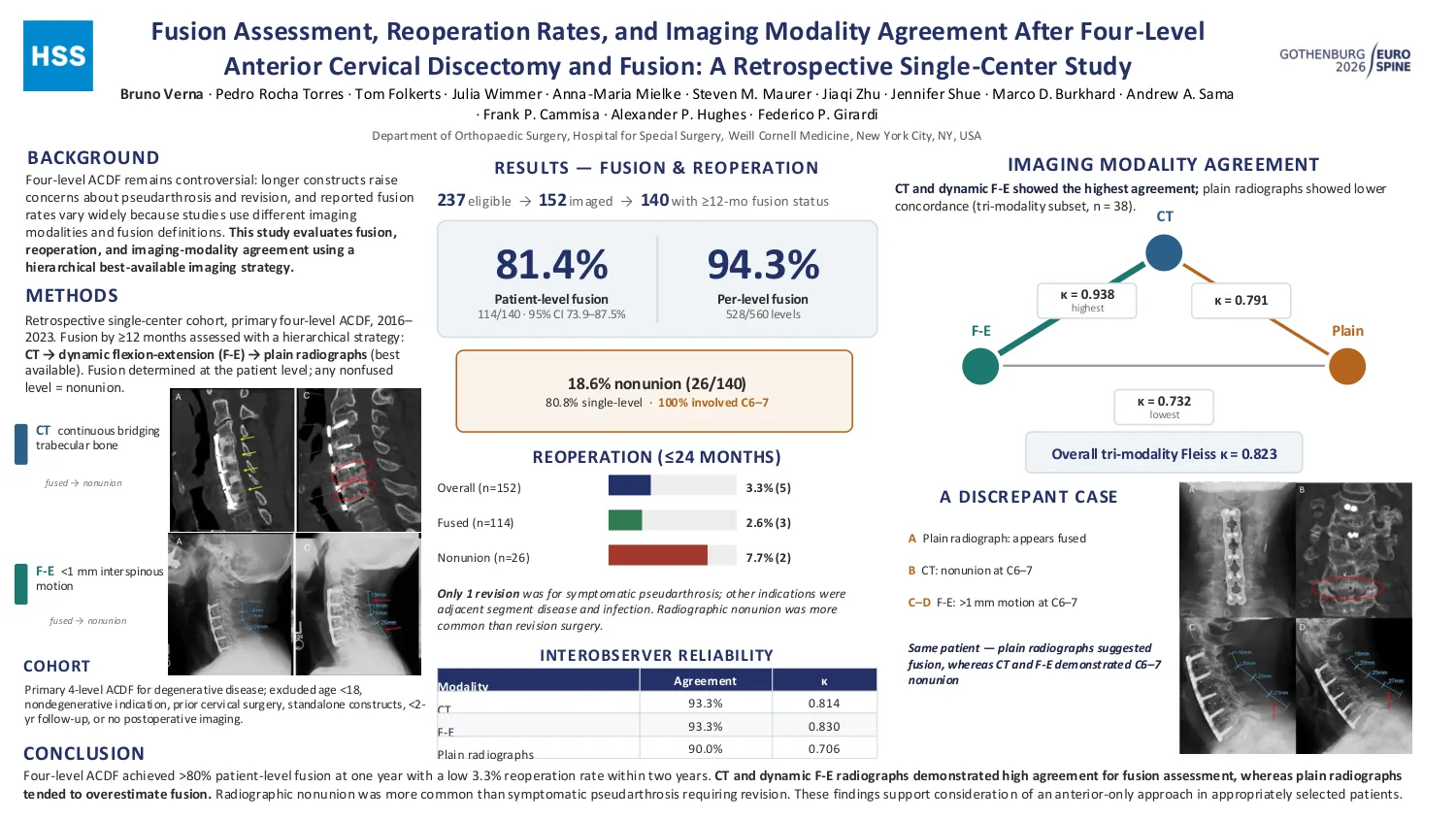
Fusion outcomes after anterior cervical discectomy and fusion (ACDF) involving four or more levels are variably reported and remain a subject of debate. Given concerns regarding high nonunion, complication, and reoperation rates, this is often not considered a preferred surgical option. Reported fusion rates vary widely, in part due to heterogeneous imaging modalities and inconsistent follow-up, and large fusion-imaged cohorts using standardized assessment strategies remain limited. The objective of our study is to evaluate fusion and reoperation rates after four-level ACDF using a hierarchical imaging strategy, assess agreement between imaging modalities, and describe reoperation rates by fusion status.
Fusion rates at ≥12 months were assessed using a hierarchical best-available imaging strategy, with CT used as the reference modality when available, followed by dynamic flexion-extension (F-E) radiographs or plain radiographs. Fusion was defined using established modality-specific criteria, including bridging trabecular bone and absence of hardware loosening on CT, and <1 mm of interspinous motion on dynamic F-E radiographs; plain radiographs were assessed for continuous bridging bone. Patients with imaging at 6-12 months were analyzed separately as an exploratory early-fusion cohort. Reoperation was defined as any subsequent cervical revision surgery occurring within 24 months of the index procedure and was recorded descriptively. Agreement between imaging modalities was assessed in patients with multiple postoperative studies using Fleiss’ kappa for overall three-modality agreement and Cohen’s kappa for pairwise comparisons.
One hundred forty patients met criteria for definitive fusion assessment at ≥12 months (CT 41%, F-E 36%, plain radiographs 23%), with an overall fusion rate of 81.4% (114/140). Early fusion was observed in 74.3% (107/144) of patients. Nonunion most commonly involved a single level, predominantly at C6-7. Within 24 months, reoperation occurred in 2 of 26 (7.7%) patients with nonunion and 3 of 114 (2.6%) fused patients; the most common revision procedure was posterior fusion (3 of 4, 75%). In a tri-modality subset, overall agreement across CT, F-E radiographs, and plain radiographs was high (Fleiss’ κ = 0.823). Pairwise agreement was highest between CT and F-E imaging (κ = 0.938), followed by CT and plain radiographs (κ = 0.791) and F-E and plain radiographs (κ = 0.732).
In a large cohort of four-level ACDF patients, fusion rates at ≥12 months exceeded 80%, and reoperation rates within 24 months were less than 5%, challenging the assumption that four-level ACDF is uniformly associated with poor outcomes. Plain radiographs tended to overestimate fusion compared with CT and F-E imaging, while CT and F-E demonstrated near-perfect agreement. These findings suggest that acceptable fusion and reoperation outcomes may be achievable in carefully selected patients undergoing four-level ACDF.