
Cervical & Neural Pathologies
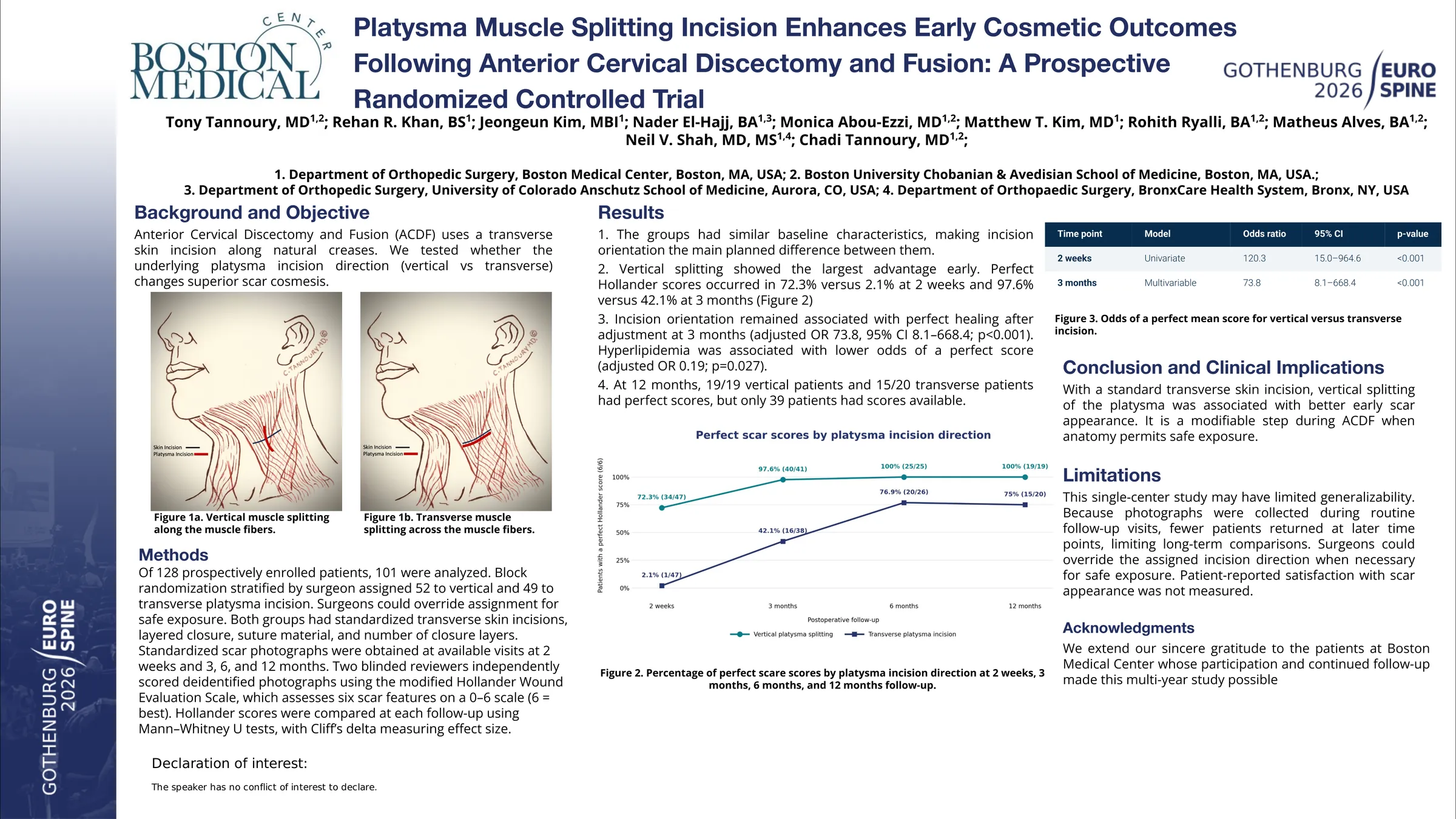
Platysma Muscle Splitting Incision Enhances Early Cosmetic Outcomes Following Anterior Cervical Discectomy and Fusion: A Prospective Randomized Controlled Trial
- BMC, Boston, United States of America
- Boston University School of Medicine, Hopkinsville, United States of America
- University of Colorado Anschutz School of Medicine, Aurora, United States of America
- Boston University School of Medicine, Boston, United States of America
- BronxCare Health System, New York, United States of America
Abstract
Anterior cervical discectomy and fusion (ACDF) typically employs a transverse skin incision to optimize cosmesis by aligning with natural skin creases. However, whether the underlying platysma is split vertically (in line with its fibers orientation) or cut transversely (in line with the skin incision) influences incisional cosmetic healing is not known. We sought to evaluate platysma incision orientation’s influence on ACDF scar cosmesis.
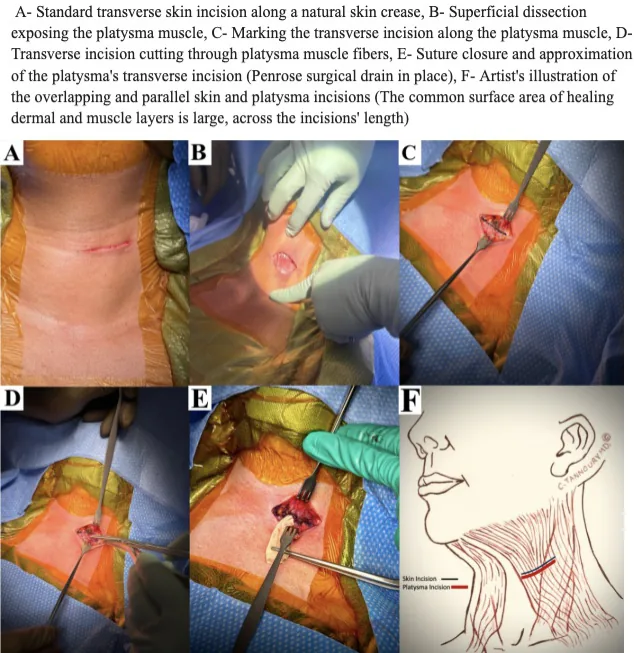
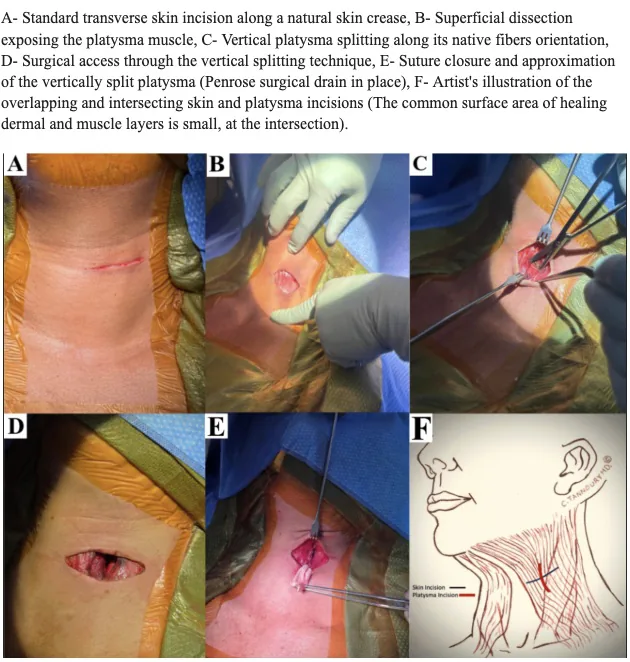
This is a prospective, randomized, single-center trial, and aims for evaluating if platysma incision orientation influences scar cosmesis. Among 128 enrolled patients undergoing elective ACDF, 101 subjects who had standardized follow-up data were included. All patients received a standardized transverse skin incision. Platysma incision was randomized to either vertical (muscle splitting, in line with muscle fibers orientation) or transverse (muscle cutting, in line with skin incision) orientation using block randomization stratified by surgeons. Demographic, comorbidity, and operative variables were collected. Standardized clinical photographs were obtained at 2 weeks, 3 months, 6 months, and 12 months and each was graded independently by two blinded reviewers using the validated, modified Hollander Wound Evaluation Scale (0 - 6, higher = better). The mean score at each time point was analyzed. Univariate analyses followed by multivariate logistic regressions identified predictors of achieving a perfect Hollander grade (6/6) at each timepoint. Inter-rater reliability between graders was measured with intraclass correlation coefficients (ICC).
Baseline characteristics were comparable between groups. At 2 weeks, vertical platysma splitting predicted better cosmetic healing (OR 120.3, 95% CI 15.0-964.6; p < 0.001). This favorable association with vertical platysma splitting persisted at 3 months (OR 73.8, 95% CI 8.1-668.4; p < 0.001). Hyperlipidemia reduced the odds of healing at 3 months only (OR 0.192, 95% CI 0.045-0.828; p = 0.027). At 6 and 12 months follow up, there were no significant predictors of achieving a Hollander grade of 6/6. By 6 months, 86% of all patients achieved a Hollander grade of 6/6 and 87.2 % by 12 months. At 12 months, 100% of the vertical group and 75% of the transverse group had perfect scores. Inter-rater reliability was excellent across all timepoints (ICC 0.973 at 2 weeks, 0.956 at 3 months, 0.976 at 6 months), with perfect agreement at 12 months (ICC = 1.000).
Following a transverse ACDF skin incision, vertical platysma splitting rather than a transverse muscle cutting incision, yields superior cosmetic surgical wound healing, especially in the first 3 months and sustained cosmetic advantage at 12 months follow-up. Overlapping transverse skin and transverse platysma incisions may potentiate surgical site inflammation and scarring in the early stages of wound healing. These findings help with patient counseling and can be employed to improve patient satisfaction with wound cosmesis.
Figures and tables
As submitted with the abstract. Tap a figure to open it at full size.