Trauma
Redefining Treatment Sequencing in the Osteoporotic Spine: The Convergence of ‘Fix and Treat’ and ‘Treat and Fix’ Strategies
- National University Hospital Singapore, Singapore, Singapore
Abstract
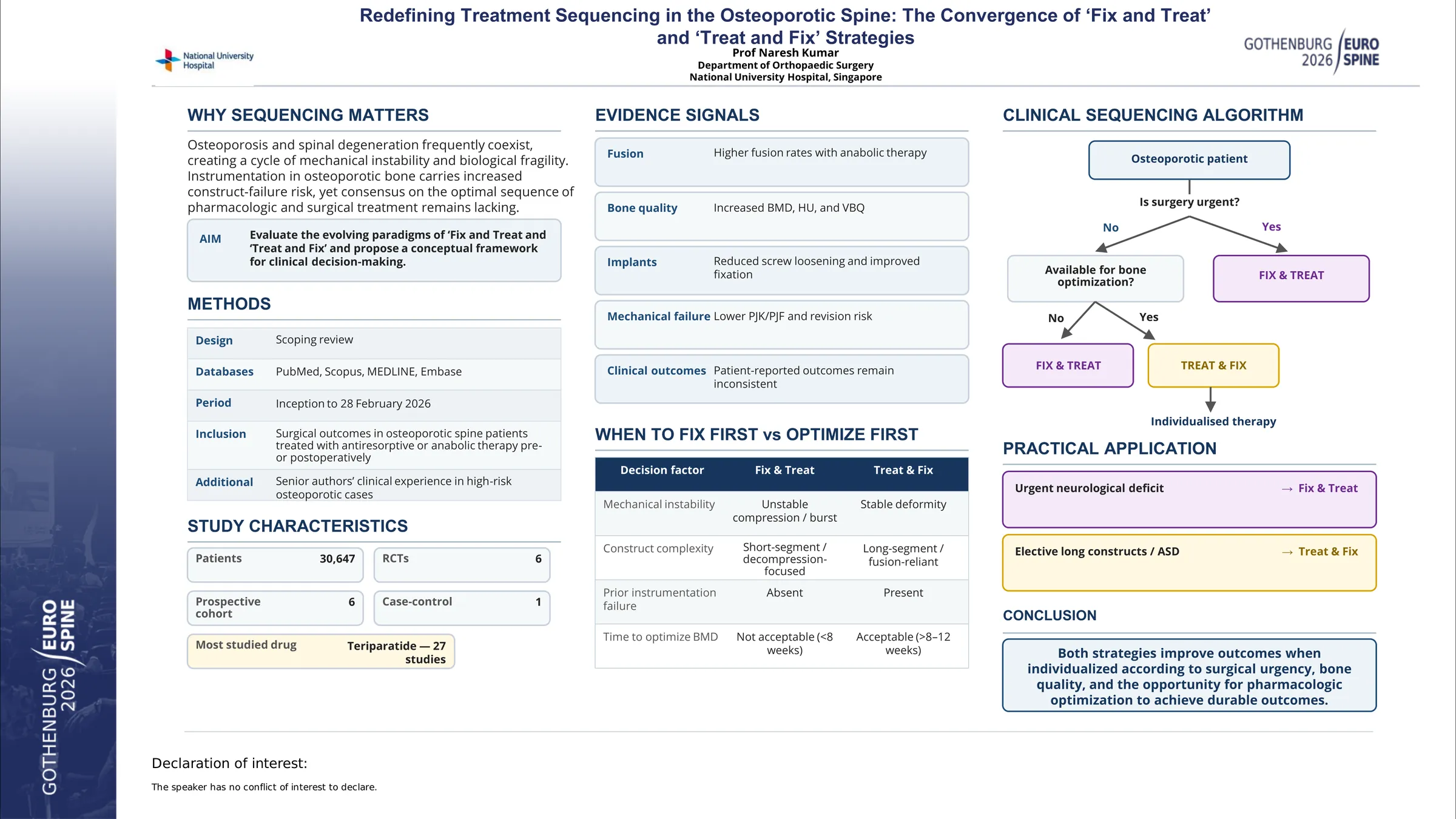
Osteoporosis frequently coexists with spinal degeneration and deformity, creating a cycle of mechanical instability and biological fragility. Instrumentation in osteoporotic bone increases risks of screw loosening, cage subsidence, pseudoarthrosis, proximal junctional failure, and revision surgery, making treatment sequencing (surgery vs pharmacotherapy) clinically important. Yet there is no consensus on whether to stabilize first and optimise bone afterwards (“Fix and Treat”) or to improve bone quality first and then perform definitive reconstruction (“Treat and Fix”). This review evaluates both paradigms and proposes a practical framework for sequencing decisions in osteoporotic spine pathology.
We reviewed PubMed, Scopus, MEDLINE, and the Cochrane Library through 1 October 2025. Included studies assessed surgical outcomes in osteoporotic patients undergoing spinal instrumentation/fusion who received antiresorptive or anabolic therapy initiated pre- or postoperatively. Outcomes included fusion, fixation-related complications (e.g., loosening), construct failure, and reoperation. Evidence was synthesized by clinical urgency and construct demands, supplemented by senior authors’ experience managing high-risk cases, including staged strategies and perioperative bone-health pathway.
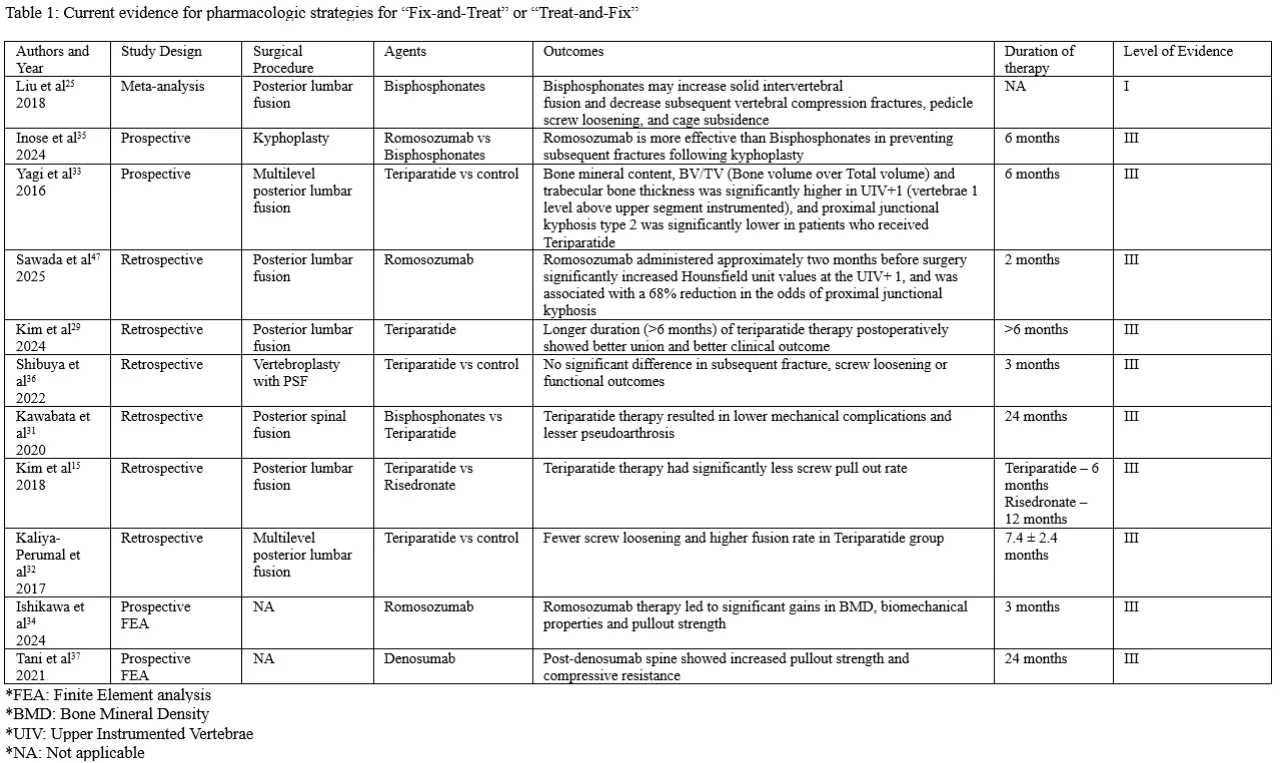
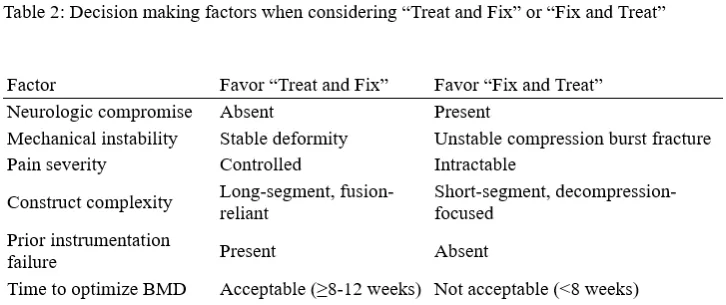
Fifty-five studies met inclusion criteria. “Fix and Treat” was most applied in urgent settings (neurological compromise, acute instability, rapidly progressive deformity), where delaying decompression or stabilization may worsen outcomes. Across heterogeneous designs, postoperative anabolic therapy—particularly teriparatide and emerging evidence for romosozumab—was associated with improved fusion and fewer instrumentation-related complications compared with no therapy or antiresorptive-only strategies. In elective cases, “Treat and Fix” appeared advantageous: short-course preoperative anabolic therapy (≥3 months) improved bone–implant integration, increased screw purchase/pullout strength, and enhanced construct stability, with reduced early loosening in several clinical series. Biomechanical and finite element analyses supported preoperative optimisation, predicting the greatest benefit in long constructs, osteotomies, and revision procedures, where fixation demands are highest.
“Fix and Treat” and “Treat and Fix” represent complementary approaches rather than opposing strategies. Sequencing should be individualised along a continuum defined by surgical urgency, baseline bone quality, construct complexity, and expected time-to-pharmacologic response, leveraging perioperative optimisation to improve durability and reduce complications.
Figures and tables
As submitted with the abstract. Tap a figure to open it at full size.