
Degenerative Thoracolumbar
Radiographic sagittal alignment correction and risk of reoperation in adult spinal deformity: stand-alone lateral lumbar interbody fusion versus circumferential fusion
- Hospital for Special Surgery Main Hospital, New York, United States of America
- Hospital for Special Surgery Main Hospital, Zurich, Switzerland
Abstract
Stand-alone lateral lumbar interbody fusion (SA-LLIF) and circumferential fusion represent surgical strategies for adult spinal deformity. PI–LL mismatch is widely used to assess sagittal alignment, with values within 10° of pelvic incidence considered surgical targets. Whether sagittal alignment severity influences reoperation risk and differs by construct type remains unclear. This study evaluated the association between sagittal alignment and reoperation and compared tolerance to sagittal deformity correction between techniques.
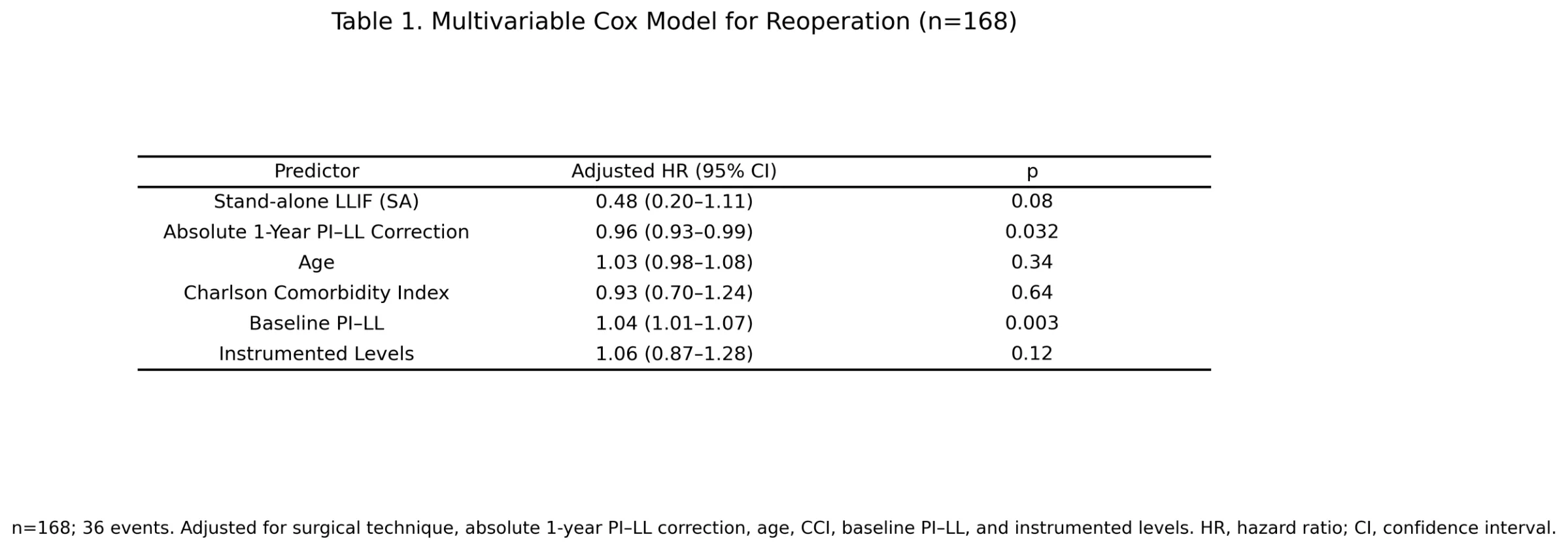
Patients were first analyzed according to preoperative PI–LL alignment status. Reoperation was defined as any subsequent revision surgery, including construct extension or same-level revision. Multivariable Cox regression evaluated associations between sagittal parameters and time to reoperation. A subgroup analysis including only patients with preoperative mismatch assessed the effect of baseline deformity magnitude and postoperative correction. Additional models examined surgical technique (SA-LLIF vs circumferential fusion) adjusted for PI–LL correction, age, CCI, baseline PI–LL, and number of instrumented levels. Early postoperative alignment corresponded to radiographs obtained prior to hospital discharge.
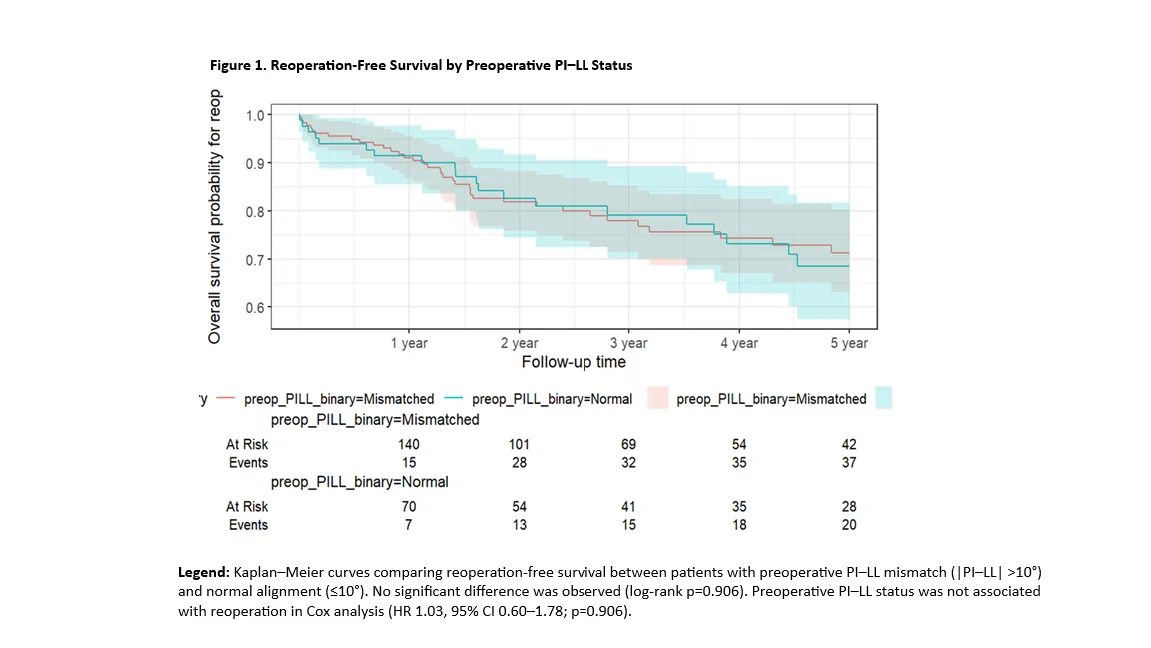
Among 259 patients, 177 (68.3%) had preoperative PI–LL mismatch >10° and 82 (31.7%) had normal PI–LL (≤10°). When comparing normal PI-LL patients versus mismatched patients independent of surgical technique, mismatch status was not associated with reoperation (HR 1.00, 95%CI 0.55–1.82, p=0.989). Most reoperations involved construct extension due to adjacent segment disease and hardware failure. Among mismatched patients (n=177; 37 reoperations), larger preoperative PI–LL values were independently associated with increased reoperation risk (HR 1.038 per degree, 95%CI 1.010–1.066, p=0.0079), corresponding to ~46% higher hazard per additional 10° of mismatch. Early postoperative alignment was not associated with reoperation. In models including 1-year alignment (n=168; 36 reoperations), greater PI–LL improvement at 1 year was independently associated with lower reoperation risk (HR 0.967 per degree, 95%CI 0.938–0.997, p=0.032). Within the mismatched subgroup (circumferential n=106; SA-LLIF n=71), surgical technique was not independently associated with reoperation after adjustment (HR 0.48, 95%CI 0.20–1.11, p=0.084).
Preoperative PI–LL mismatch alone was not associated with reoperation when comparing normal PI-LL and mismatched patients. However, among mismatched patients, greater baseline deformity increased reoperation risk, while greater 1-year sagittal correction was protective. After adjustment for correction magnitude, surgical technique was not independently associated with reoperation, suggesting that alignment severity and its correction — rather than construct selection — drive reoperation risk.
Figures and tables
As submitted with the abstract. Tap a figure to open it at full size.