
Complications & Epidemiology
Lumbar Sympathetic Chain Integrity During the Minimally Invasive Oblique Antepsoas Lumbosacral Fusion: Intraoperative Analysis And A Prospective Clinical Outcomes Study
- BMC, Boston, United States of America
- Boston University School of Medicine, Hopkinsville, United States of America
Abstract
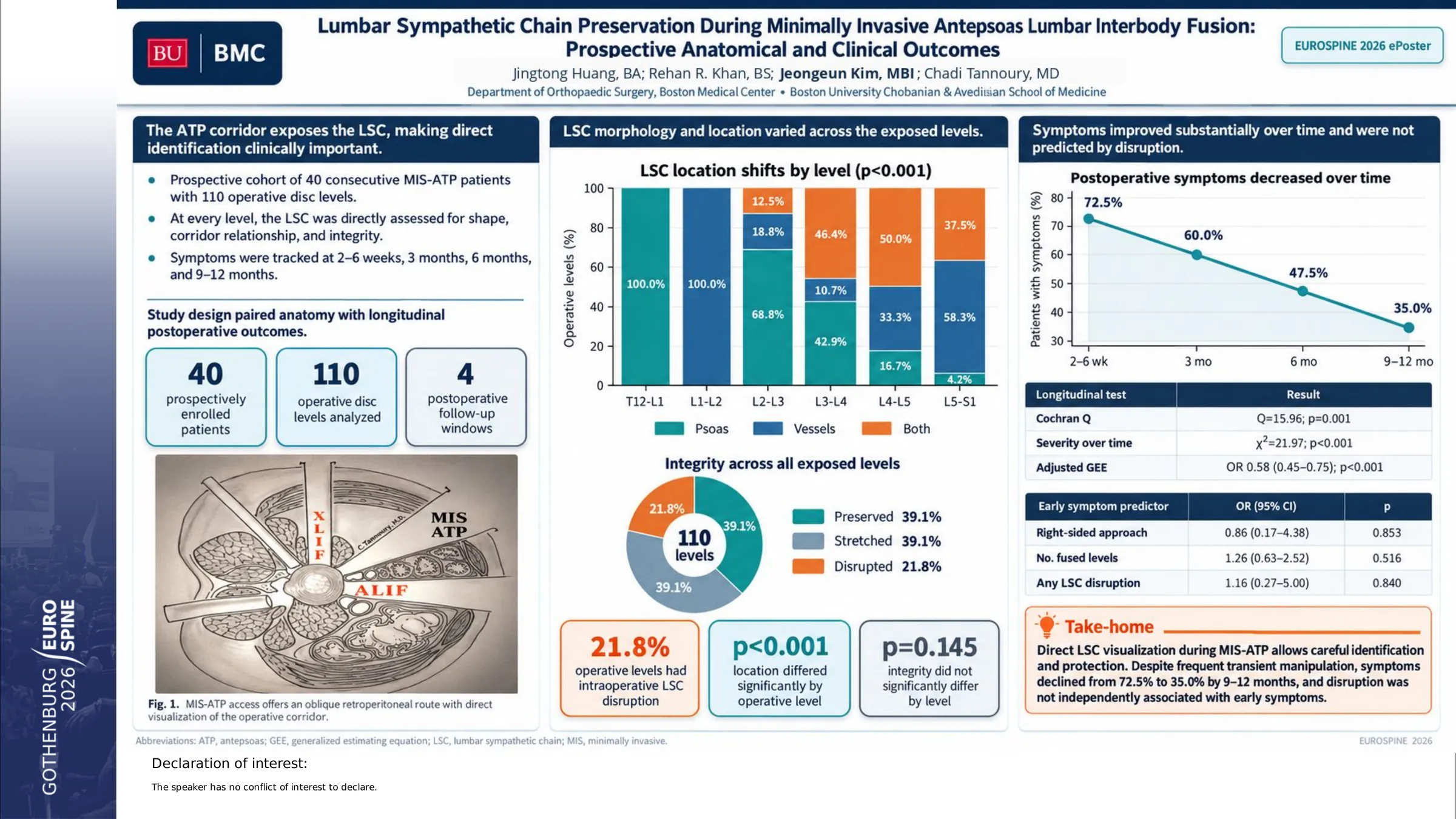
The lumbar sympathetic chain (LSC) lies within the antepsoas (ATP) operative corridor when performing lumbar fusions. However, little is known of the LSCs intraoperative anatomical variations and the postoperative clinical outcomes following ATP-LSC manipulation. This prospective study aimed to delineate real-time, intraoperative LSC morphology, location, and integrity during ATP lumbar fusions, followed by examining each operated patient postoperatively for development of any LSC-related autonomic and neurologic symptoms.
Forty consecutive patients undergoing ATP lumbar fusion were prospectively enrolled at a single academic medical center. For each case, at each operated level, the LSC was directly visualized and documented intraoperatively for its morphology, location, and integrity (preserved, stretched, disrupted). Postoperative symptoms were recorded at 2-6 weeks, 3 months, 6 months, and 9-12 months. Clinical outcomes collected included neuropathic, autonomic, and visceral related symptoms. Repeated-measures analyses using Cochran’s Q test were performed to evaluate changes in symptom prevalence across postoperative timepoints.
A total of 110 disc levels were analyzed (2.75 ± 1.15 average levels fused). LSC morphology was round-tubular in 50%, thin/flimsy in 30%, and flat in 20%. Integrity was absolutely preserved in 39.1%, preserved but stretched in 39.1%, and disrupted in 21.8% of operated levels. Postoperative symptoms were noted in 72.5% at 2-6 weeks, and subsequently declined to 59.0% at 3 months, 45.2% at 6 months, and 27.3% at 9-12 months (p = 0.003). Symptoms were predominantly ipsilateral to the surgical approach and most commonly reported as proximal thigh neuralgia or numbness. Autonomic symptoms were infrequent (≤12.5% early, ≤4.5% late), and visceral complications were rare (constipation 10%, urinary retention 2.5%, no retrograde ejaculation). Persistent long-term symptoms were uncommon.
During MIS-ATP lumbar fusions, the LSC demonstrated significant anatomical variability with controlled intraoperative manipulation, nonetheless, low rates of clinically significant complications were observed. Postoperative symptoms were typically mild, ipsilateral, and significantly resolved over time. The MIS-ATP approach to lumbar fusions allows for direct LSC visualization, careful manipulation, and overall preservation.