
Adult Deformity
Gait Velocity Uniquely Predicts Pre-Operative Disability in Adult Spinal Deformity Patients
- The University Of Oklahoma Health Sciences Center, Oklahoma City, United States of America
Abstract
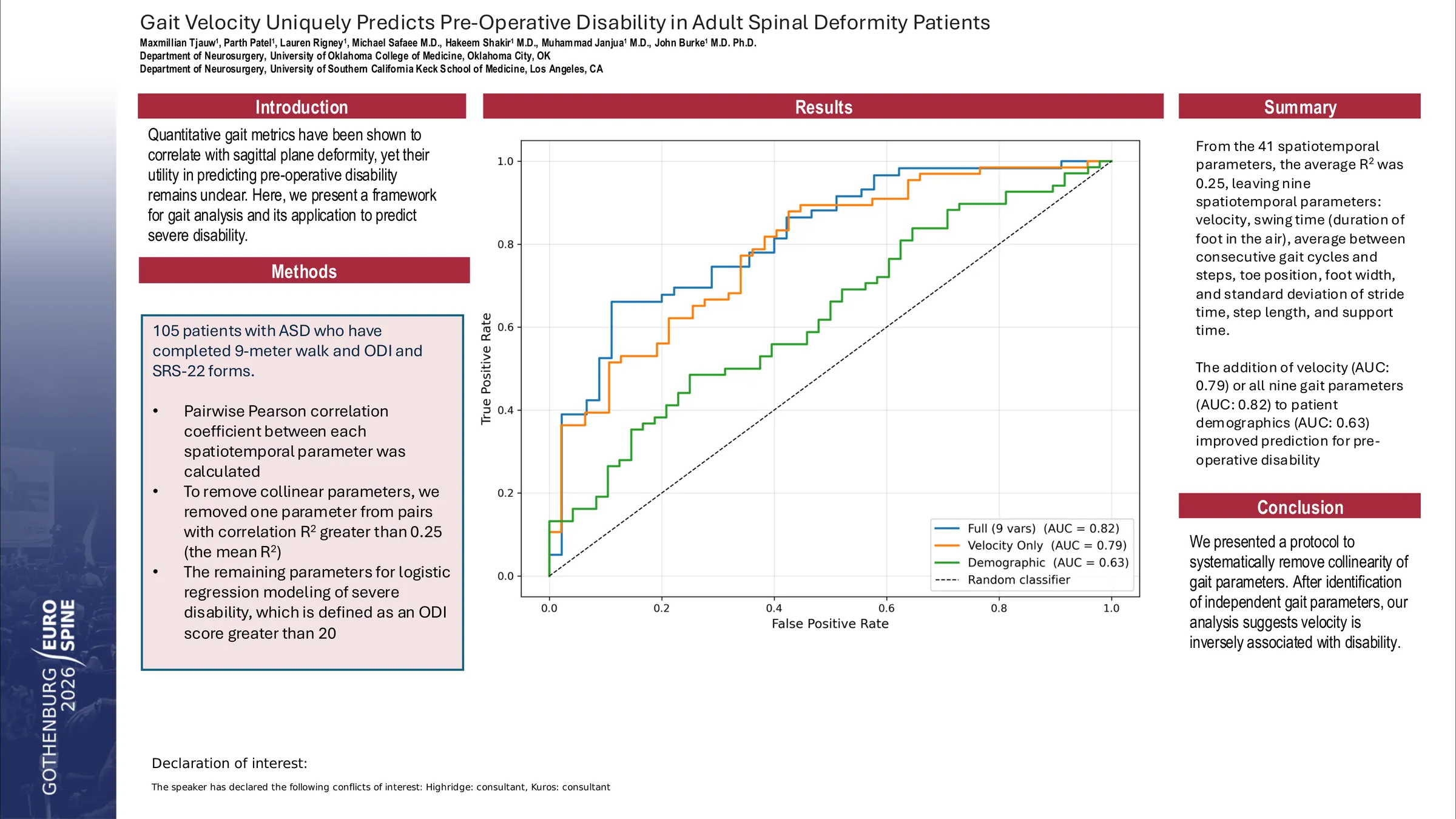
Quantitative gait metrics have been shown to correlate with sagittal plane deformity, yet their utility in predicting pre-operative disability remains unclear. Here, collected objective spatial temporal gait parameters in spinal deformity patients to assess which feature of gait best correlates with pre-operative disability.
105 ASD patients were included in this single center study. Each patient completed the Oswestry Deformity Index (ODI), Scoliosis Research Form 22 (SRS-22), and a 9-meter walk using a computerized gait analysis system that reported 41 spatiotemporal gait parameters. We calculated the pairwise Pearson correlation coefficient between each spatiotemporal gait parameter; collinear gait parameters were removed. We calculated the mean correlation of each parameter to pre-operative ODI and SRS-22. A multivariate classifier was used to predict pre-operative ODI and SRS-22 scores We carried forward the remaining parameters for logistic regression modeling of severe disability (ODI > 40%). We constructed three multivariate logistic regression models to predict pre-operative disability using gait parameters and demographics information: (1) all gait parameters and demographic data (the full model), (2) gait velocity alone and demographic data (velocity model), and (3) demographic information alone (control model).
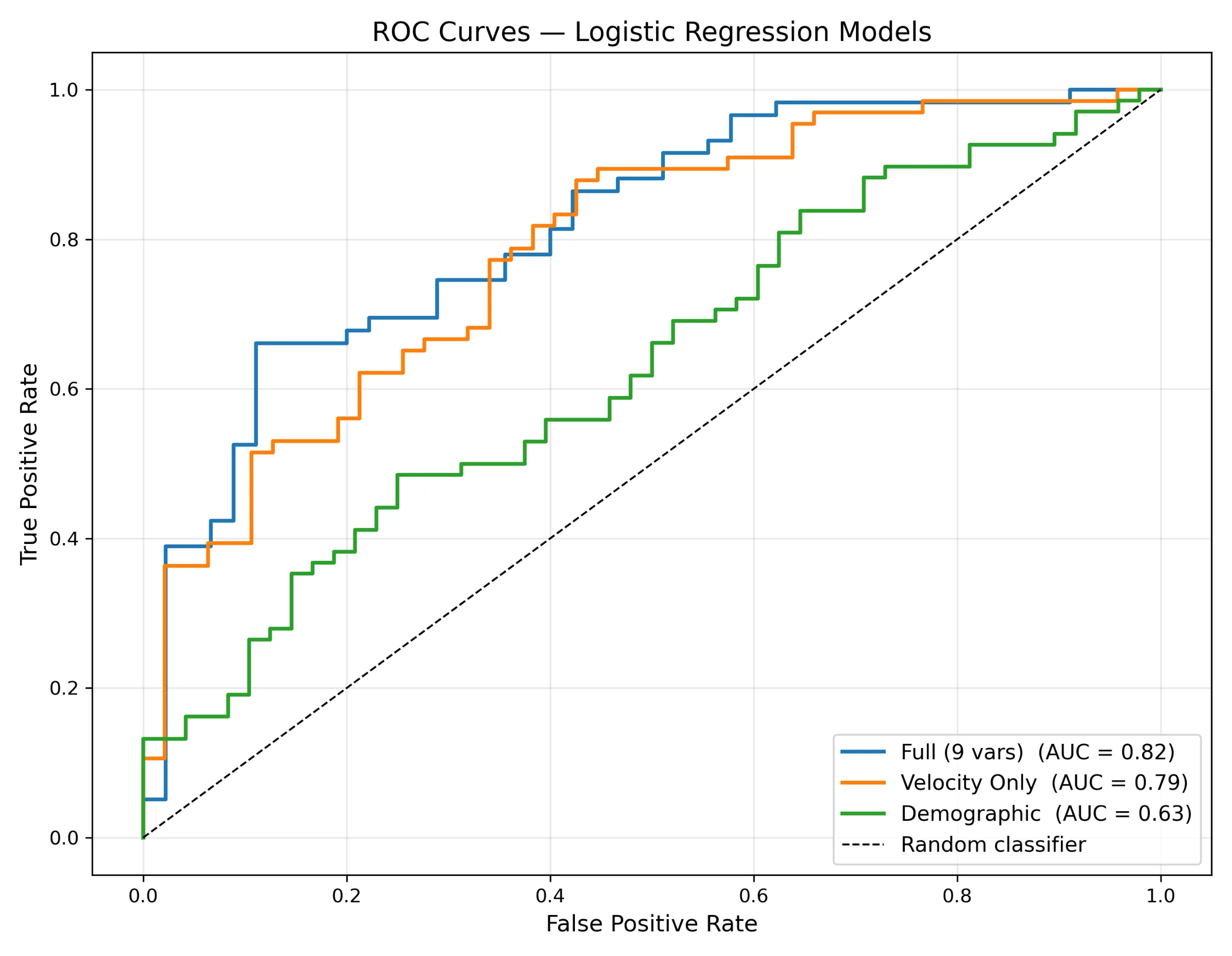
Nine spatial-temporal gait parameters were included after accounting for co-linearity: velocity, swing time (duration of foot in the air), average between consecutive gait cycles and steps, toe position, foot width, and standard deviation of stride time, step length, and support time. On univariate regression, of the nine parameters, only velocity was significantly correlated with ODI (R2: 0.07, 95% CI 0.01, 0.18, p < 0.01) and SRS-22 (R2: 0.21, 95% CI 0.09, 0.35, p < 0.001). In the multi-variate model, the full model predicted pre-operative disability with an AUC of 0.82, velocity model had an AUC of 0.79, and the control model had an AUC of 0.63 (Figure 1). In both the full and velocity models, increased velocity was uniquely associated with lower risk of severe deformity (full model: OR 0.19, 95% CI 0.08, 0.44, p < 0.001; velocity model: OR 0.30, 95% CI 0.17, 0.52, p < 0.001).
Gait mats are a powerful tool to quickly measure spatial temporal gait parameters in the clinic setting, however they can yield highly correlated metrics that are difficult to analyze. Here, we found that among 41spatial temporal metrics of gait, velocity specifically and uniquely predicts disability in spinal deformity patients. Future research is needed to assess how additional gait parameters can supplement velocity to evaluate spinal patients.
Figures and tables
As submitted with the abstract. Tap a figure to open it at full size.