Degenerative Thoracolumbar
Randomized IDE Clinical Trial Results and Long-Term Outcomes of the Interspinous Process Lumbar Spinal Stabilization System for Predominant Discogenic Low Back Pain
- The Orthopedic Center of St. Louis, Chesterfield, United States of America
- SPIRITT Research, St. Louis, United States of America
- Pacific Sports and Spine, Eugene, United States of America
- Tallahassee Neurological Clinic, Tallahassee, United States of America
- Precision Spine & Orthopedic Specialists, Leawood, United States of America
- Advanced Neurosurgery, Dayton, United States of America
- Florida Orthopaedic Institute, Temple Terrace, United States of America
- Argires Marotti Neurosurgical Associates of Lancaster, Lancaster, United States of America
- Indiana Spine Group, Carmel, United States of America
- OrthoIndy, Indianapolis, United States of America
Abstract
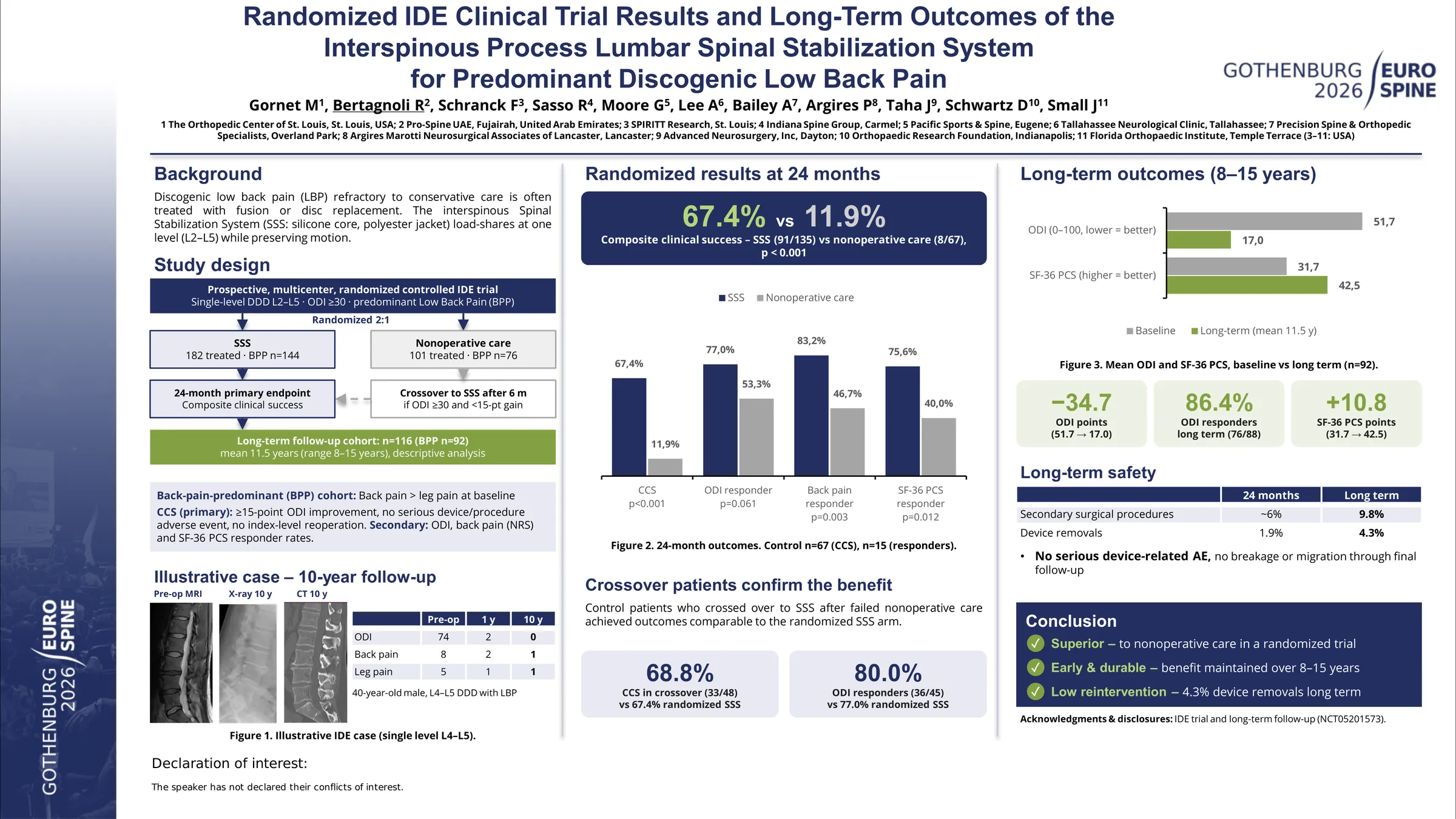
Surgical management of discogenic low back pain remains challenging when symptoms persist despite prolonged conservative care. Posterior dynamic stabilization was developed to address these limitations while avoiding more invasive strategies such as fusion or total disc replacement.We report results from a randomized IDE trial comparing the Spinal Stabilization System (SSS) to structured non-op care, including long-term clinical outcomes in treated patients with predominant low back pain. SSS consists of a silicon core surrounded by a polyester jacket and was implanted between adjacent spinous processes at one level (L2-L5) to load-share with painfully overloaded spinal structures while preserving motion at the treated level.
Prospective, multicenter, randomized, controlled IDE trial with subsequent long-term single-arm cohort analysis. Skeletally mature patients with single-level lumbar DDD (L2–L5), ODI ≥30, and predominant low back pain were randomized 2:1 to SSS implantation or structured nonoperative care. Control patients could cross over to SSS after 6 months if ODI remained ≥30 with <15-point improvement. The primary endpoint was composite clinical success (CCS) at 24 months: ≥15-point ODI improvement, no serious device/procedure adverse event, and no index-level reoperation. Additional clinical outcomes included Numerical Rating Scale (NRS) for back pain intensity and Short-Form 36 physical function (SF-36 PCS). Denominators reflect subjects with evaluable outcome data.
A total of 182 subjects were randomized and treated with SSS and 101 were treated in the control group. At 24 months, in the predominant low back pain cohort (144 SSS vs 76 control), CCS was achieved in 67.4% (91/135) of SSS-treated patients versus 11.9% (8/67) of controls (p < 0.001). ODI responder rates were 77.0% (97/126) for SSS and 53.3% (8/15) for controls (p = 0.061). Back pain responder rates were 83.2% (104/125) for SSS versus 46.7% (7/15) for controls (p = 0.003). SF-36 PCS responder rates were 75.6% (93/123) for SSS versus 40.0% (6/15) for controls (p = 0.012). Crossover patients demonstrated comparable outcomes (CCS 68.8% [33/48]; ODI responder 80.0% [36/45]). At long-term follow-up (mean =11.5 yrs; 8-15 yrs ), outcomes were evaluated descriptively in the treated cohort (n = 92). Mean ODI improved from 51.7 at baseline to 17.0 long term, and mean SF-36 PCS improved from 31.7 to 42.5, with sustained functional benefit. Secondary surgical intervention rates remained low, with ~6% procedures and 1.9% removals through 24 months and 9.8% procedures with 4.3% removals long term.
SSS demonstrated early and durable improvement in all clinical outcomes and significant treatment benefits for subjects at 24 months in a randomized IDE trial and long-term follow-up cohort.