
Degenerative Thoracolumbar
Intra-articular Platelet-Rich Plasma versus Corticosteroids for Lumbar Facet Syndrome: A Systematic Review and Meta-analysis
- Clinica Universidad de Navarra, Pamplona, Spain
- Universidad Panamericana, Ciudad de Mexico, Mexico
- Clinica Universidad de Navarra, Madrid, Spain
Abstract
Lumbar facet syndrome is a major contributor to chronic axial low back pain and frequently results in repeated interventional procedures. Intra-articular corticosteroids provide short-term analgesia but do not modify the inflammatory microenvironment of the facet joint. Platelet-rich plasma (PRP), through growth factor release and cytokine modulation, has been proposed as a biologically active alternative with potential for sustained benefit. This systematic review and meta-analysis aimed to compare the efficacy and safety of intra-articular PRP versus corticosteroids in adults with lumbar facet syndrome.
The review followed PRISMA guidelines and was registered in PROSPERO (CRD420251166755). A comprehensive search (2000–2025) was conducted in MEDLINE, Embase, Scopus, Web of Science, The Cochrane Library, ClinicalTrials.gov, and grey literature. Randomized controlled trials comparing intra-articular PRP with corticosteroids in adults were included. Risk of bias was assessed using RoB 2. The primary outcome was pain reduction (VAS). Secondary outcomes included functional disability (ODI) and safety. Random-effects meta-analysis was performed when feasible, and heterogeneity was assessed using I².
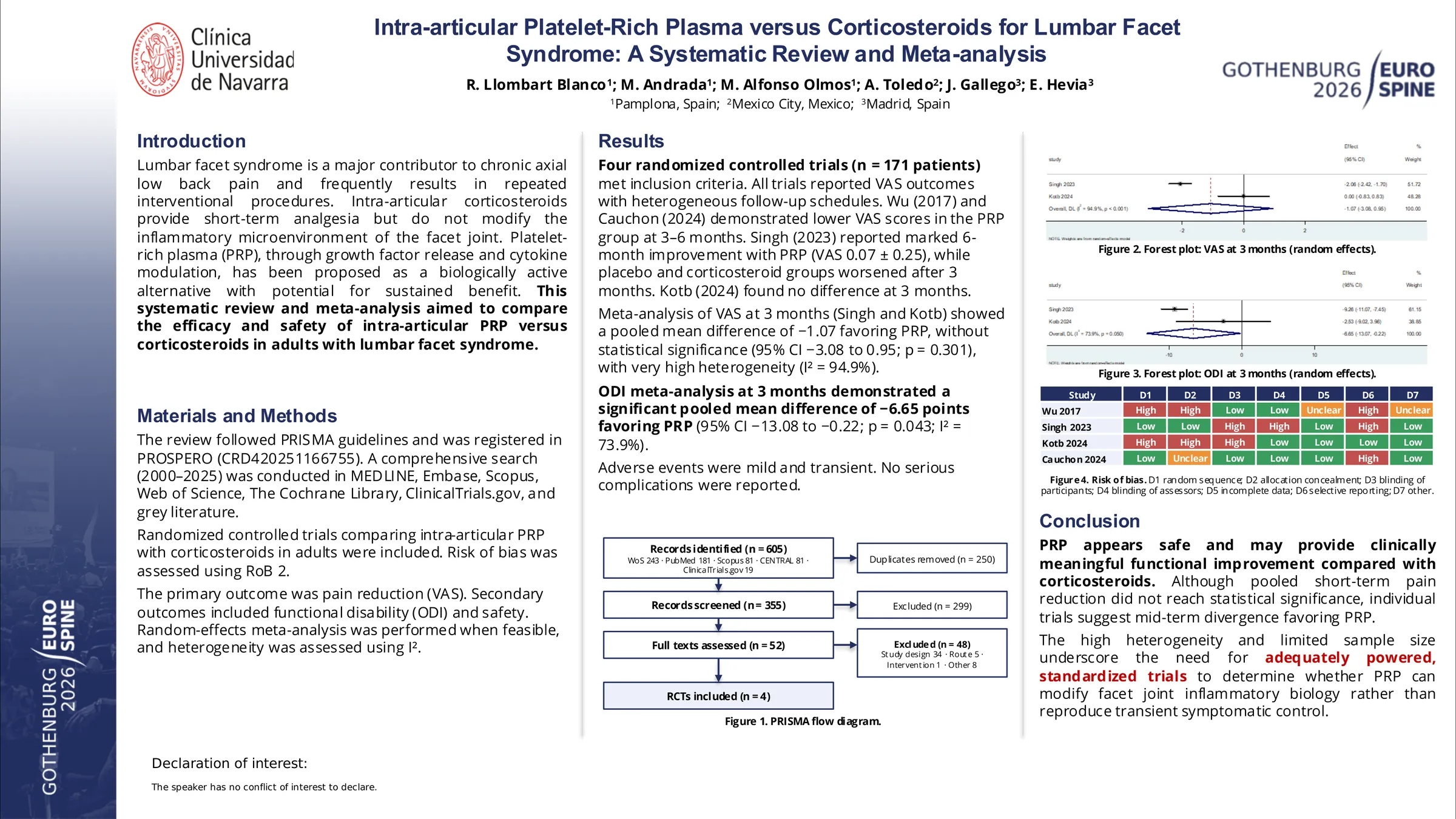
Four randomized controlled trials (n = 171 patients) met inclusion criteria. All trials reported VAS outcomes with heterogeneous follow-up schedules. Wu (2017) and Cauchon (2024) demonstrated lower VAS scores in the PRP group at 3–6 months. Singh (2023) reported marked 6-month improvement with PRP (VAS 0.07 ± 0.25), while placebo and corticosteroid groups worsened after 3 months. Kotb (2024) found no difference at 3 months.
Meta-analysis of VAS at 3 months (Singh and Kotb) showed a pooled mean difference of −1.07 favoring PRP, without statistical significance (95% CI −3.08 to 0.95; p = 0.301), with very high heterogeneity (I² = 94.9%).
ODI meta-analysis at 3 months demonstrated a significant pooled mean difference of −6.65 points favoring PRP (95% CI −13.08 to −0.22; p = 0.043; I² = 73.9%).
Adverse events were mild and transient. No serious complications were reported.
PRP appears safe and may provide clinically meaningful functional improvement compared with corticosteroids. Although pooled short-term pain reduction did not reach statistical significance, individual trials suggest mid-term divergence favoring PRP. The high heterogeneity and limited sample size underscore the need for adequately powered, standardized trials to determine whether PRP can modify facet joint inflammatory biology rather than reproduce transient symptomatic control.