
Adult Deformity
Radiographic Clustering Enhances Subgroup Prediction of Mechanical Complications in Adult Spinal Deformity
- Clinique du Dos Bordeaux-Terrefort, Bordeaux, France
- Humanitas San Pio X, Milano, Italy
- Clinique Terrefort - Bruges, Bordeaux, France
- . European Spine Study Group (Vall d'Hebron University Hospital, Barcelona, Spain
- Vall d'Hebron University Hospital, Barcelona, Spain
- La Paz University Hospital, Madrid, Spain
- Schulthess Klinik, Zurich, Switzerland
- Acibadem University Maslak Hospital, Istanbul, Türkiye
- CHRU strasbourg - Les Hôpitaux Universitaires de Strasbourg , Strasbourg, France
- King Faisal Specialist Hospital and Research Center, Riyadh, Saudi Arabia
- Elsan - Polyclinic Jean Villar, Bordeaux, France
- ELSAN Polyclinique Jean Villar, Clinique du Dos, Bordeaux-Terrefort, Pessac, France
Abstract
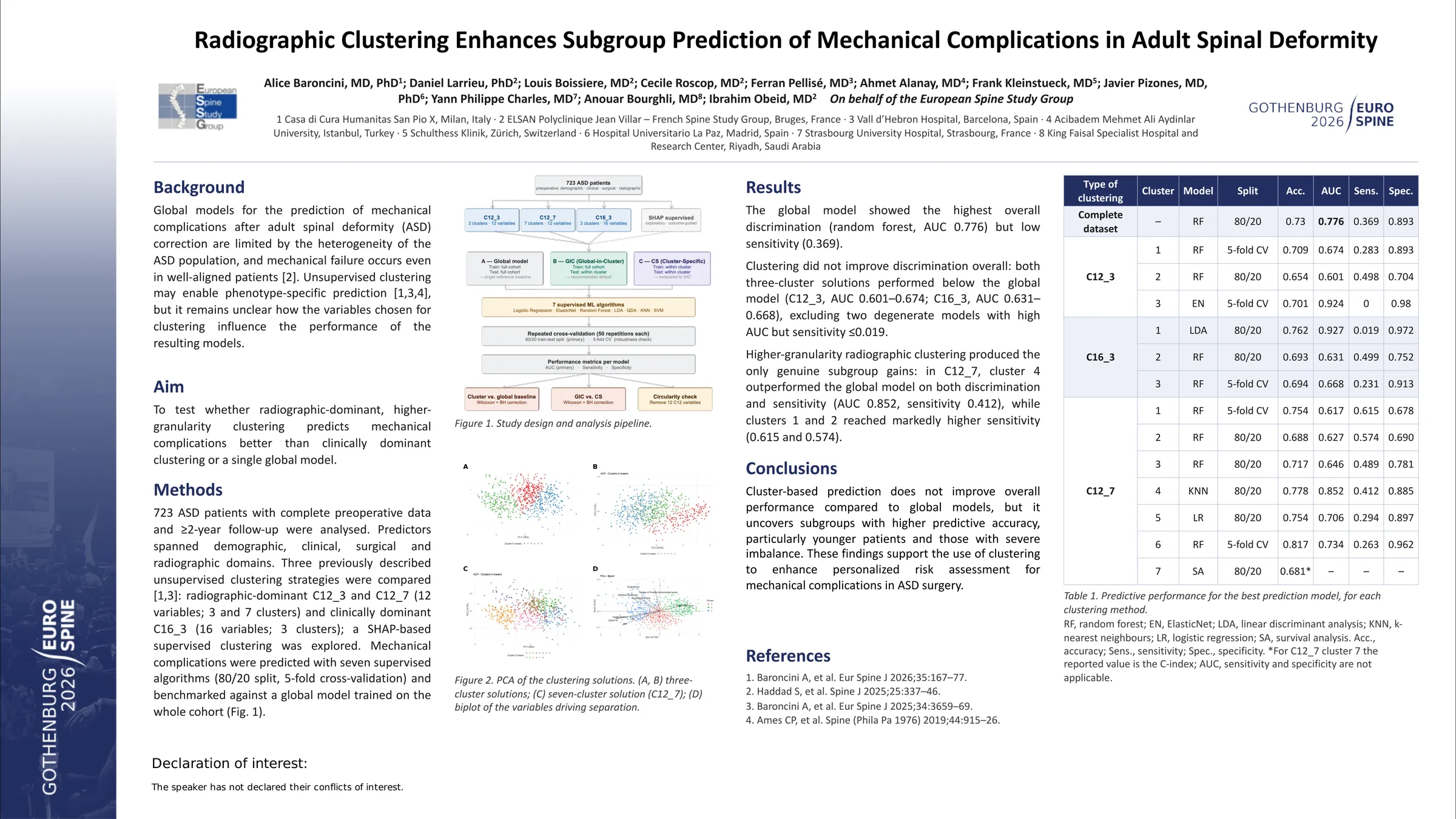
Global risk models for mechanical complications after adult spinal deformity (ASD) correction may be limited by patient heterogeneity. Clustering may bridge this gap by enabling phenotype-specific prediction. However, it is unclear how the choice of variables used for clustering influences the performance of the prediction models.
Retrospective analysis of prospectively collected data. 723 ASD patients with complete preoperative data and ≥2-year follow-up were included. Predictors spanned demographics, surgical variables, PROMs, and radiographic parameters. Mechanical complications were predicted using supervised models with an 80/20 split and 5-fold cross-validation. Clustering strategies varied by feature emphasis and number of groups: clinical-heavy C16-3 (3 clusters), radiographic-heavy C12-3 and C12-7 (3 and 7 clusters, respectively), and SHAP-based supervised clustering.
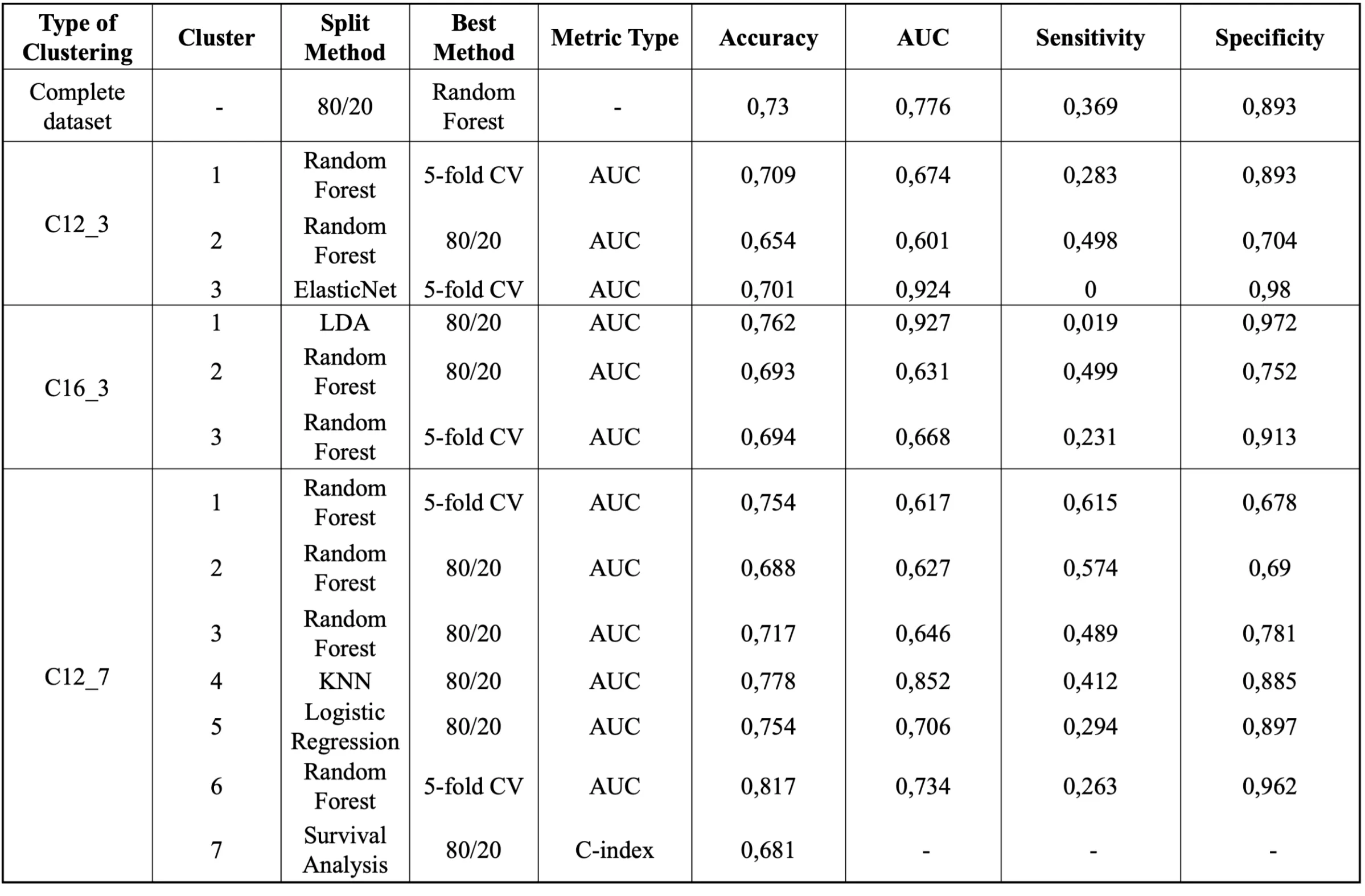
The best global model achieved AUC=0.77 (ElasticNet/random forest). Clustering did not improve overall performance, but radiographic-heavy C12-7 identified clinically relevant subgroups with equal or higher discrimination and/or higher sensitivity than the global model: younger clusters (AUC 0.76–0.82) and a severe sagittal and coronal imbalance cluster (AUC=0.75). Clinically-heavy C16-3 improved prediction in one subgroup (AUC=0.76), while most other clusters across approaches had AUC ≈0.70. SHAP-based supervised clustering showed comparable performance (AUC 0.70–0.72).
Table caption: Predictive performance for the best prediction model, for each clustering method.
This is the first study to evaluate the impact of clustering and models on the performance of a prediction. In ASD, the choice of clustering variables matters: radiographic-heavy clustering best supported the prediction of a radiographic-driven outcome and revealed transitions in risk across phenotypes. These findings provide a practical bridge from AI to subgroup-tailored complication risk stratification and follow-up planning.
Figures and tables
As submitted with the abstract. Tap a figure to open it at full size.