
Adult Deformity
Predicting SRS-22 MCID Attainment After Adult Spinal Deformity Surgery: Do Clinical or Radiographic Clusters Perform Better?
- Humanitas San Pio X, Milano, Italy
- ELSAN Polyclinique Jean Villar, Clinique du Dos, Bordeaux-Terrefort, Pessac, France
- Elsan - Polyclinic Jean Villar, Bordeaux, France
- . European Spine Study Group (Vall d'Hebron University Hospital, Barcelona, Spain
- La Paz University Hospital, Madrid, Spain
- Vall d'Hebron University Hospital, Barcelona, Spain
- Schulthess Klinik, Zurich, Switzerland
- Acibadem University Maslak Hospital, Istanbul, Türkiye
- CHRU strasbourg - Les Hôpitaux Universitaires de Strasbourg , Strasbourg, France
- King Faisal Specialist Hospital and Research Center, Riyadh, Saudi Arabia
- Clinique Terrefort - Bruges, Bordeaux, France
- Clinique du Dos Bordeaux-Terrefort, Bordeaux, France
Abstract
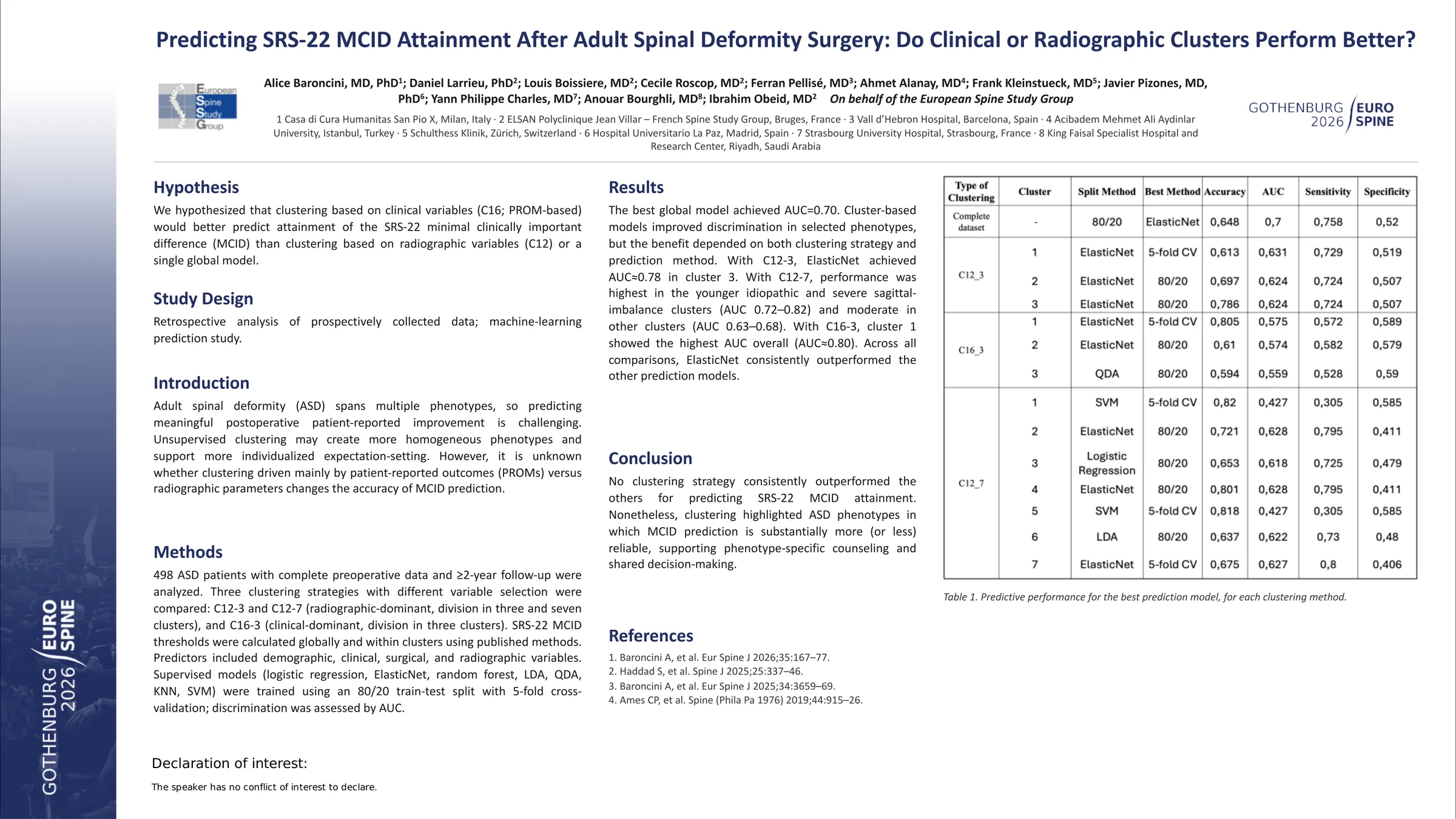
Adult spinal deformity (ASD) spans multiple phenotypes, so predicting meaningful postoperative patient-reported improvement is challenging. Unsupervised clustering may create more homogeneous phenotypes and support more individualized expectation-setting. However, it is unknown whether clustering driven mainly by patient-reported outcomes (PROMs) versus radiographic parameters changes the accuracy of MCID prediction.
Retrospective analysis of prospectively collected data. 498 ASD patients with complete preoperative data and ≥2-year follow-up were analyzed. Three clustering strategies with different variable selection were compared: C12-3 and C12-7 (radiographic-dominant, division in three and seven clusters), and C16-3 (clinical-dominant, division in three clusters). SRS-22 MCID thresholds were calculated globally and within clusters using published methods. Predictors included demographic, clinical, surgical, and radiographic variables. Supervised models (logistic regression, ElasticNet, random forest, LDA, QDA, KNN, SVM) were trained using an 80/20 train-test split with 5-fold cross-validation; discrimination was assessed by AUC.
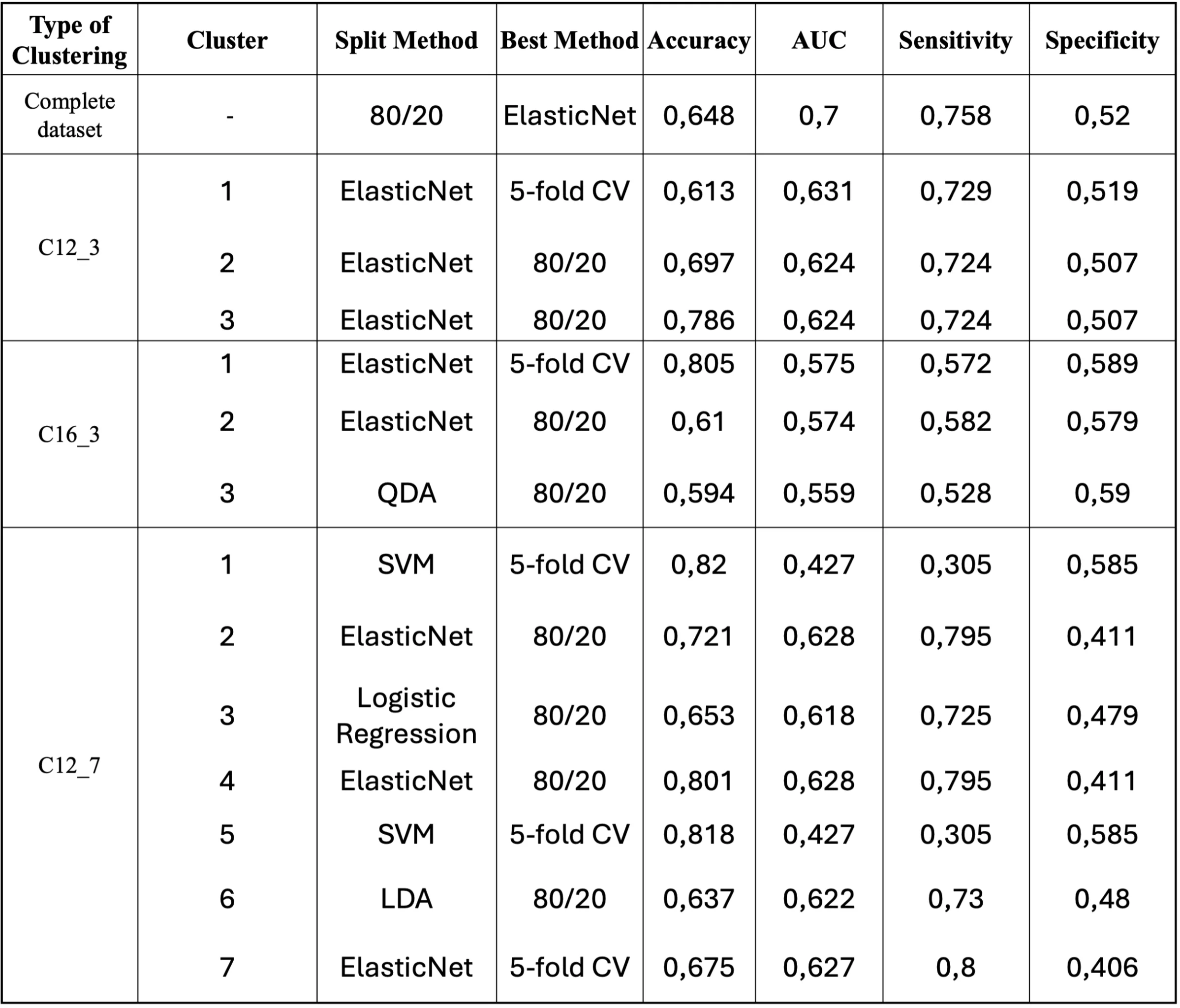
The best global model achieved AUC=0.70. Cluster-based models improved discrimination in selected phenotypes, but the benefit depended on both clustering strategy and prediction method. With C12-3, ElasticNet achieved AUC≈0.78 in cluster 3. With C12-7, performance was highest in the younger idiopathic and severe sagittal-imbalance clusters (AUC 0.72–0.82) and moderate in other clusters (AUC 0.63–0.68). With C16-3, cluster 1 showed the highest AUC overall (AUC≈0.80). Across all comparisons, ElasticNet consistently outperformed the other prediction models.
Table caption: Predictive performance for the best prediction model, for each clustering method.
No clustering strategy consistently outperformed the others for predicting SRS-22 MCID attainment. Nonetheless, clustering highlighted ASD phenotypes in which MCID prediction is substantially more (or less) reliable, supporting phenotype-specific counseling and shared decision-making.
Figures and tables
As submitted with the abstract. Tap a figure to open it at full size.