
Degenerative Thoracolumbar
Beyond the Success of Neural Decompression: Preoperative Psychosocial Status as an Independent Predictor of Low Back Pain Relief in Lumbar Spinal Stenosis
- Fukushima Medical University, Fukushima, Japan
Abstract
Low back pain (LBP) is a common symptom of lumbar spinal stenosis (LSS). While decompression surgery is generally effective, some patients experience persistent LBP despite technically successful neural decompression. This study aimed to investigate whether preoperative psychosocial factors—measured by the Brief Scale for Psychiatric Problems in Orthopaedic Patients (BS-POP), a validated screening tool for perioperative psychosocial assessment—independently predict LBP improvement, even after adjusting for the clinical success of surgical decompression.
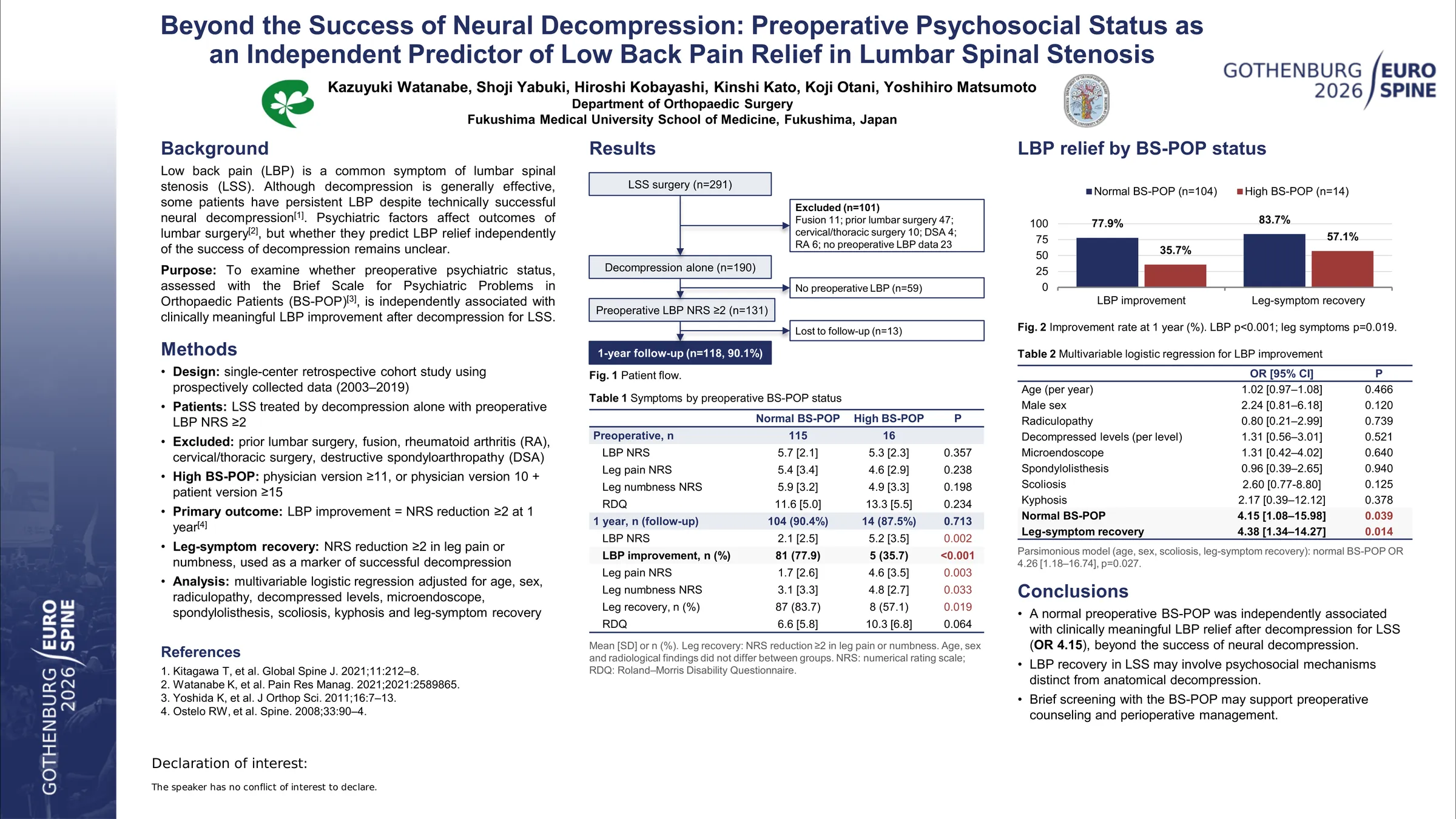
This study was a prospective cohort study using a prospectively maintained database. We identified 131 consecutive LSS patients with preoperative LBP (NRS ≧ 2) who underwent decompression surgery between 2003 and 2019. Of these, 118 patients (90.1%) completed a 1-year follow-up. The primary outcome was LBP improvement, defined as an NRS reduction of ≧ 2 points. Preoperative BS-POP scores were obtained from both physician and patient versions; high BS-POP was defined as ≥11 points on the physician version, or 10 points on the physician version combined with ≥15 points on the patient version. To account for the clinical success of surgery, recovery of leg symptoms (defined as an NRS reduction ≧ of 2 for either leg pain or numbness) was evaluated. A multivariable logistic regression model was constructed including age, sex, spinal deformities, the number of decompressed levels, recovery of leg symptoms, and BS-POP scores.
Overall, 72.9% of patients (86/118) achieved meaningful LBP improvement; 81/104 patients (77.9%) in the normal BS-POP group, and only 5/14 patients (35.7%) in the high BS-POP group (p < 0.05). In the multivariable analysis, even after adjusting for recovery of leg symptoms and other clinical factors, a normal preoperative BS-POP score remained a potent independent predictor of LBP improvement (OR 4.15; 95% CI 1.08–15.98; p < 0.05).
Preoperative psychiatric status, evaluated by the BS-POP, is a significant predictor of postoperative LBP improvement, independent of the success of surgical neural decompression. These findings suggest that LBP recovery in LSS is influenced by psychological mechanisms distinct from anatomical decompression, highlighting the efficacy of psychosocial screening to optimize perioperative management.