
Growing Spine
Identifying patterns of coronal malalignment according to the Obeid coronal malalignment classification (O-CM) for Adolescent and Adult Idiopathic Scoliosis
- King Faisal Specialist Hospital and Research Center, Riyadh, Saudi Arabia
- Humanitas San Pio X, Milano, Italy
- ELSAN Polyclinique Jean Villar, Clinique du Dos, Bordeaux-Terrefort, Pessac, France
- . European Spine Study Group (Vall d'Hebron University Hospital, Barcelona, Spain
- Vall d'Hebron University Hospital, Barcelona, Spain
- La Paz University Hospital, Madrid, Spain
- Schulthess Klinik, Zurich, Switzerland
- Acibadem University Maslak Hospital, Istanbul, Türkiye
- CHRU strasbourg - Les Hôpitaux Universitaires de Strasbourg , Strasbourg, France
- Clinique Terrefort - Bruges, Bordeaux, France
- Elsan - Polyclinic Jean Villar, Bordeaux, France
- Clinique du Dos Bordeaux-Terrefort, Bordeaux, France
Abstract
Coronal alignment of spinal deformities has been investigated over the past decade, however no study looked into CM characteristics inside the idiopathic scoliosis population preoperatively. The aim of the current study was to identify patterns of coronal malalignment according to the O-CM classification for adolescent and adult idiopathic scoliosis patients that were categorized according to the Lenke classification with > 2cm CM.
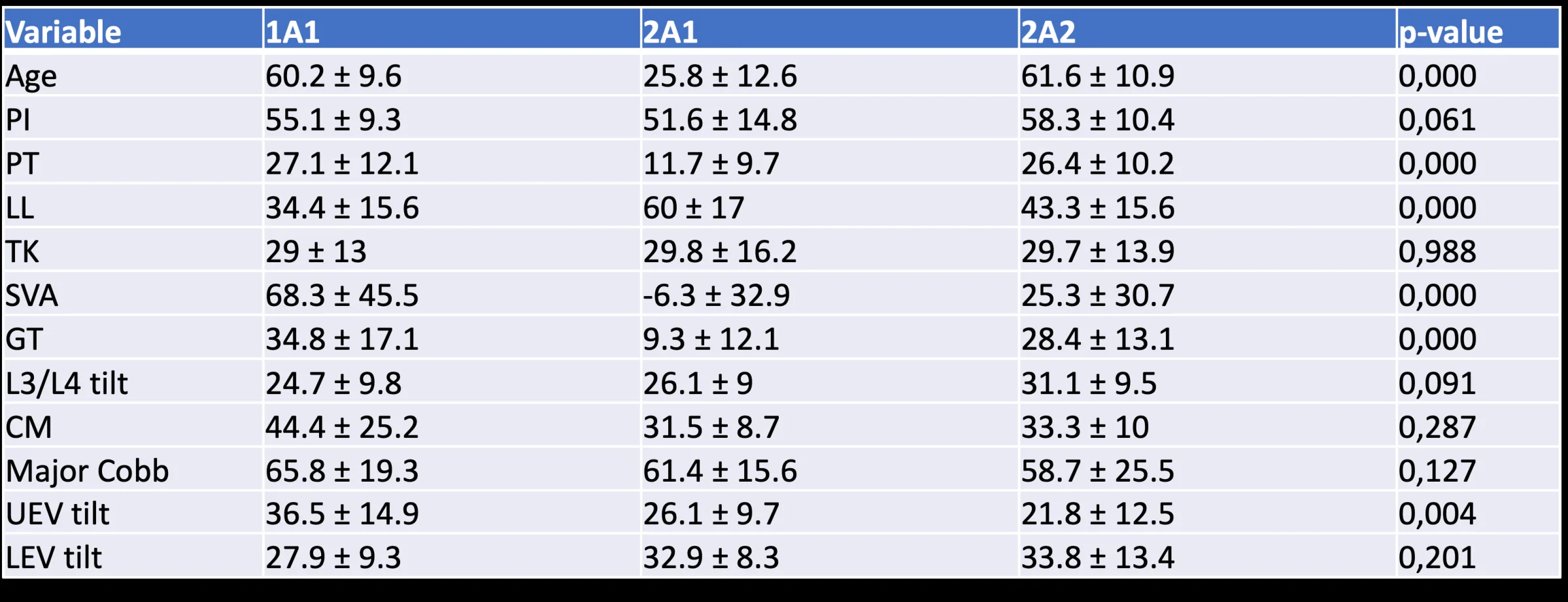
Retrospective analysis of prospectively collected data. Patients were classified by 3 experienced spine surgeons according to the Lenke classification for idiopathic scoliosis and the O-CM classification, which was followed by a comprehensive analysis on all cases where complete agreement has been reached between the reviewers. Age and various radiographic variables in the coronal and sagittal planes were analysed. Descriptive statistical analysis included frequency distributions and cross-tabulations to examine relationships between Lenke and O-CM classifications. Decision tree models were created to predict O-CM subtypes based on radiographic parameters. Comparative Analysis of O-CM Classification Subtypes was performed (Figure 1).
135 patients were included. The 3 main Lenke curve types that showed coronal malalignment were 5C (46.7%), 6C (25.9%) and 1AR (14.8%). CM was mainly toward the Convex side represented by O-CM type 2A1 (67.4%) followed by 2A2 (12.6%). The strongest predictors for CM were age where patients younger than 47 years were in the convex 2A1 type and patients older than 47 years were in the convex 2A2 type, Upper End Vertebra tilt with a cut-off angle of 34° where a higher angle lead mainly to a concave malalignment type 1A1 and a lower angle lead to a convex malalignment 2A2. L3/L4 tilt parameter was higher in types 2A1 and 2A2 when compared to 1A1 however the difference did not reach statistical significance (p=0.091). Major cobb angle was not observed as a predictor for CM.
This is the first study to identify patterns of CM in idiopathic scoliosis. Single structural curves showed higher tendency to CM. Driver of CM seems to be the vertebra with higher coronal tilt: concave if UEV higher, convex if LEV higher.
Figures and tables
As submitted with the abstract. Tap a figure to open it at full size.