
Adult Deformity
Quantifying trunk and hip mobility in ASD with sagittal malalignment: an original analysis towards unlocking the spine-hip relationship
- Saint Joseph University of Beirut, Beirut, Lebanon
Abstract
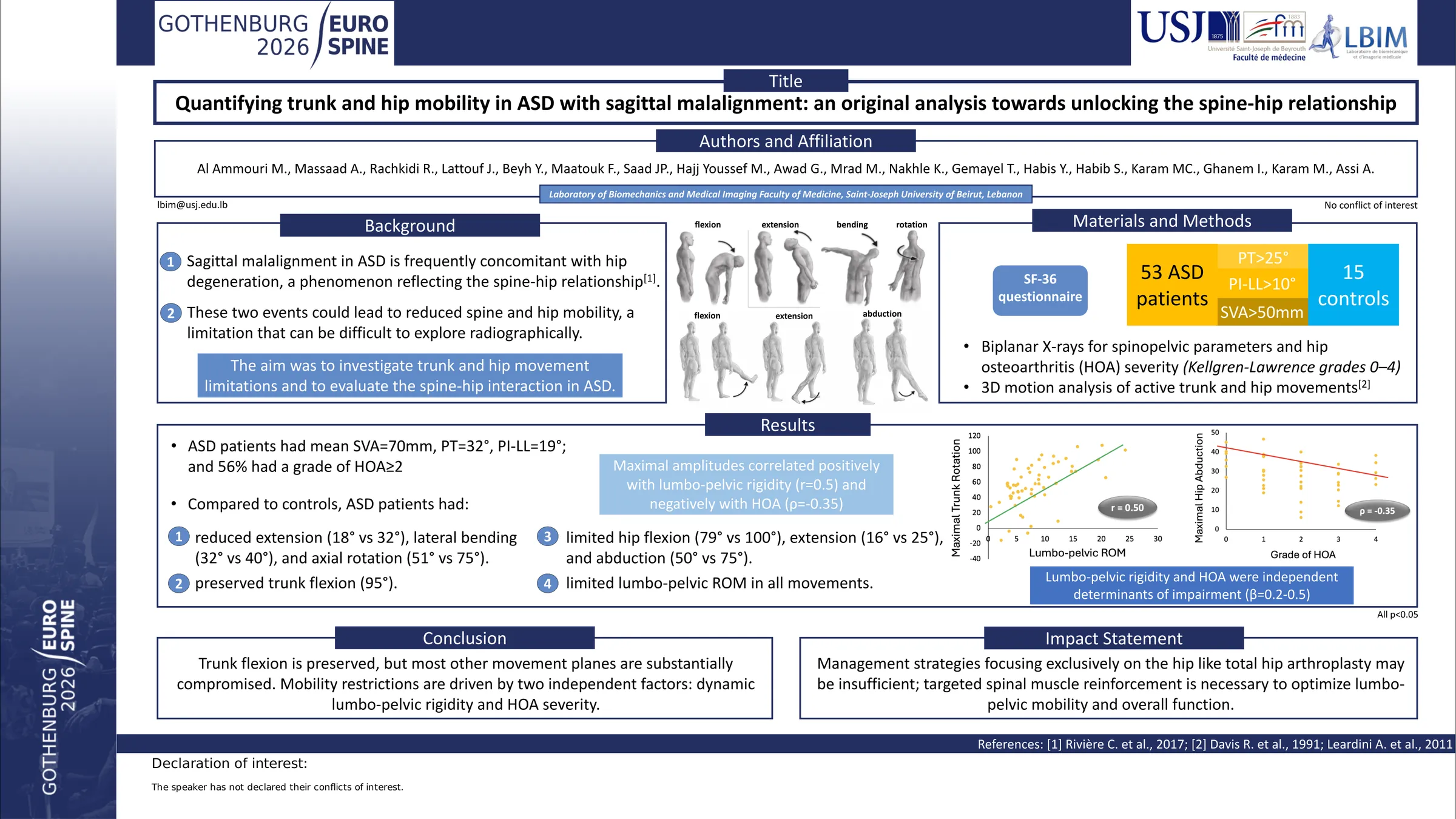
Sagittal malalignment in ASD is frequently concomitant with hip degeneration, a phenomenon known as spine-hip syndrome. These two events could lead to reduced spine and hip mobility, a limitation that can be difficult to explore radiographically. The aim was to investigate trunk and hip movement limitations using 3D movement analysis and to evaluate the relationship between spine and hip in ASD patients presenting with sagittal malalignment.
53 ASD patients with sagittal malalignment (PT>25° and/or PI-LL>10° and/or SVA>50mm) and 15 control subjects filled QOL questionnaires and underwent low dose biplanar X-rays. Spinopelvic parameters and the Kellgren and Lawrence grade of hip osteoarthritis (HOA) were extracted. All subjects underwent 3D movement analysis of trunk (flexion, extension, bending, rotation) and hip (flexion, extension, abduction) movements from which full-body joint and segment kinematics were calculated. Demographics, spinopelvic parameters, and kinematics were compared between the two groups. Determinants of kinematic limitations were explored using stepwise multiple linear regressions.
On average, ASD patients had SVA=70mm, PT=32°, PI-LL=19°; 56% had a high grade of HOA ≥2. During trunk movements, ASD patients were able to achieve normal trunk maximal flexion (95°). However, they failed to achieve maximal amplitude during extension (18 vs 32° in controls), bending (32 vs 40°) and rotation (51 vs 75°, all p<0.05). They had limited lumbo-pelvic range of motion (ROM) in all trunk movements (L1L5-pelvis: 3 vs 11° during extension; 3 vs 9° during bending; Figure 1). During hip movements, ASD had limited maximal amplitude in all movements: flexion (79 vs 100° in controls), extension (16 vs 25°) and abduction (50 vs 75°, all p<0.05). They had limited lumbo-pelvic ROM in all hip movements (L1L5-pelvis: 5 vs 10° and 2 vs 6° during flexion and extension resp.; 4 vs 10° during abduction; all p<0.05; Figure 1). Maximal amplitude was negatively correlated to SVA (r=-0.60), the grade of HOA (ρ=-0.42), lumbo-pelvic ROM (r=-0.5) and physical component of SF-36 (r=0.50; all p<0.001). While lumbo-pelvic rigidity and grade of HOA were not correlated, both were significant determinants of trunk and hip movement limitations (β varied between 0.2 and 0.5).
ASD patients couldn’t reach maximal amplitude in most of the trunk and hip movements due to two independent factors. The first factor was the limited lumbo-pelvic movement, noticed in all ASD patients, underlying a dynamic rigidity in this segment. The second independent factor was the high grade of HOA when present. This might suggest that opting for a hip-exclusive treatment such as total hip arthroplasty does not necessarily result in restoration of spinal mobility.
Figures and tables
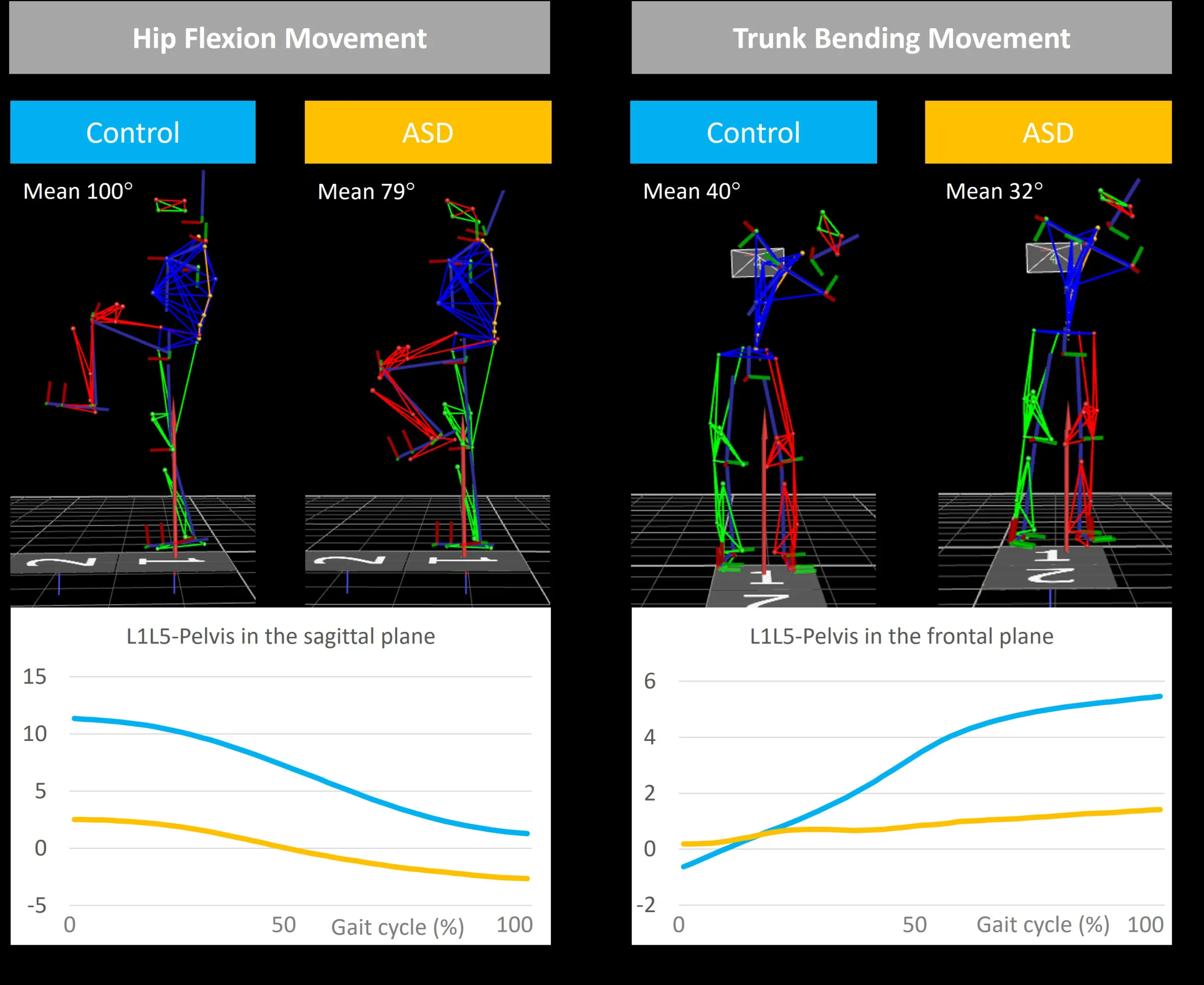
As submitted with the abstract. Tap a figure to open it at full size.