
Basic Science & Economics
Oversizing pedicle screw diameter relative to pedicle width improves fixation strength: A cadaveric pull-out and toggling study
- Universitätsklinik Balgrist, Zürich, Switzerland
Abstract
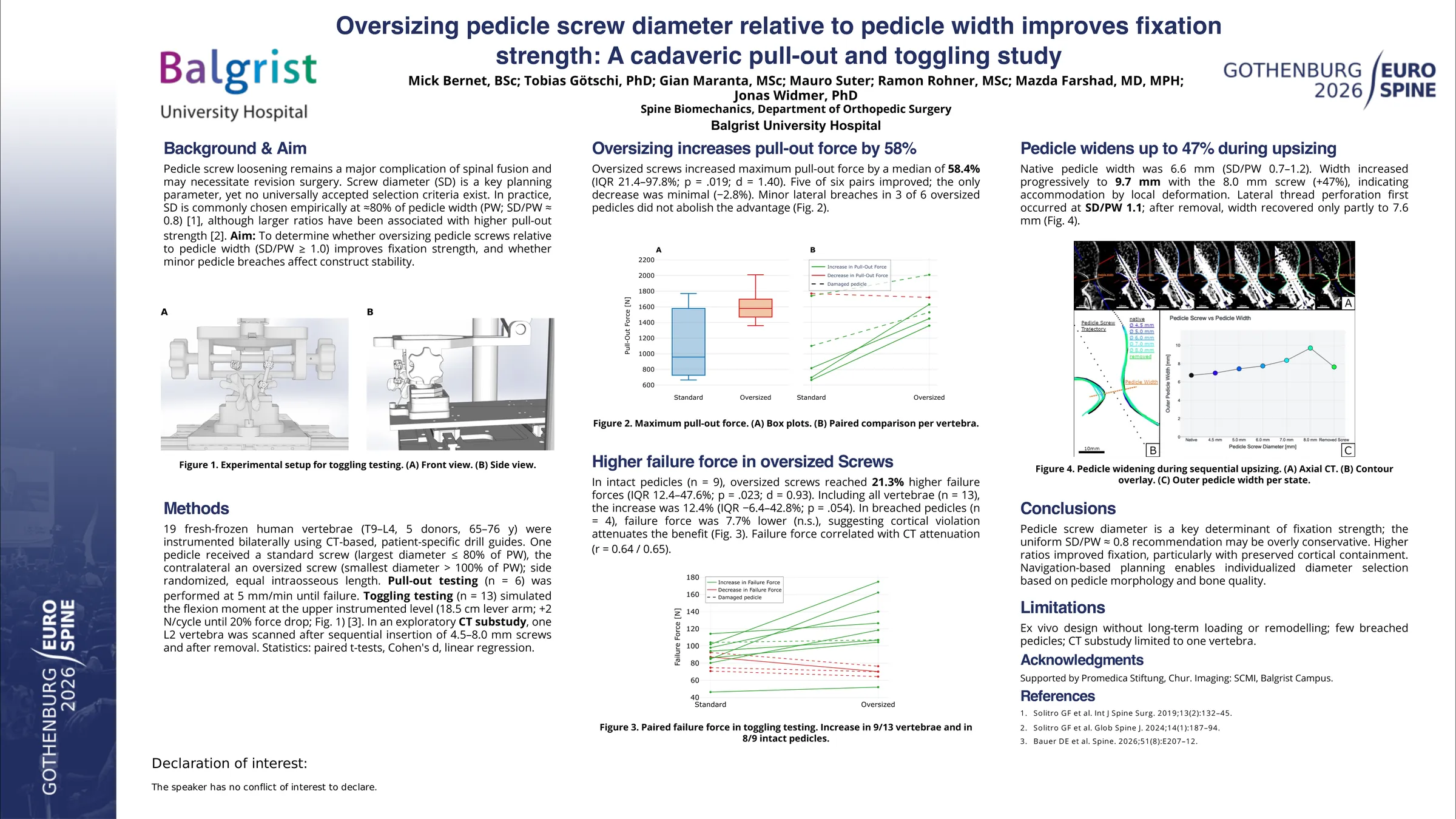
Pedicle screw loosening remains a major complication in spinal fusion. The standard implant sizing strategy (screw diameter (SD) ≈ 0.8 × pedicle width (PW)) may be overly conservative. We investigated whether screws exceeding this ratio improve fixation strength in ex vivo vertebrae under two biomechanical test conditions.
A biomechanical cadaveric study was conducted using nineteen human vertebrae. In a paired cadaveric design, each vertebra received a standard screw (SD/PW ≈ 0.8) on one pedicle and an oversized screw (SD/PW ≥ 1.0) on the contralateral side. Two biomechanical setups were tested: uniaxial pull-out testing, and toggling testing with perpendicular cyclic loading. Screw stability was assessed by measuring the achieved maximum pull-out force for pull-out testing and the failure force for toggling testing.
Oversized screws increased median failure force in both trials. For the pull-out testing, the median increase in pull-out force with oversized screws was 58.4% (interquartile range [IQR] 21.4%–97.8%; p = 0.019; effect size d = 1.40). For the toggling testing, the median increase in failure force with oversized screws was 12.4% (IQR -6.4%–42.8%; p= 0.054; effect size = 0.59), which did not reach significance. However, when only intact pedicles were included (n = 9 pairs), a median increase of 21.3% (IQR 12.4%–47.6%; p= 0.023; effect size = 0.93) was achieved, showing significance.
Pedicle screw diameter is a key parameter for fixation strength, but the currently adopted “one-size-fits-all” 0.8 SD/PW recommendation does not yield optimal biomechanical results. These findings support moving toward biomechanics-based, patient-specific screw diameter selection rather than relying on a uniform 80% pedicle width recommendation.