
Complications & Epidemiology
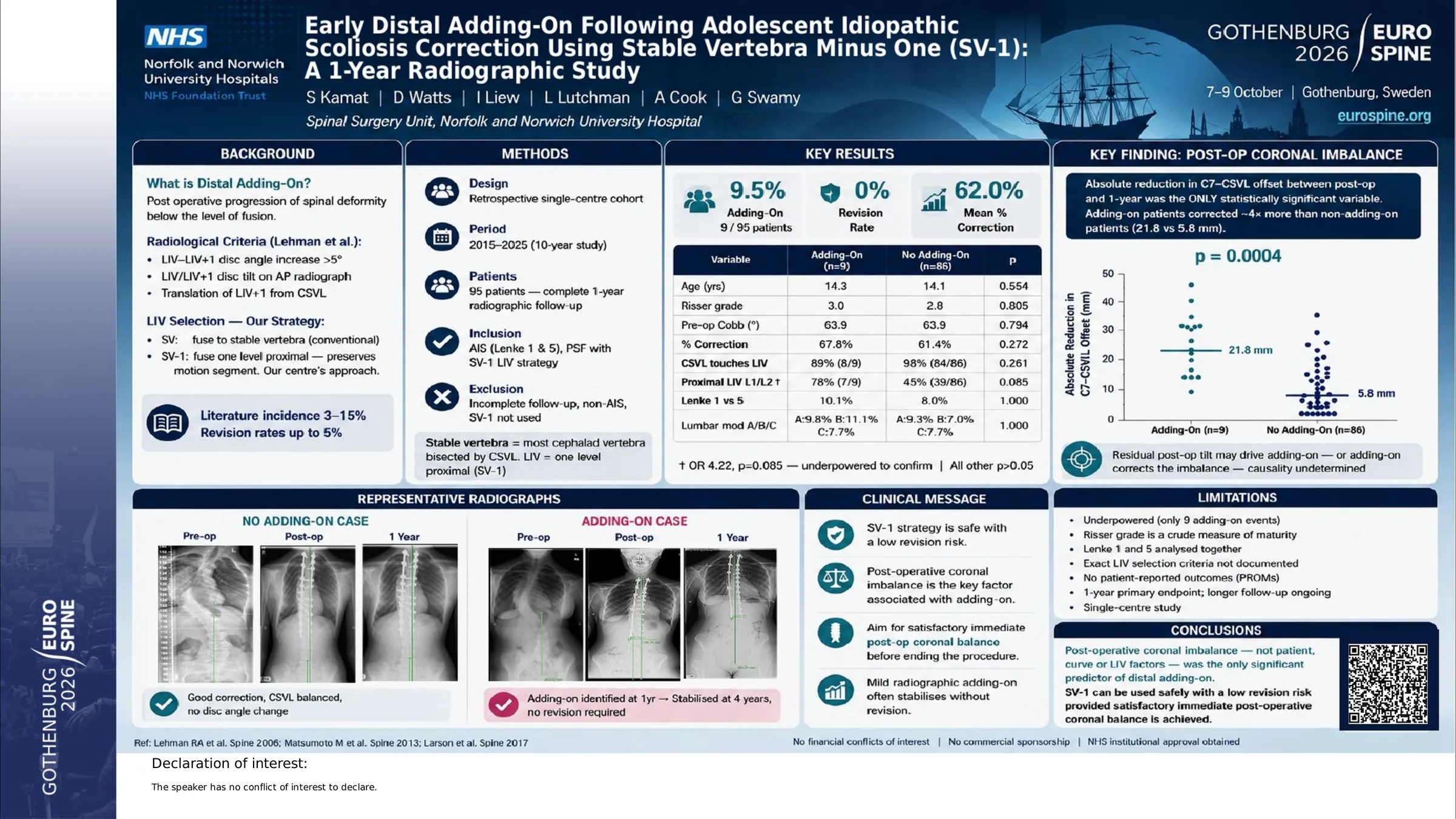
Early Distal Adding-On Following Adolescent Idiopathic Scoliosis Correction Using Stable Vertebra Minus One (SV-1): A 1-Year Radiographic Study
- Norfolk and Norwich University Hospital, Oswestry, United Kingdom
- Norfolk and Norwich University Hospital, Norwich, United Kingdom
Abstract
Distal adding-on is a recognised phenomenon following posterior spinal fusion (PSF) for adolescent idiopathic scoliosis (AIS), with reported incidence ranging from 3–15% and potential association with distal fusion level selection. At our centre, the lowest instrumented vertebra (LIV) is commonly selected as stable vertebra minus one (SV–1). This study aimed to determine the incidence of early distal adding-on at one year following PSF for AIS using an SV–1 strategy and to assess associations with LIV–central sacral vertical line (CSVL) relationship, skeletal maturity, and curve magnitude and correction.
A retrospective single-centre radiographic review was performed of AIS patients (Lenke 1 and 5) undergoing PSF between 2021 and 2024. The LIV was selected using an SV–1 strategy. Distal adding-on was defined as an increase in LIV–LIV+1 disc angulation greater than 5° on standing anteroposterior radiographs at one-year follow-up compared with early post-operative imaging. Demographic data, Risser grade, pre- and post-operative Cobb angles, percentage correction, and CSVL–LIV relationship were recorded. Associations with distal adding-on were analysed using Fisher’s exact test and Mann–Whitney U tests.
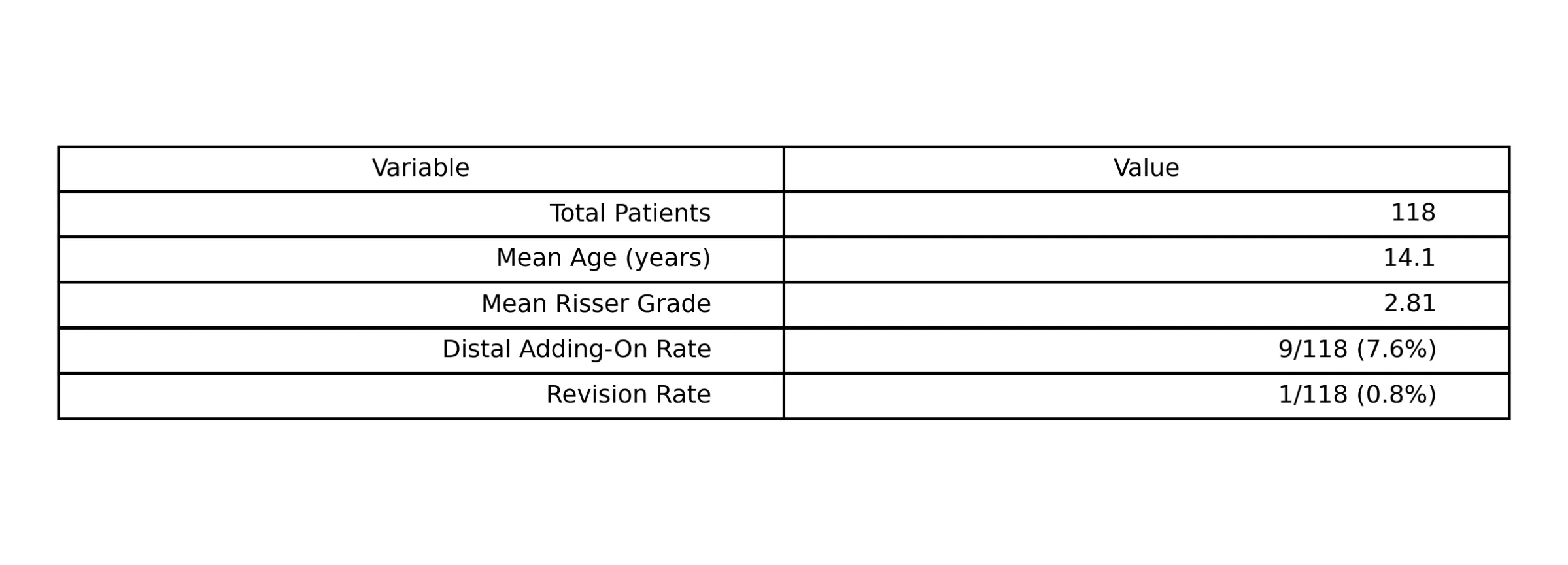
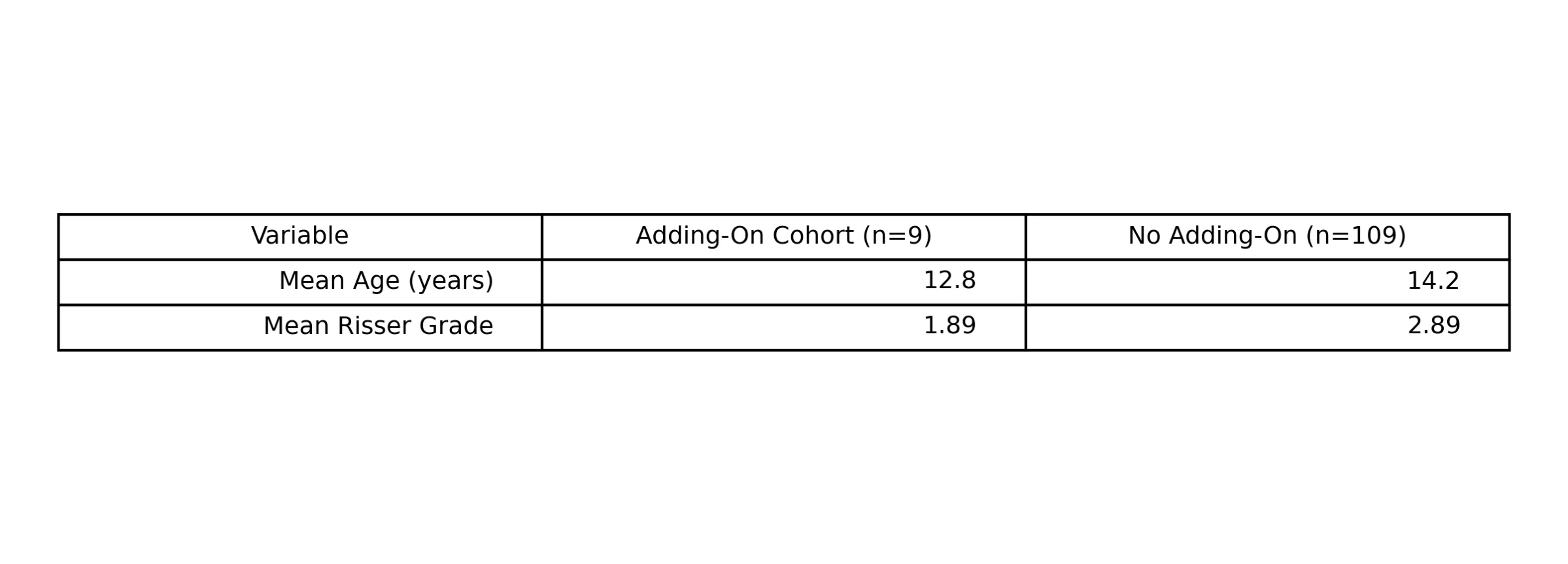
One hundred and eighteen patients had complete radiographic data (mean age 14.1±1.4 years; 86.4% female). Mean pre-operative Cobb angle was 64.4±13.1°, improving to 25.1±12.3° post-operatively (mean absolute correction 39.3°; mean percentage correction 61.0%). Distal adding-on occurred in 9 of 118 patients (7.6%) at one-year follow-up. One patient (0.8%) subsequently required revision surgery for progressive distal adding-on identified at one year and revised at two-year follow-up. A statistically significant association was identified between adding-on and younger age (p=0.003) and lower Risser grade (p=0.049). No statistically significant association was identified between adding-on and gender or CSVL–LIV relationship (all p>0.05).
Use of SV-1 as the distal fusion level in AIS is associated with a low rate of early distal adding-on at 1 year. Lower skeletal maturity may increase the risk of early distal adding-on, while CSVL-LIV relationship alone does not guarantee prevention. Longer-term follow-up is required to determine the clinical significance and revision risk.
Figures and tables
As submitted with the abstract. Tap a figure to open it at full size.