
Degenerative Thoracolumbar
Minimally Invasive Versus Open Transforaminal Lumbar Interbody Fusion for Single-Level Degenerative Disease: A Five-Year Matched Cohort Analysis
- St. Joseph's University Medical Center, Paterson, United States of America
Abstract
Minimally invasive transforaminal lumbar interbody fusion (MIS-TLIF) has been adopted to reduce perioperative morbidity compared with open TLIF. While short-term benefits are well established, long-term data comparing revision patterns, fusion durability, and patient-reported outcomes remain limited, particularly beyond five years. This study compared five-year clinical and radiographic outcomes following MIS-TLIF versus open TLIF for single-level degenerative lumbar pathology.
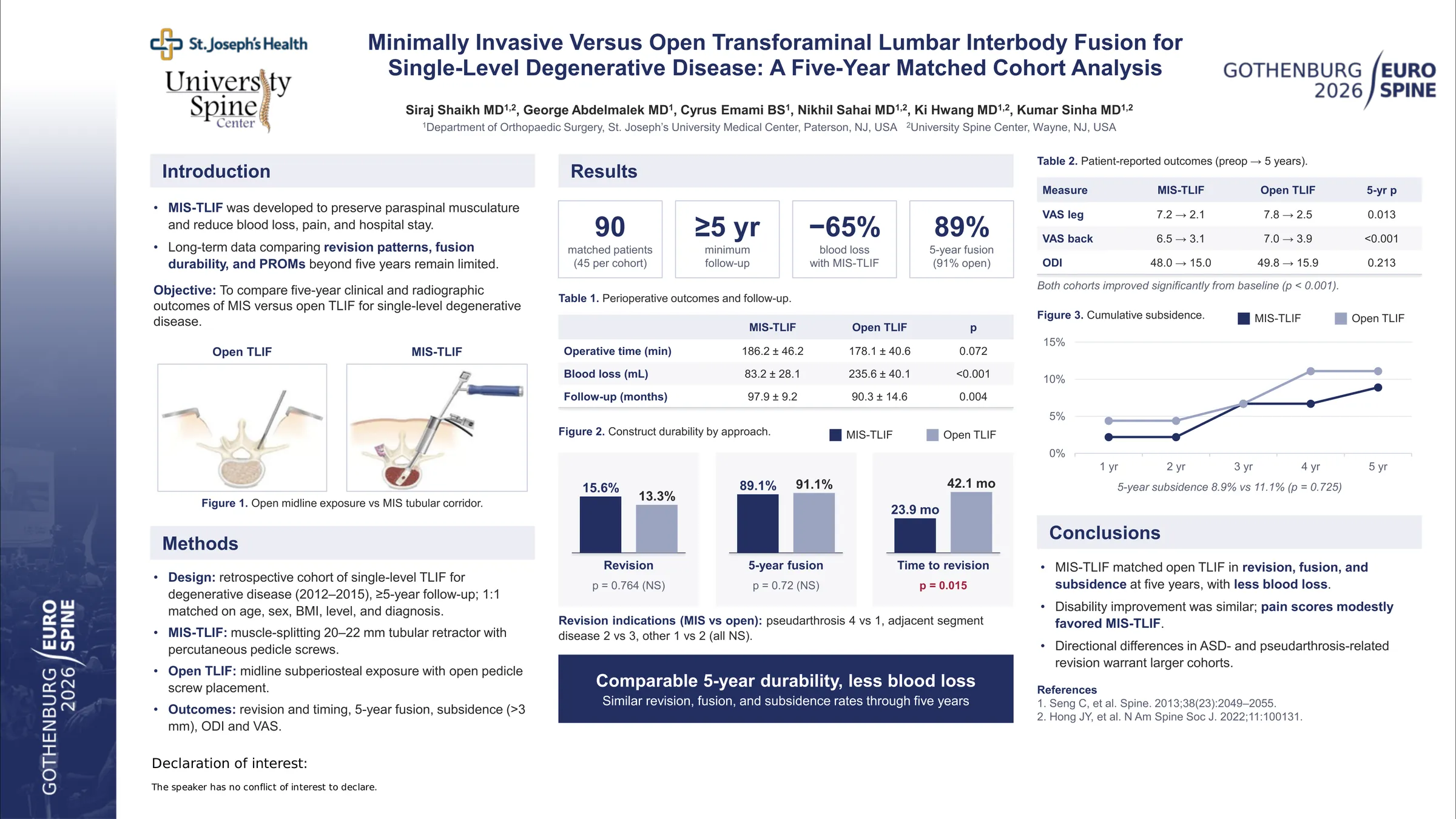
A retrospective matched cohort study was performed at a single institution including adult patients (≥18 years) undergoing single-level TLIF between January 2012 and December 2015. Exclusion criteria included multilevel fusion, non-degenerative indications, incomplete data, or <5 years follow-up. Patients were matched 1:1 (MIS-TLIF vs open TLIF) on age, sex, BMI, operative level, and diagnosis (45 per cohort; N=90). MIS-TLIF utilized a tubular retractor system with percutaneous screws; open TLIF used a midline approach with open screw placement. Outcomes included operative time, estimated blood loss (EBL), revision surgery and timing, subsidence (>3 mm), five-year fusion status, and PROMs (ODI, VAS). Statistical significance was set at p<0.05.
Baseline characteristics were well balanced between cohorts. Mean follow-up was longer in the MIS-TLIF group (97.9 vs 90.3 months, p=0.004). Operative time was similar between groups (186.2 vs 178.1 minutes, p=0.072), while EBL was significantly lower with MIS-TLIF (83.2 vs 235.6 mL, p<0.001). Overall revision rates were comparable (15.6% MIS vs 13.3% open, p=0.764). Revision indications included pseudarthrosis, adjacent segment disease (ASD), residual stenosis, epidural hematoma, and infection, with no significant between-group differences for individual indications. ASD-related revisions were numerically higher after open TLIF, whereas pseudarthrosis-related revisions were numerically higher after MIS-TLIF. Mean time to revision was shorter following MIS-TLIF (23.9 vs 42.1 months, p=0.015). Subsidence rates remained low and comparable at all time points, including five years (8.9% MIS vs 11.1% open, p=0.725). Five-year fusion rates were similarly high (89.1% MIS vs 91.1% open). Both cohorts demonstrated significant improvement in ODI and VAS scores; at five years, ODI was comparable, while VAS back and leg pain modestly favored MIS-TLIF.
In a matched cohort with minimum five-year follow-up, MIS-TLIF was associated with lower blood loss and comparable long-term revision, fusion, and subsidence outcomes relative to open TLIF, with similar disability improvement and modestly lower pain scores at five years. Numerical differences in ASD- and pseudarthrosis-related revisions suggest potential directional tradeoffs that did not reach statistical significance, underscoring the need for larger cohorts to clarify approach-related differences in infrequent late endpoints.