
Complications & Epidemiology
Impact of resident versus specialist performed lumbar spine surgery
- Aarhus University Hospital, Aarhus, Denmark
Abstract
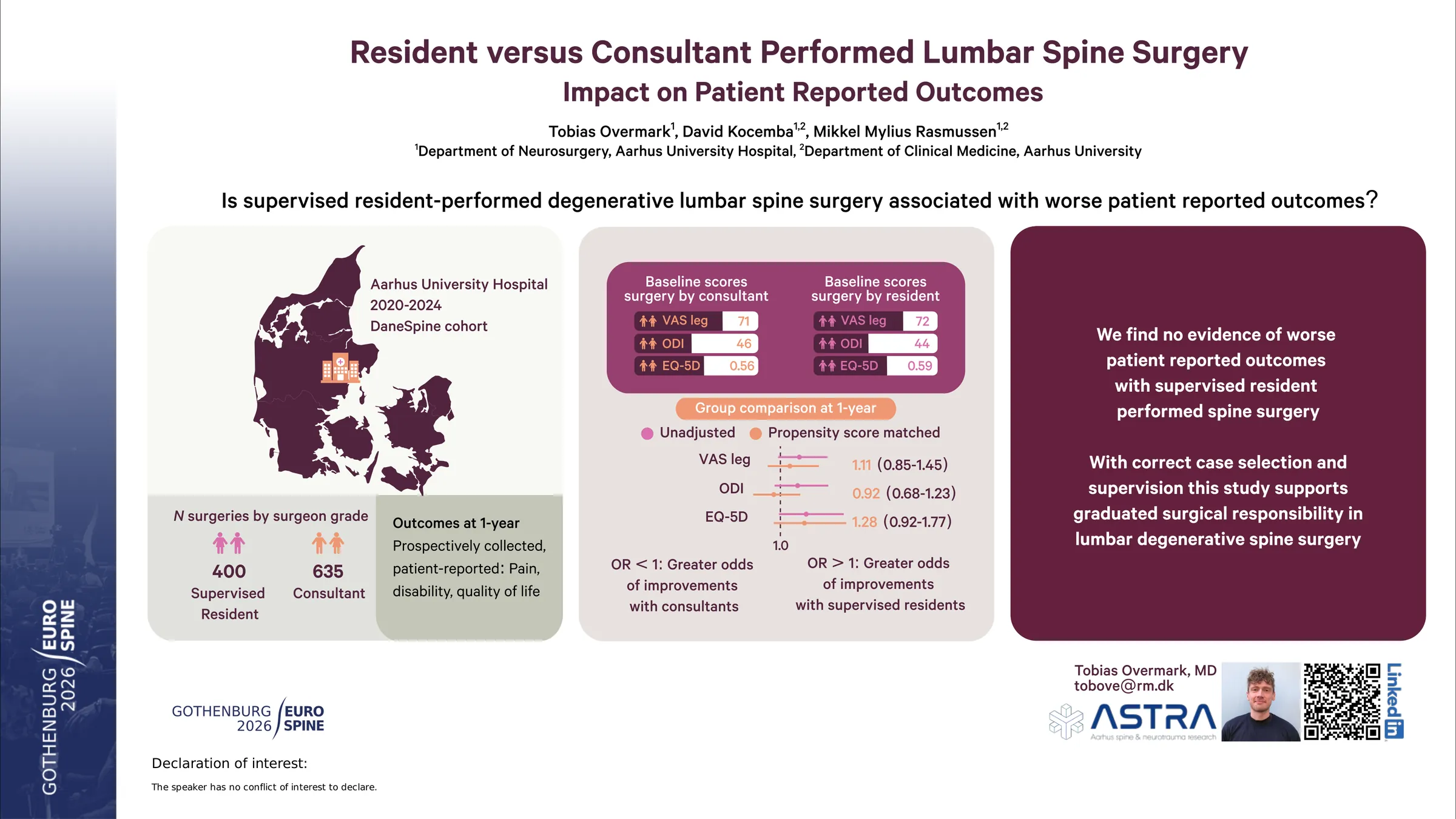
Lumbar spine surgery for degenerative conditions is frequently performed by neurosurgical residents under specialist supervision as part of surgical training. Previous studies have shown that resident involvement is not associated with increased perioperative complications, however evidence regarding longer-term patient-reported outcomes (PROs) remains limited.
We conducted a retrospective cohort study of patients undergoing lumbar spine surgery for degenerative conditions at a tertiary neurosurgical center in Denmark between 2020 and 2024. Clinical data and PROs were obtained from the national registry DaneSpine with prospectively collected baseline and 1-year follow-up outcomes. The exposure was the surgeon’s experience level (resident vs specialist). Primary outcomes were visual analogue scale scores for leg pain (VAS-LP), Oswestry Disability Index (ODI), and European Quality of Life index (EQ5D) at 1-year follow-up. Secondary outcomes were visual analogue scale scores for back pain (VAS-BP) and patient satisfaction. Multivariable ordinal and logistic regression models were adjusted for prespecified confounders.
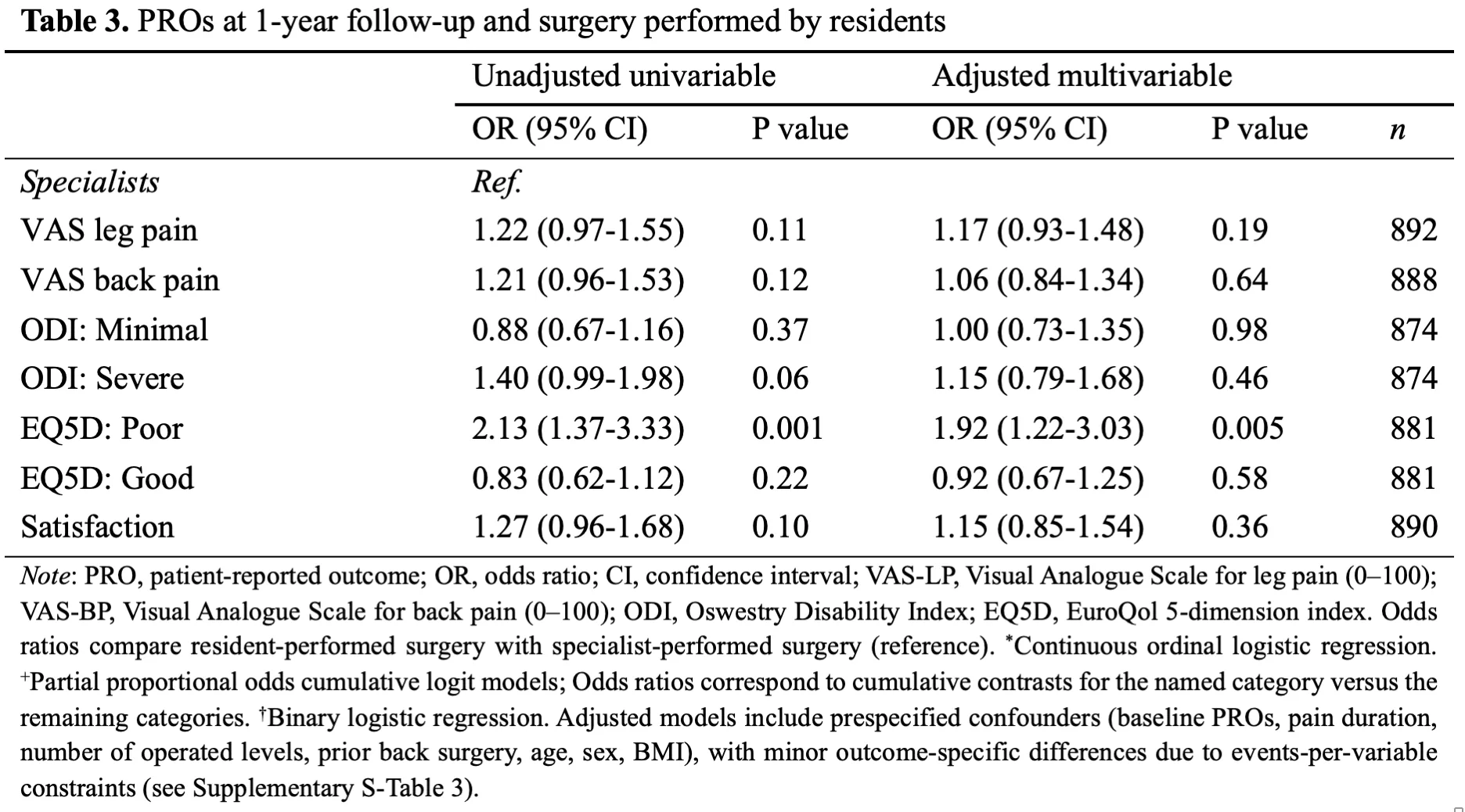
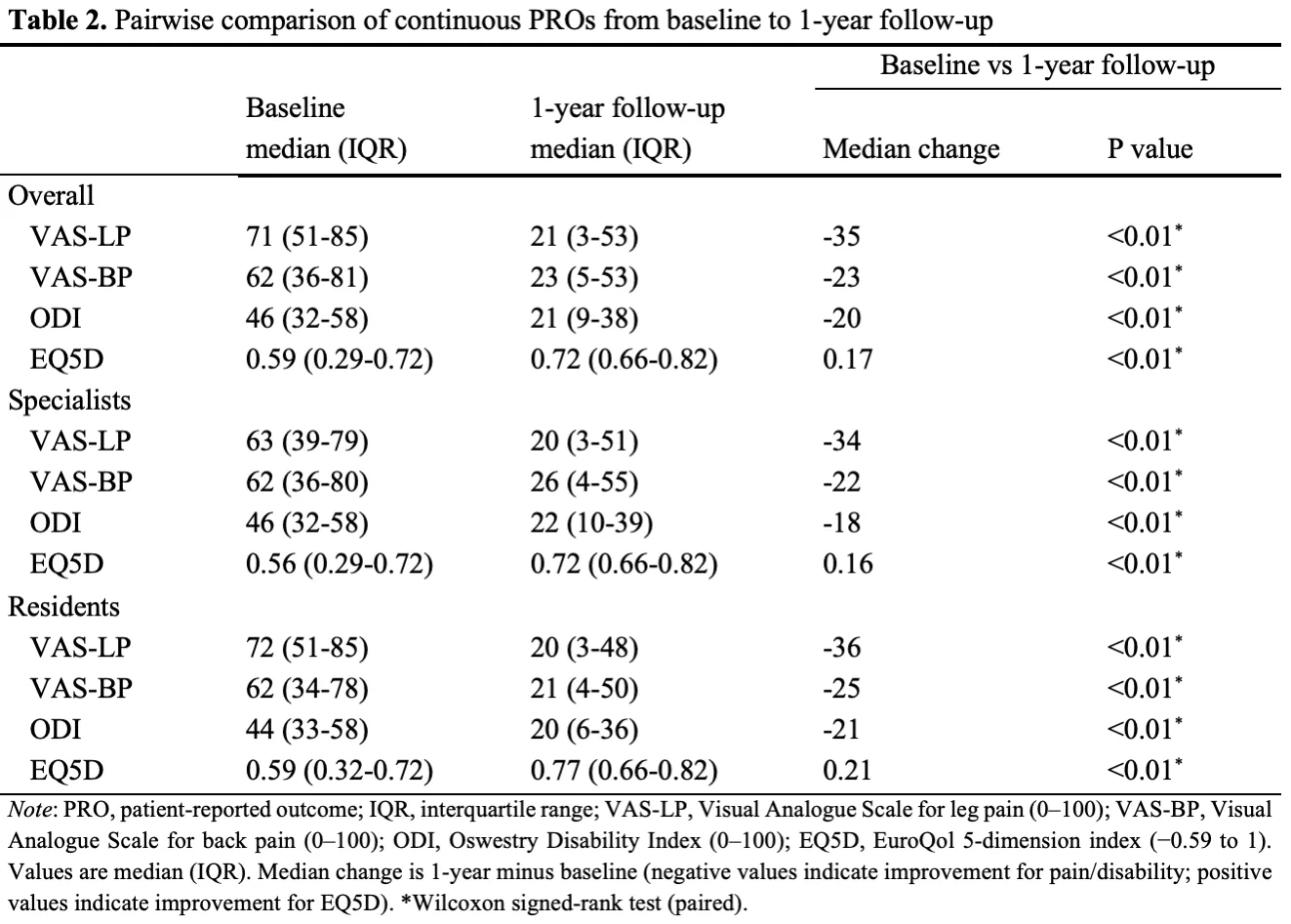
Among 1815 eligible patients, 1035 with complete follow-up were included; 635 procedures (61%) were performed by specialists and 400 (39%) by supervised residents. Both groups demonstrated improvements from baseline to 1-year follow-up in VAS-LP, VAS-BP, ODI, and EQ5D (all P < .01), with similar median improvements between groups. In adjusted analyses, resident-performed surgery was not associated with differences in VAS-LP (OR 1.17, 95% CI 0.93–1.48), VAS-BP (OR 1.06, 95% CI 0.84–1.34), ODI disability categories, or patient satisfaction (OR 1.15, 95% CI 0.85–1.54) when compared to specialists. For EQ5D, resident-performed surgery was associated with 92% higher odds of poor quality of life at 1-year follow-up (OR 1.92, 95% CI 1.22–3.03). Sensitivity analyses, including multiple imputation for missing 1-year follow-up data, supported these findings.
Lumbar spine surgery performed by supervised residents resulted in significant improvements in pain, disability, and quality-of-life at 1-year, similar to specialist-performed surgery across most patient-reported outcomes. When residents and specialists were compared, specialist-performed surgery displayed a non-significant trend towards better pain and function outcomes and a significant difference in quality-of-life measured by EQ5D. These findings support the overall safety of supervised resident training, while highlighting the need for continued attention to training and supervision.
Figures and tables
As submitted with the abstract. Tap a figure to open it at full size.