
Degenerative Thoracolumbar
Comparative Clinical and Radiographic Outcomes of Mini-ALIF with Percutaneous Fixation Versus MI-TLIF in Intermediate-to-High-Grade Isthmic Spondylolisthesis
- St. Joseph's University Medical Center, Paterson, United States of America
Abstract
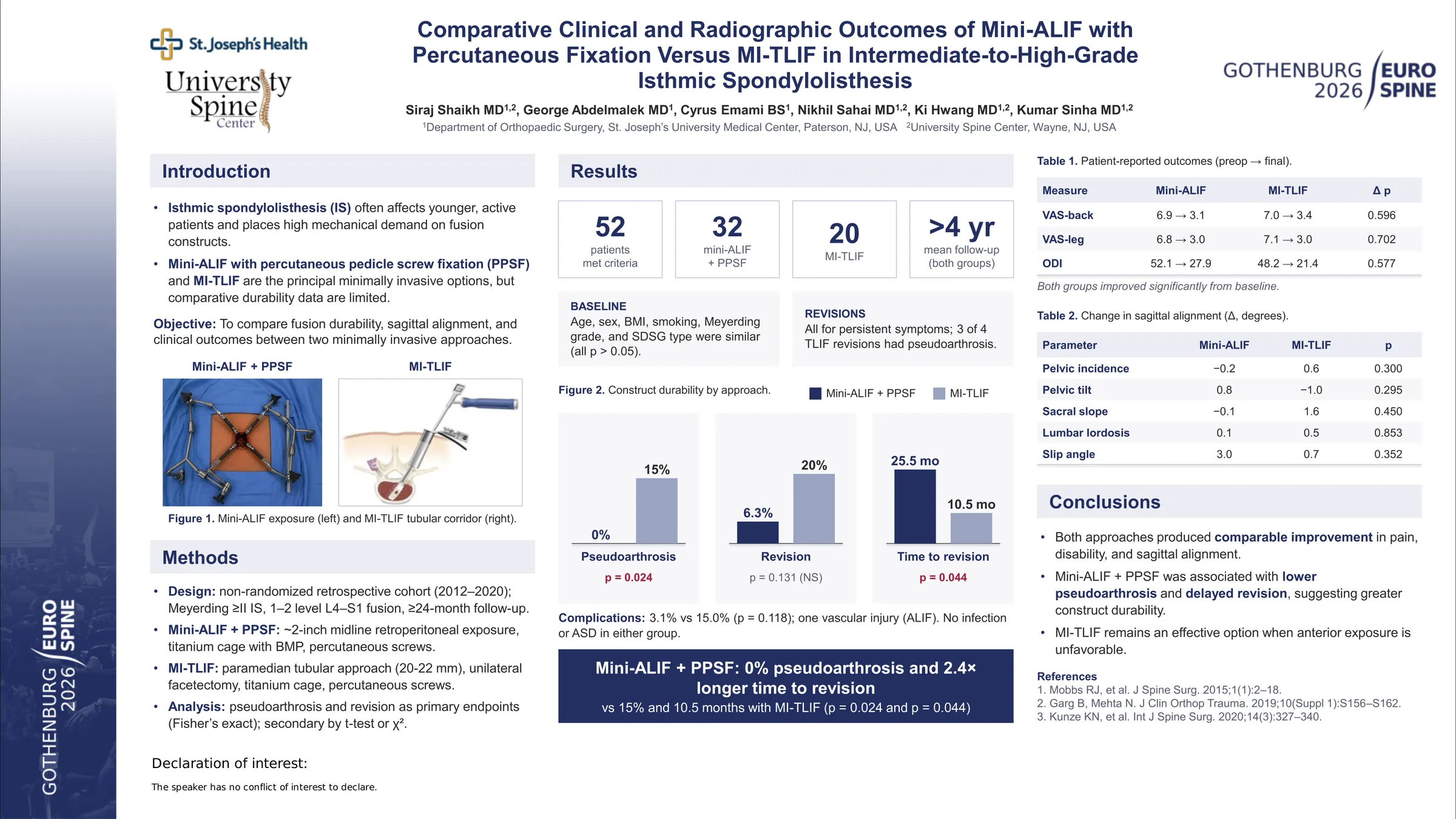
Intermediate-to-high-grade isthmic spondylolisthesis places substantial mechanical demands on fusion constructs. Mini-ALIF + PPSF and MI-TLIF are commonly utilized minimally invasive strategies, but comparative data remain limited. The purpose of this study was to compare clinical outcomes, radiographic alignment, and fusion durability between these approaches.
Adults with intermediate-to-high-grade IS treated between 2012 and 2020 were included. Degenerative etiologies were excluded. Patients were counseled on both procedures, with approach selection reflecting shared decision-making incorporating patient preference, surgeon preference, and patient-specific anatomic or exposure-related risk factors. Demographics, complications, pseudarthrosis, revision rate and timing, radiographic parameters (pelvic incidence, pelvic tilt, sacral slope, lumbar lordosis, slip angle), and PROMs were compared. Minimum follow-up was 24 months.
Fifty-two patients met inclusion criteria (mini-ALIF + PPSF: n=32; MI-TLIF: n=20). Baseline demographics and follow-up duration were similar between groups. Pseudarthrosis occurred less frequently in the mini-ALIF + PPSF cohort (0% vs 15%, p=0.024). Mean time to revision was longer following mini-ALIF + PPSF (25.5 vs 10.5 months, p=0.044), despite similar overall revision rates. Radiographic alignment parameters and magnitude of correction did not differ significantly between groups. Both cohorts demonstrated significant improvements in VAS and ODI scores, with no between-group differences. Complication rates were low and comparable.
Both mini-ALIF + PPSF and MI-TLIF result in meaningful clinical improvement for intermediate-to-high-grade isthmic spondylolisthesis. Mini-ALIF + PPSF was associated with superior fusion durability and delayed revision timing while achieving comparable alignment correction and patient-reported outcome improvement.