
Complications & Epidemiology
Preoperative Paraspinal Muscle Degeneration as a Predictor of Adjacent Segment Disease Following Spinal Fusion
- St. Joseph's University Medical Center, Paterson, United States of America
- St. Joseph's University Medical Center, Wayne, United States of America
Abstract
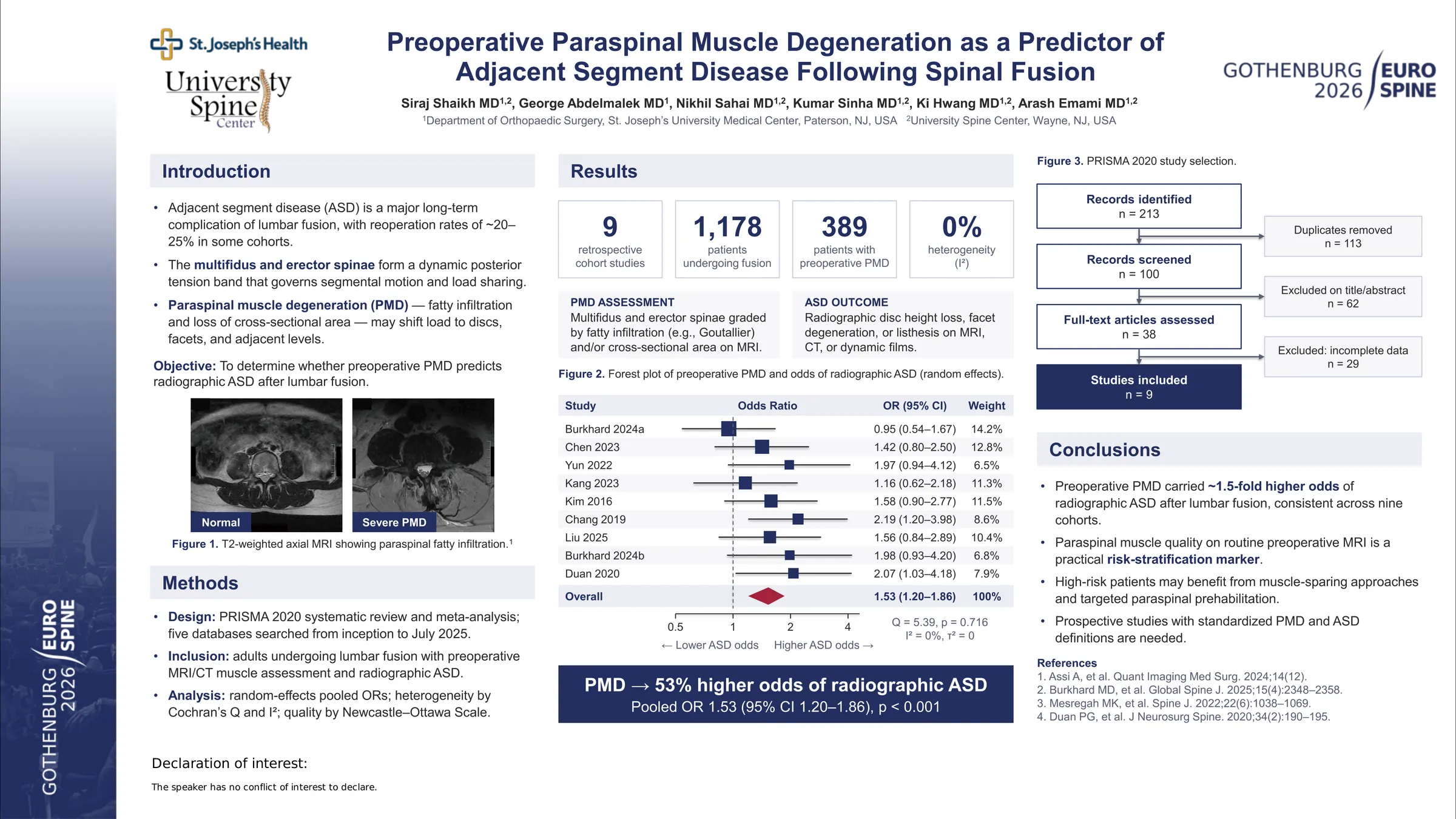
Adjacent segment disease (ASD) is a common long-term complication following spinal fusion. Paraspinal muscle degeneration (PMD) may compromise spinal stability and accelerate ASD. The purpose of this study was to evaluate the association between preoperative PMD and ASD risk following spinal fusion.
A systematic review and meta-analysis were conducted in accordance with PRISMA 2020 guidelines. Comprehensive searches were performed across PubMed, Embase, Web of Science, Scopus, and the Cochrane Library from database inception through July 2025. Eligible studies included adult patients undergoing spinal fusion with imaging-based quantification of paraspinal muscle degeneration using MRI or CT. Data were extracted as odds ratios (ORs) with 95% confidence intervals (CIs) and pooled using a random-effects model. Heterogeneity was assessed using Cochran’s Q and I² statistics.
Nine studies encompassing 1,178 patients met inclusion criteria. Pooled analysis demonstrated that patients with preoperative paraspinal muscle degeneration had a significantly higher likelihood of developing adjacent segment disease following fusion (OR 1.53; 95% CI 1.21–1.86; p < 0.001). No significant heterogeneity was detected across studies.
Preoperative paraspinal muscle degeneration is strongly associated with an increased risk of adjacent segment disease following spinal fusion. These findings underscore the importance of preoperative assessment of paraspinal muscle quality and support the use of muscle-preserving surgical techniques and targeted postoperative rehabilitation strategies to mitigate ASD risk.