
Degenerative Thoracolumbar
Prospective Comparison of Full-Endoscopic, Tubular, and Open Lumbar Discectomy: One-Year Clinical and Functional Outcomes
- University Hospital in Hradec Králové, Charles University, Hradec Králové, Czech Republic
Abstract
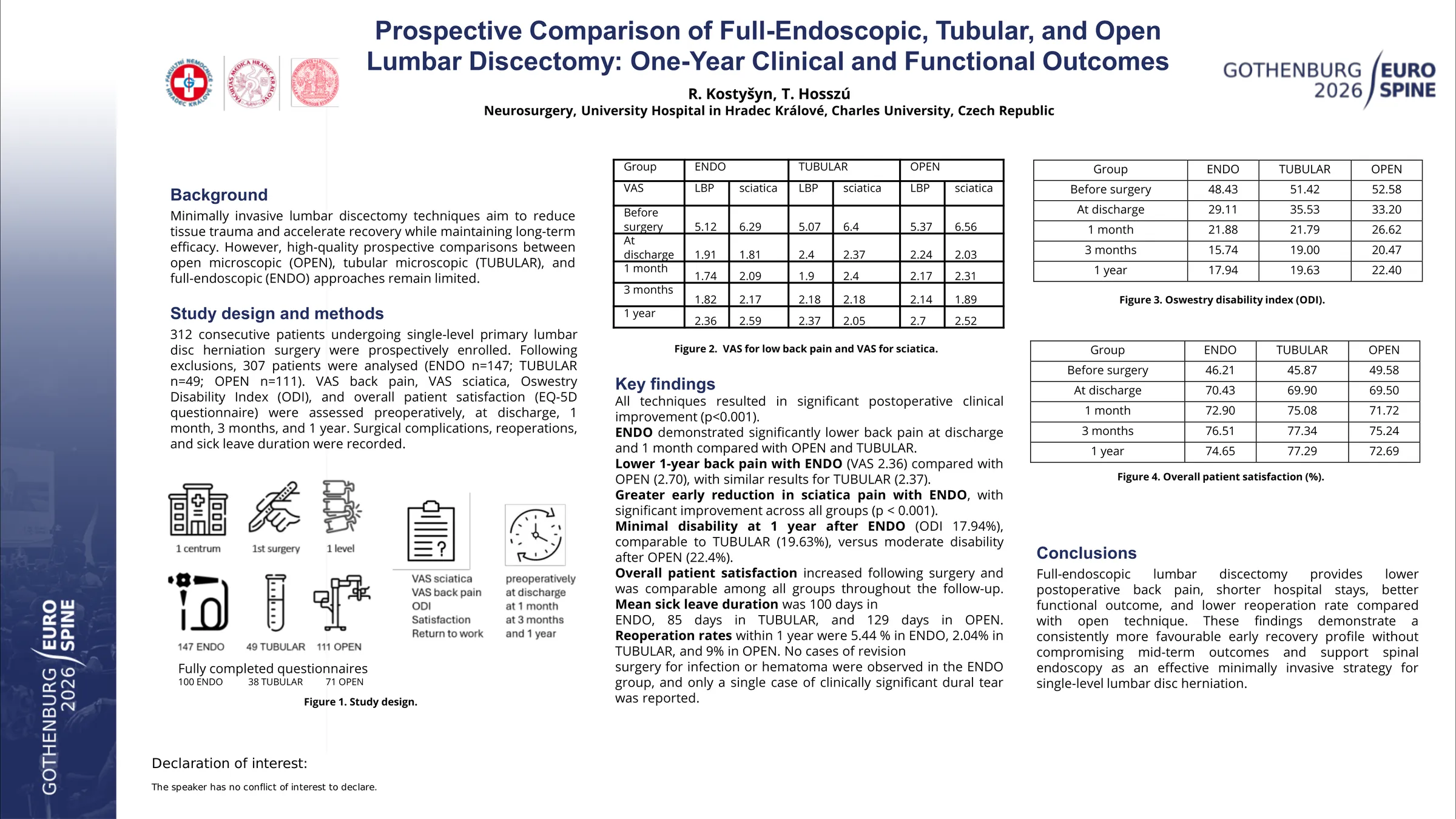
Minimally invasive lumbar discectomy techniques aim to reduce tissue trauma and accelerate recovery while maintaining long-term efficacy. However, high-quality prospective comparisons between open microscopic (OPEN), tubular microscopic (TUBULAR), and full-endoscopic (ENDO) approaches remain limited.
312 consecutive patients undergoing single-level primary lumbar disc herniation surgery were prospectively enrolled. Following exclusions, 307 patients were analysed (ENDO n=147; TUBULAR n=49; OPEN n=111). VAS back pain, VAS sciatica, Oswestry Disability Index (ODI), and overall patient satisfaction (EQ-5D questionnaire) were assessed preoperatively, at discharge, 1 month, 3 months, and 1 year. Surgical complications, reoperations, and sick leave duration were recorded. Statistical significance was set at p<0.05.
All techniques resulted in significant postoperative clinical improvement (p<0.001). ENDO demonstrated significantly lower back pain at discharge and 1 month compared with OPEN and TUBULAR. At 1-year, back pain remained lower in ENDO (VAS 2.36) and TUBULAR (2.37) compared with OPEN (2.70). Sciatica pain reduction was significant across groups (p<0.001), with lower early postoperative values in ENDO. At 1-year, ODI scores indicated minimal disability in ENDO (17.94%) and TUBULAR (19.63%), and moderate disability in OPEN (22.4%). Overall patient satisfaction increased following surgery and was comparable among all groups throughout the follow-up. Mean sick leave duration was 100 days in ENDO, 85 days in TUBULAR, and 129 days in OPEN. Reoperation rates within 1 year were 5.44 % in ENDO, 2.04% in TUBULAR, and 9% in OPEN. No cases of revision surgery for infection or hematoma were observed in the ENDO group, and only a single case of clinically significant dural tear was reported.
Full-endoscopic lumbar discectomy provides lower postoperative back pain, shorter hospital stays, better functional outcome, and lower reoperation rate compared with open technique. These findings demonstrate a consistently more favourable early recovery profile without compromising mid-term outcomes and support spinal endoscopy as an effective minimally invasive strategy for single-level lumbar disc herniation.