
Complications & Epidemiology
Prevalent Vertebral Fracture Predicts Mechanical Complications After Spinal Instrumentation in Elderly Patients
- Hyogo Medical University , Nishinomiya, Japan
- Hyogo College of Medicine, Nishinomiya, Japan
Abstract
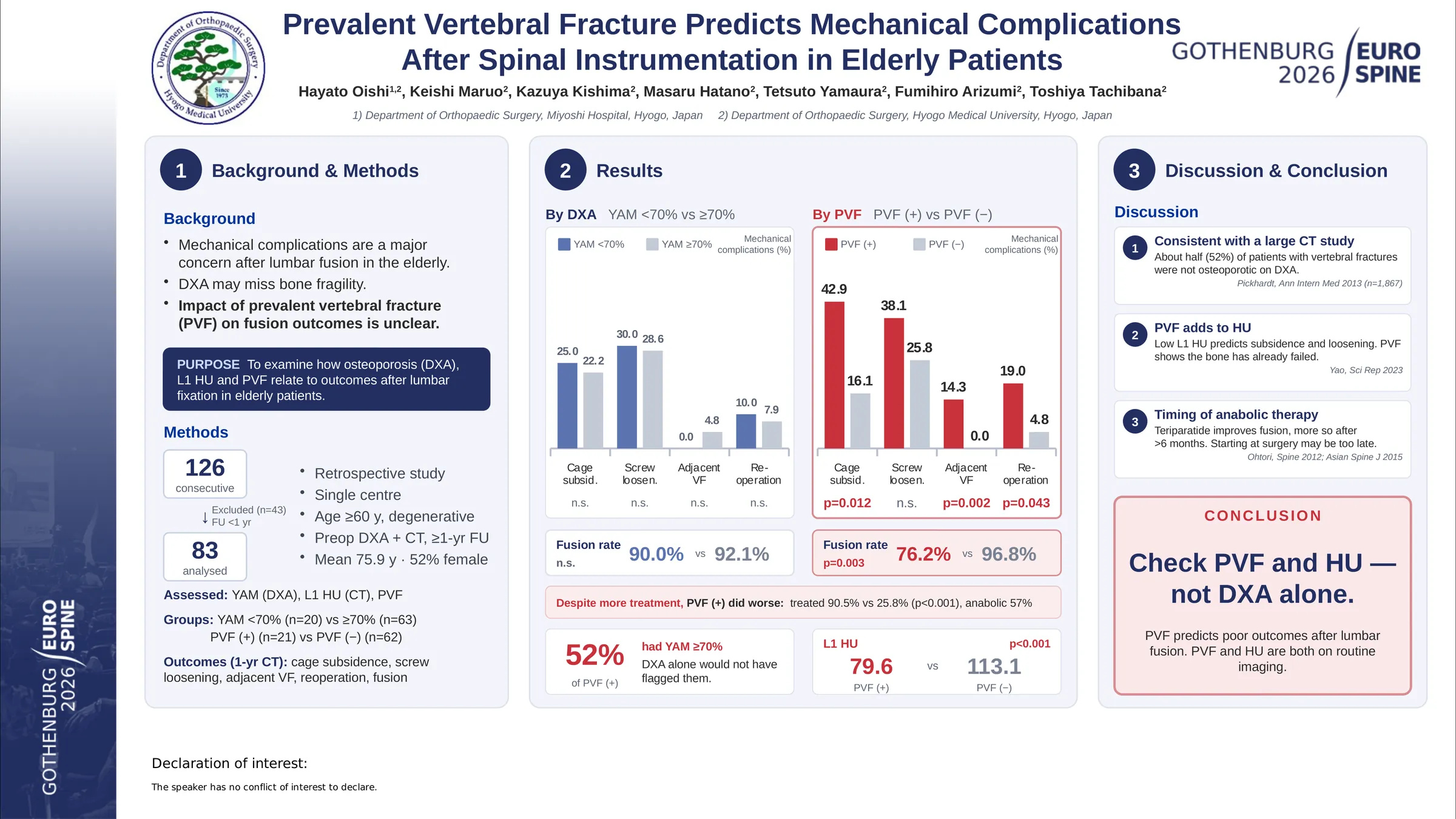
The number of spinal instrumentation performed in elderly patients has increased substantially in recent years. However, mechanical complications such as cage subsidence, screw loosening, adjacent vertebral fracture (VF), and nonunion remain major concerns. Preoperative bone quality assessment using dual-energy X-ray absorptiometry (DXA) is widely used as a screening tool for osteoporosis (OP). In addition, recent studies have indicated that prevalent vertebral fracture (PVF) is an independent risk factor for subsequent fractures. Nevertheless, the impact of PVF on postoperative outcomes following lumbar instrumentation remains unclear. The purpose of this study was to investigate the influence of osteoporosis and PVF on surgical outcomes after lumbar spinal fixation in elderly patients.
We retrospectively reviewed 126 consecutive patients aged ≥60 years who underwent lumbar spinal instrumentation for degenerative disease at our institution after September 2021. Among them, 83 patients (mean age 75.9 years; 52% female) who underwent preoperative DXA and had at least 1-year follow-up were included. Patient-related factors (age, sex, L1 Hounsfield unit [HU] value, presence of PVF, and osteoporosis treatment) and postoperative outcomes (cage subsidence, screw loosening, reoperation, adjacent vertebral fracture, and fusion rate) were evaluated. Patients were categorized into an osteoporosis group (OP; YAM <70%) and a non-OP group. Outcomes were also compared according to the presence or absence of PVF.
OP (YAM <70%) was identified in 24% of patients. The OP group showed significantly lower L1 HU values (71.5 vs. 113.9, p<0.01), a higher had PVF (48% vs. 15%, p=0.014), and greater use of anabolic agents (62% vs. 13%, p<0.01) compared with the non-OP group. No significant differences were observed between OP and non-OP groups in postoperative mechanical complications or fusion rates.
PVFs were observed in 25% of patients, of whom 52% had YAM ≥70%. Patients with PVF had significantly higher rates of cage subsidence (43% vs. 16%, p=0.01), reoperation (19% vs. 5%, p=0.04), and adjacent VF (14% vs. 0%, p<0.01), as well as a significantly lower fusion rate (76% vs. 97%, p<0.01). Among patients with PVF, 57% received anabolic agents. Of the seven reoperations, three were due to adjacent VFs; two of these patients had been treated with bisphosphonates.
Patients with PVF was strongly associated with mechanical complications, nonunion, and reoperation after spinal instrumentation. Notably, nearly half of patients with PVFs had YAM ≥70%, suggesting that DXA alone may underestimate bone fragility. PVF should therefore be considered an important risk factor independent of DXA-based osteoporosis when planning spinal instrumentation in elderly patients.