
Tumours & Infection
Local Antibiotic Delivery Using Absorbable Calcium Sulphate Beads in Paediatric Spinal Surgery: Early Outcomes from a Tertiary Spinal Centre
- Evelina London Children's Hospital, London, United Kingdom
Abstract
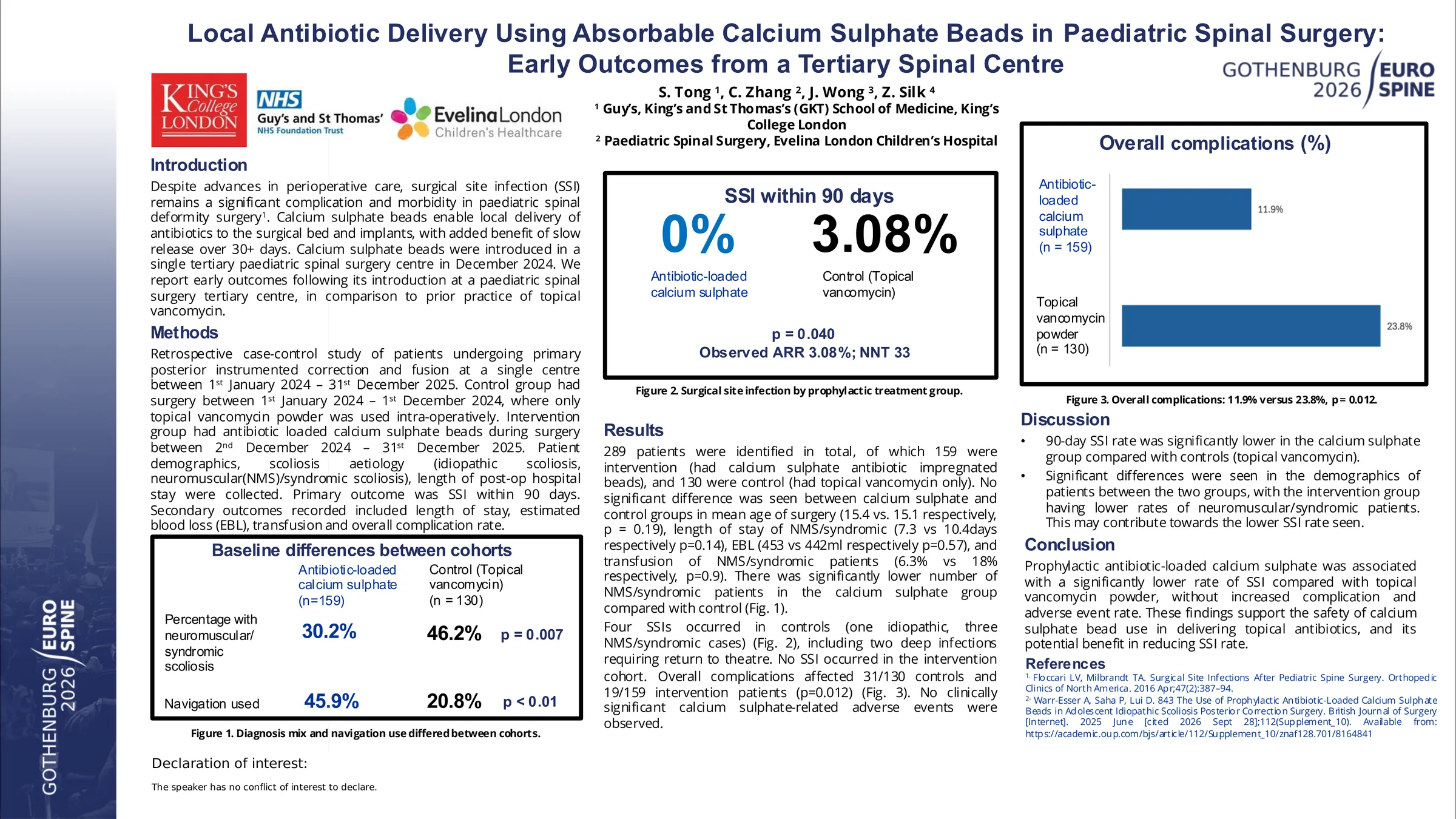
Despite advances in peri-operative care, surgical site infection (SSI) remains a significant complication in paediatric spinal deformity surgery. Antibiotic-loaded calcium sulphate enables high local antibiotic concentrations without need for removal and, unlike topical powder, offers sustained drug-elution. Although increasingly used in orthopaedics, evidence in paediatric spinal deformity surgery remains limited. We report early outcomes following its introduction at a tertiary centre.
Retrospective comparative cohort study of consecutive patients undergoing primary posterior instrumented correction and fusion for spinal deformity between 1 January 2024 and 31 December 2025. Prophylactic antibiotic-loaded calcium sulphate was introduced in December 2024, creating two cohorts: topical antibiotic powder (control, n=130) and calcium sulphate (intervention, n=159). Minimum follow-up was 90 days.
In the intervention group, beads were most commonly loaded with 500mg vancomycin plus 120mg gentamicin (140/159 cases). Controls received 1g topical vancomycin powder. Other infection prevention measures were unchanged. Primary outcome was SSI rate. Secondary outcomes included return to theatre for wound complications, overall complications (Clavien–Dindo), transfusion, and adverse events.
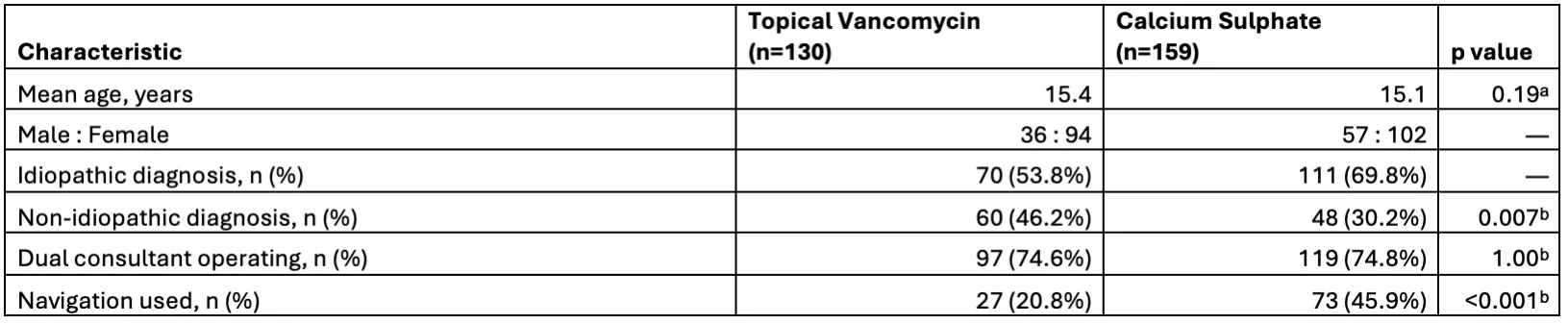
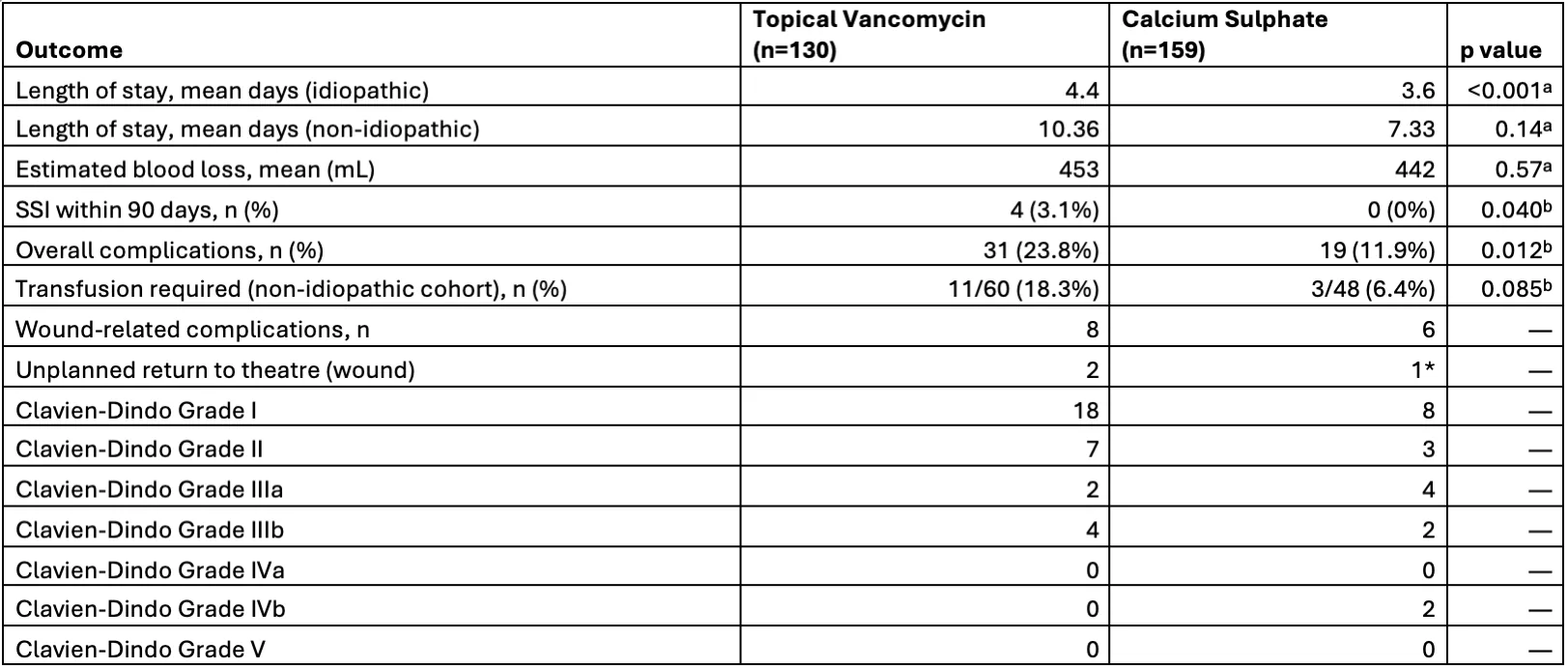
Baseline characteristics are summarised in Table 1. Mean age was similar (15.4 vs 15.1 years; p=0.19). The control cohort included a higher proportion of non-idiopathic diagnoses (46.2% vs 30.2%; p=0.007). Navigation use was more frequent in the calcium sulphate group (45.9% vs 20.8%; p<0.001), while dual consultant operating rates were comparable (p=1.00). Outcomes are detailed in Table 2. No SSIs occurred in the calcium sulphate cohort, compared with four in controls (3.1%), including two deep infections requiring return to theatre (absolute risk reduction 3.08%; number needed to treat 33; p=0.040). Overall complications were lower with calcium sulphate (11.9% vs 23.8%; p=0.012). Estimated blood loss was similar (p=0.57). Transfusion rates in non-idiopathic patients was 18.3% vs 6.3% (p=0.085). Length of stay was shorter in idiopathic patients (3.6 vs 4.4 days; p<0.001), with no difference in the non-idiopathic cohort (p=0.14). No clinically significant calcium sulphate-related adverse events were observed.
In this retrospective single-centre cohort, prophylactic antibiotic-loaded calcium sulphate was associated with a statistically significant reduction in SSI compared with topical vancomycin powder, without increased clinically significant wound or systemic complications. Although differences in case mix and follow-up limit definitive conclusions, these findings support further prospective evaluation of local antibiotic delivery carriers in paediatric spinal deformity patients.
Figures and tables
As submitted with the abstract. Tap a figure to open it at full size.