
Growing Spine
Long-term outcomes 5-15 years after posterior spinal fusion with segmental pedicle screw instrumentation for adolescent idiopathic scoliosis: A retrospective cohort study
- Aalborg University Hospital, Aalborg, Denmark
Abstract
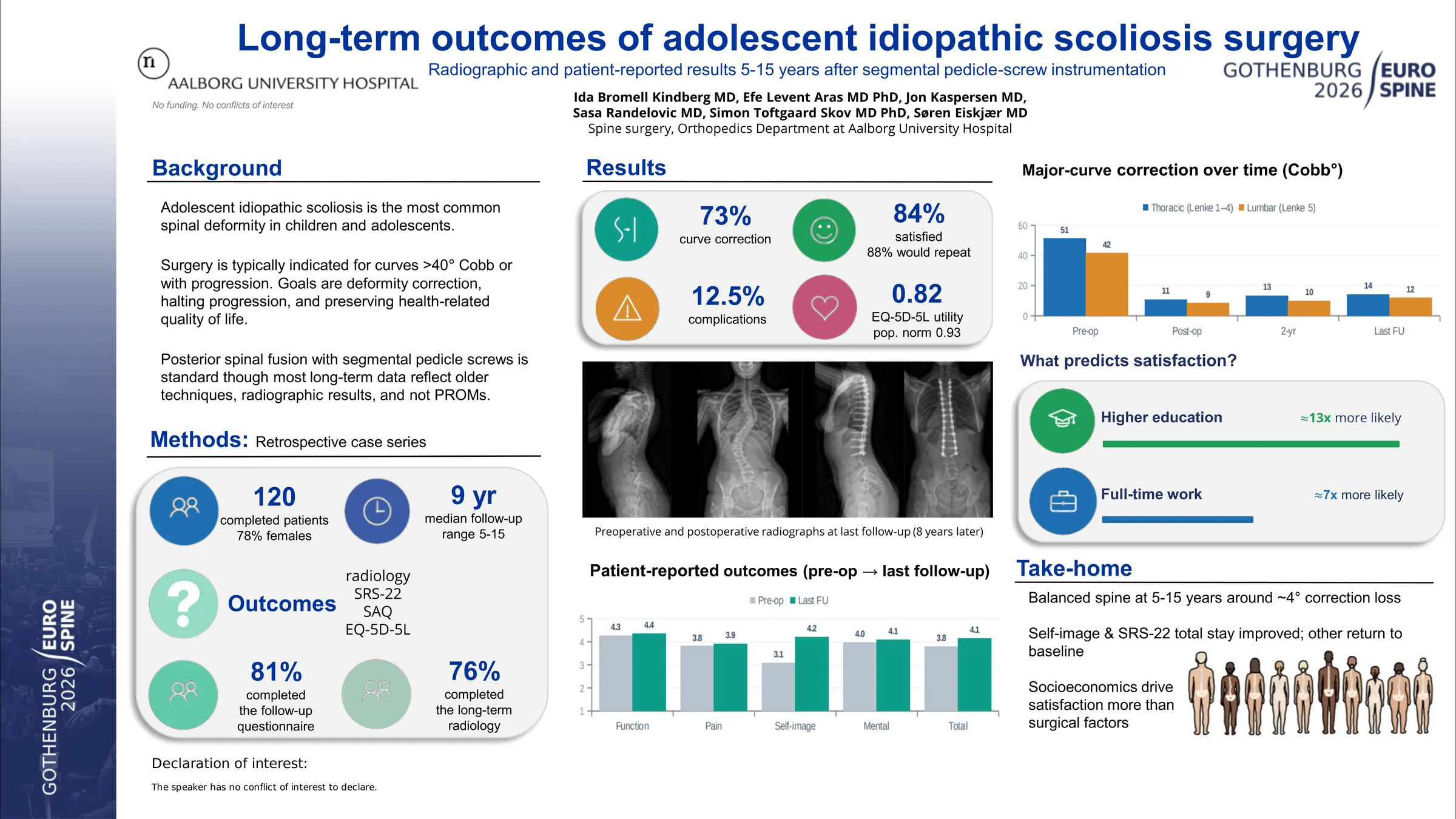
The long-term outcomes after adolescent idiopathic scoliosis (AIS) surgery using segmental pedicle screw constructs are sparsely reported. This limits the ability to counsel patients and families regarding expected long-term prognosis. The primary aim was to evaluate the long-term radiographic and patient reported outcome measures (PROM) after posterior spinal fusion for AIS and to identify predictors of patient satisfaction.
The study design was a retrospective single center cohort study with data for both PROMs and radiological variables 5 to 15 years after AIS surgery.
Consecutive AIS patients aged 11–21 years who underwent posterior spinal fusion between 2009 and 2020 were identified through the hospital registry. Long-term PROMs were collected electronically using SRS-22 and EQ-5D-5L. Preoperative PROMs were retrieved from the national spine registry. Radiographic parameters were assessed preoperatively, postoperatively, and at final follow-up. Multivariable logistic regression was performed to identify predictors of satisfaction at long-term follow-up.
Of 148 eligible patients, 120 (81%) completed long-term PROM assessment and 112 (76%) attended radiographic follow-up (median 9 years). The overall complication rate was 12.5%. Mean major curve correction was 78% postoperatively, with an average loss of approximately 4° at final follow-up. SRS-22 self-image and total scores and EQ-5D utility scores were significantly improved compared with preoperative values. At long-term follow-up, 84% of patients reported being satisfied or very satisfied with surgical results. Socioeconomic variables, Lenke type 2 curves, and number of instrumented levels were independent predictors of satisfaction (AUC 0.85).
Posterior spinal fusion with segmental pedicle screw instrumentation for AIS provides durable radiographic correction and sustained improvement in patient-reported outcomes at up to 15 years. Long-term satisfaction is influenced not only by surgical factors but also by socioeconomic variables.