
Complications & Epidemiology
Predictive Value of the 5-Item Modified Frailty Index in High-Complexity Thoracolumbar Spine Surgery
- Hospital Italiano de Buenos Aires, Buenos Aires, Argentina
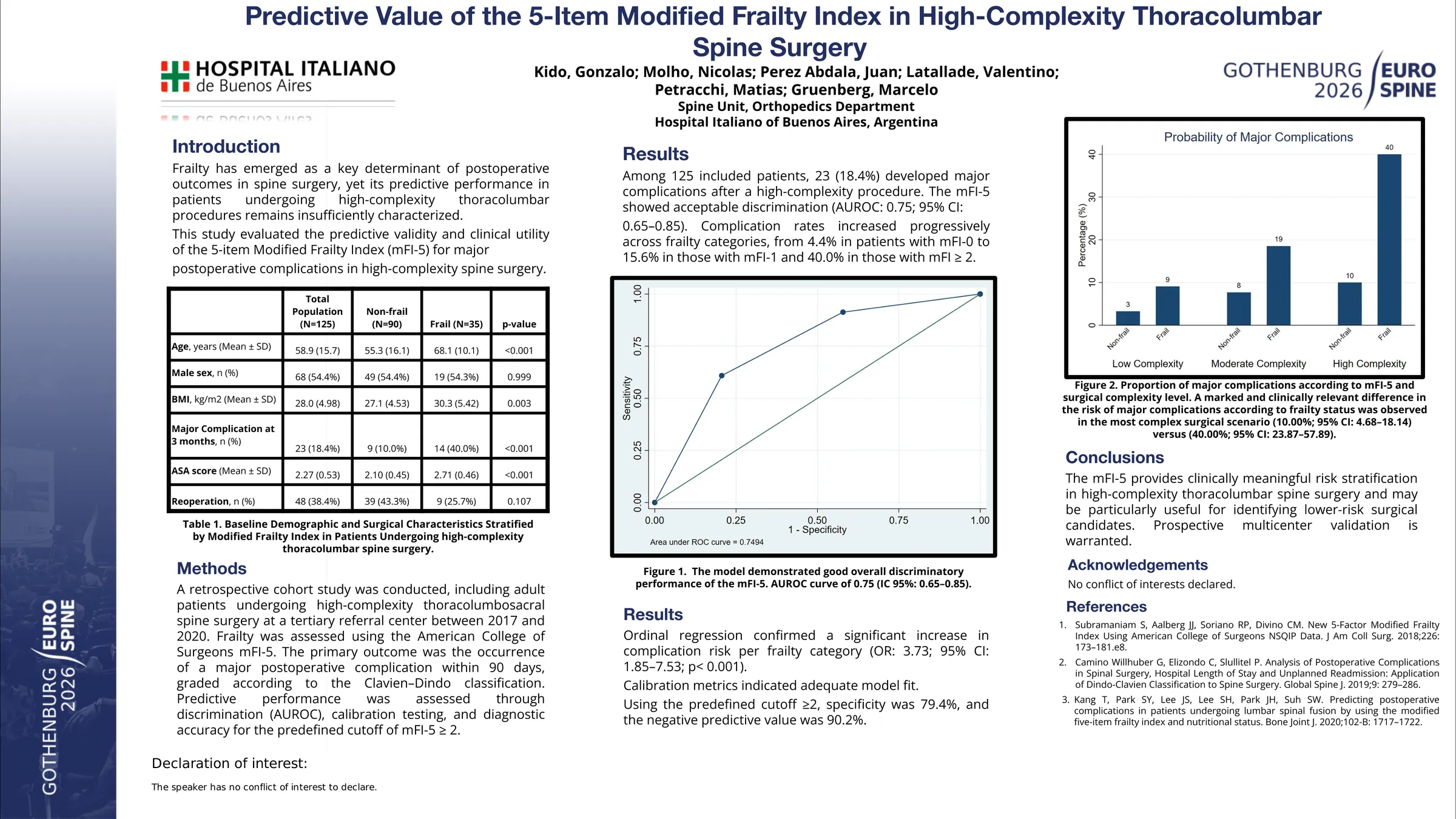
Abstract
Frailty has emerged as a key determinant of postoperative outcomes in spine surgery, yet its predictive performance in patients undergoing high-complexity thoracolumbar procedures remains insufficiently characterized. This study evaluated the predictive validity and clinical utility of the 5-item Modified Frailty Index (mFI-5) for major postoperative complications in high-complexity spine surgery.
A retrospective cohort study was conducted, including adult patients undergoing high-complexity thoracolumbosacral spine surgery at a tertiary referral center between 2017 and 2020. Frailty was assessed using the American College of Surgeons mFI-5. The primary outcome was the occurrence of a major postoperative complication within 90 days, graded according to the Clavien–Dindo classification. Surgical complexity was classified based on procedural invasiveness and technical demands. Predictive performance was assessed through discrimination (AUROC), calibration testing, and diagnostic accuracy for the predefined cutoff of mFI-5 ≥ 2.
Among 125 included patients, 23 (18.4%) developed major complications after a high-complexity procedure. The mFI-5 showed acceptable discrimination (AUROC: 0.75; 95% CI: 0.65–0.85). Complication rates increased progressively across frailty categories, from 4.4% in patients with mFI-0 to 15.6% in those with mFI-1 and 40.0% in those with mFI ≥ 2. Ordinal regression confirmed a significant increase in complication risk per frailty category (OR: 3.73; 95% CI: 1.85–7.53; p < 0.001). Calibration metrics indicated adequate model fit. Using the predefined cutoff ≥2, specificity was 79.4%, and the negative predictive value was 90.2%
The mFI-5 provides clinically meaningful risk stratification in high-complexity thoracolumbar spine surgery and may be particularly useful for identifying lower-risk surgical candidates. Prospective multicenter validation is warranted.