
Basic Science & Economics
Interdependence of Body Mass Index and Skeletal Muscle Index in Predicting Gravitational Spinal Instability in Adolescent Idiopathic Scoliosis
- Daejeon Eulji University Medical Center, Daejeon, Korea, Republic of
- Gangnam severance Hospital, Seoul, Korea, Republic of
Abstract
This study aimed to evaluate the impact of Body Mass Index (BMI) and Skeletal Muscle Index (SMI) on gravitational spinal instability—defined as the change in Cobb angle between standing and supine positions—in patients with adolescent idiopathic scoliosis (AIS). Specifically, we investigated to determine whether these indices function as independent predictors of the postural change in Cobb angle or if their influences are fundamentally interdependent.
A total of 84 patients diagnosed with AIS were enrolled. Gravitational instability was quantified by calculating the difference in Cobb angle ( Cobb) obtained from standing and supine radiographs. Body composition, including SMI and absolute skeletal muscle mass (SMM), was assessed via bioelectrical impedance analysis (Inbody®). The relationships between Cobb, BMI, SMI and SMM were analyzed using Pearson’s correlation, partial correlation, and multivariable linear regression analysis.
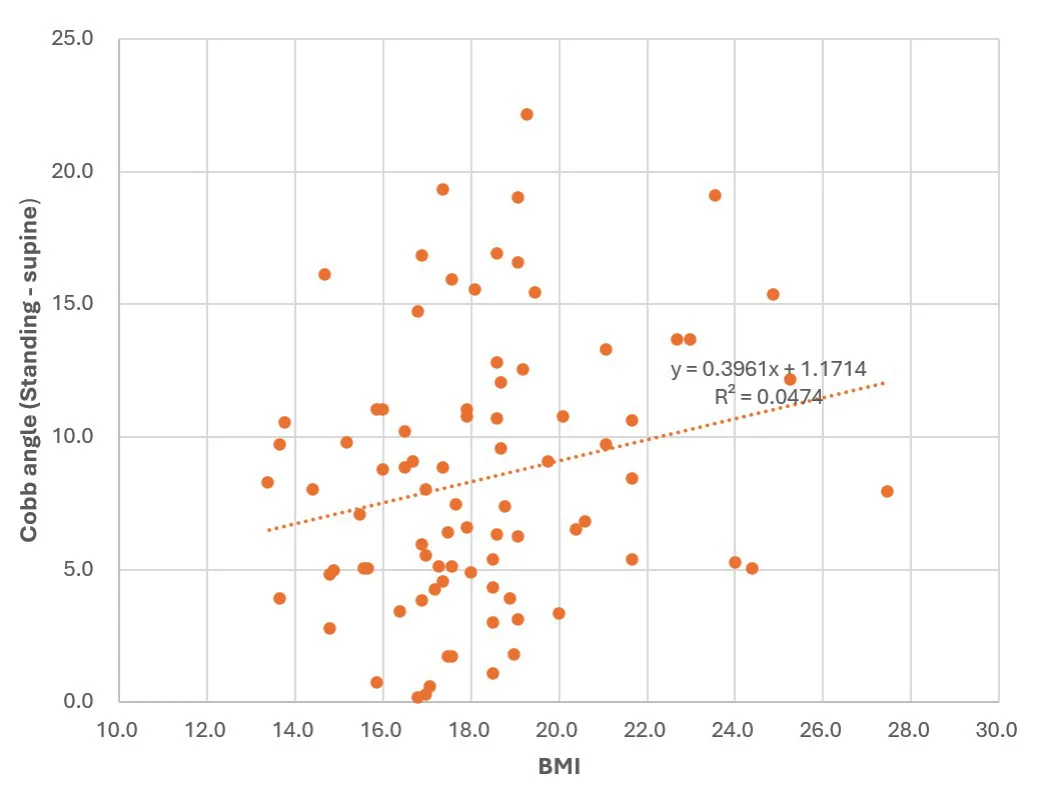
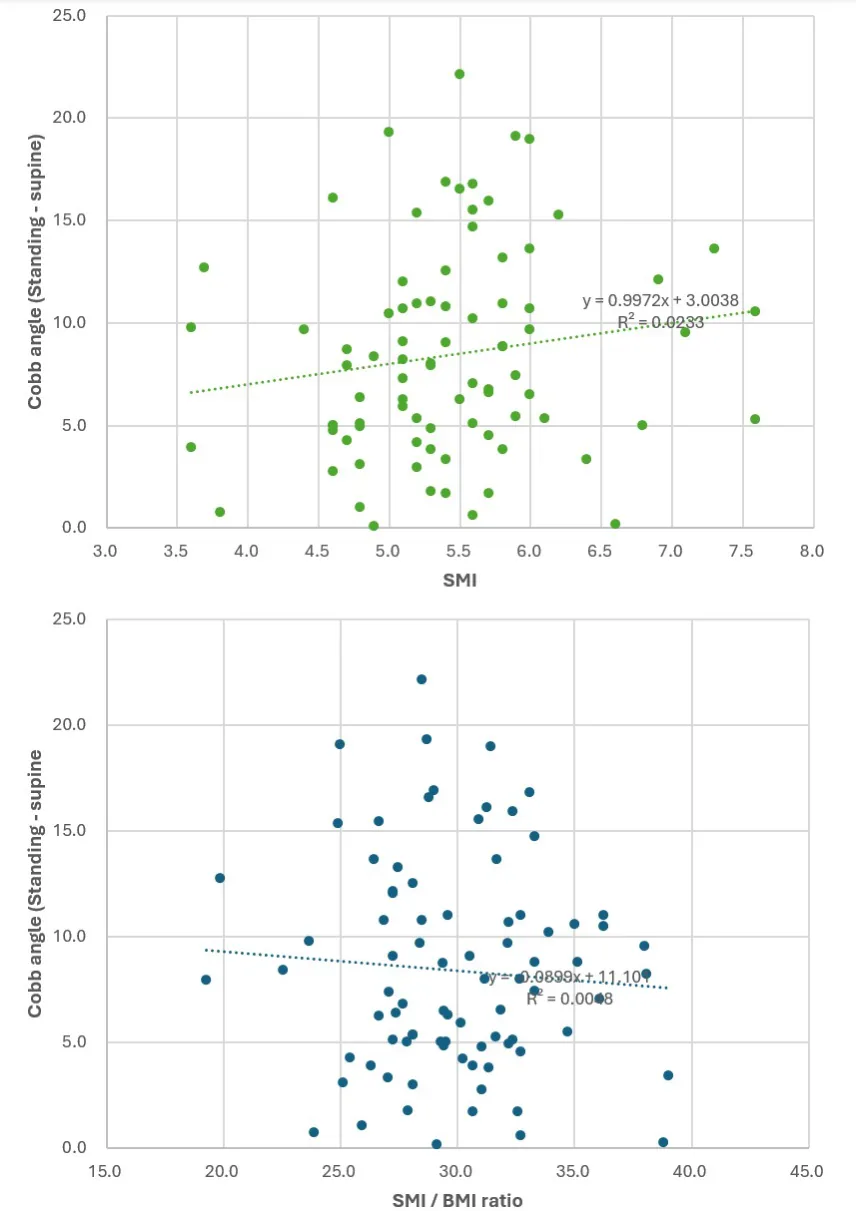
The mean age of the patients was 13.2 ± 1.8 years (range, 8–17 years), with a median Risser stage of 2.8 (range, 0–4). Univariate analysis revealed that BMI was significantly correlated with Cobb angle (r = 0.218, p < 0.05), suggesting that overall body habitus is a factor in gravitational spinal changes. In contrast, SMI nor SMM showed no statistically significant correlation with Cobb angle (r = 0.204 and r = 0.126, respectively; p > 0.05). Interestingly, the SMI/BMI ratio exhibited a weak negative trend (r = -0.069, p > 0.05), though it did not reach the threshold for significance. Crucially, partial correlation analysis revealed that the initial significance of BMI was lost when controlling for SMI and SMM (p > 0.05). Similarly, muscle indices showed no independent association with spinal instability once adjusted for BMI (p > 0.05).
These findings point to a strong collinearity between BMI and muscularity, indicating that neither parameter serves as a standalone predictor of spinal instability in this cohort. The univariate correlation of BMI appears to be a confounded reflection of the combined influence of total body mass and muscle distribution, rather than representing an independent mechanical factor. Those factors interplay between total body habitus (load) and muscular support (stabilizer). Notably, the inverse trend observed between the SMI/BMI ratio and Cobb angle points toward a potential protective effect of higher relative muscle mass against gravitational collapse. These findings highlight the "load-to-support" balance as a critical determinant of spinal stability. Consequently, our findings suggest that clinical evaluation of AIS may benefit from moving beyond simple metrics like BMI. Exploring integrated indices could provide a more comprehensive reflection of the complex biomechanical profiles.
Figures and tables
As submitted with the abstract. Tap a figure to open it at full size.