Adult Deformity
Assessment of Contemporary Radiographic Markers to Predict Pre-Operative Disability in Adult Spinal Deformity Patient
- The University Of Oklahoma Health Sciences Center, Oklahoma City, United States of America
- Keck Medicine of USC, Los Angeles, United States of America
Abstract
Several radiographic metrics of sagittal alignment have been proposed and have been correlated with pre-operative patient reported outcomes (PROMs). Here, we directly compare several such radiographic parameters of sagittal alignment to identify which parameter is the best predictor of pre-operative disability in spinal deformity patients.
96 ASD patients were included in our single center study. Each patient completed the Oswestry Deformity Index (ODI), Scoliosis Research Form 22 (SRS-22) and spinal imaging with standing full-length X-Rays. The following radiographic parameters were collected: PI-LL (pelvic incidence – lumbar lordosis), T4-L1PA (absolute value of T4 pelvic angle – L1 pelvic angle), T1PA (T1 pelvic angle), SVA (sagittal vertical axis), expected minus actual L1PA, C2T (C2 tilt angle), and PT (pelvic tilt). We calculated the pairwise Pearson correlation coefficient between the radiographic measurements and SRS-22, ODI, and PCA score. Lastly, we used logistic regression modeling of severe disability (ODI > 40%)- with each single radiographic parameter and all 7 parameters with covariates of age, height, body mass index, and gender.
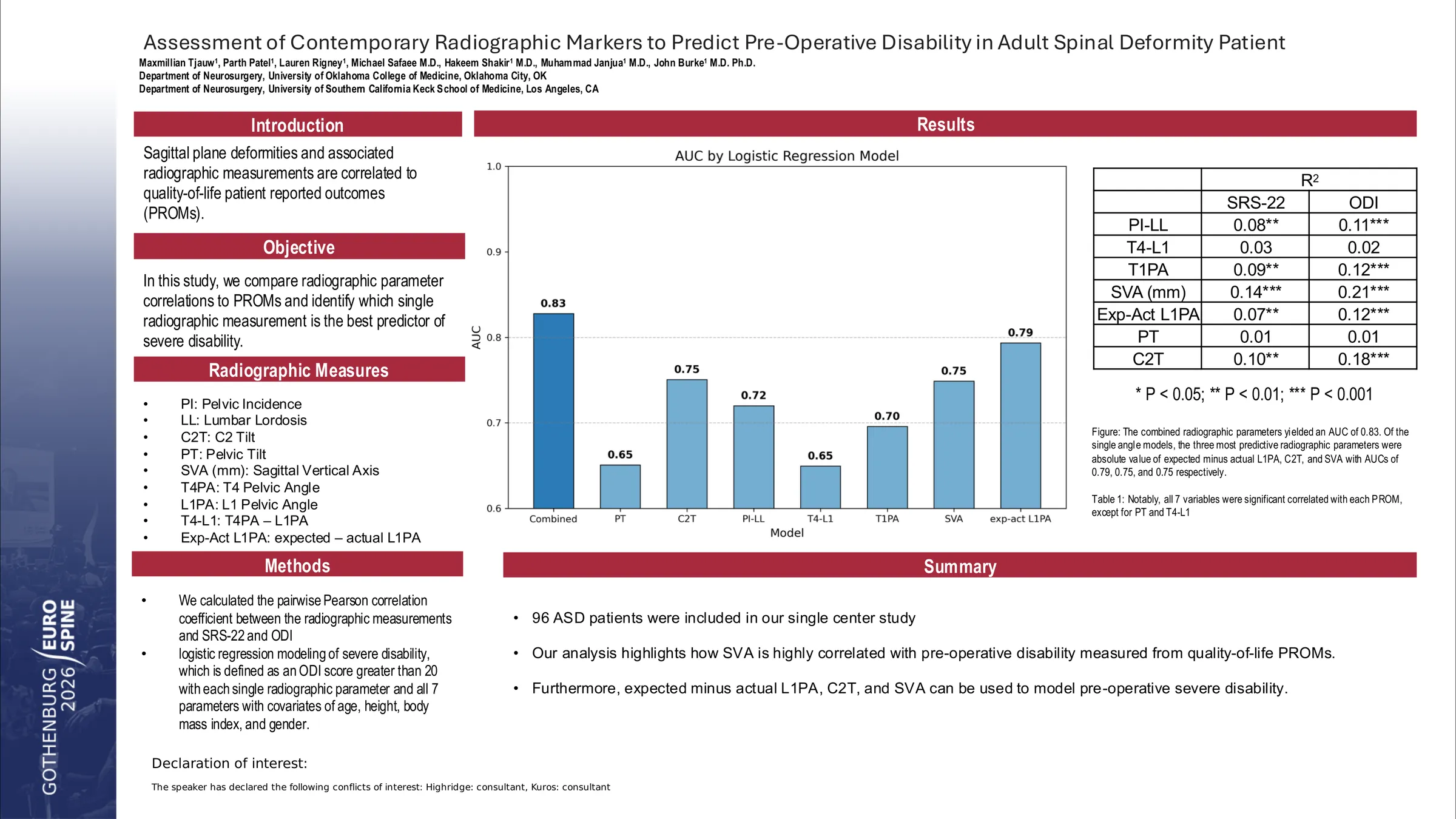
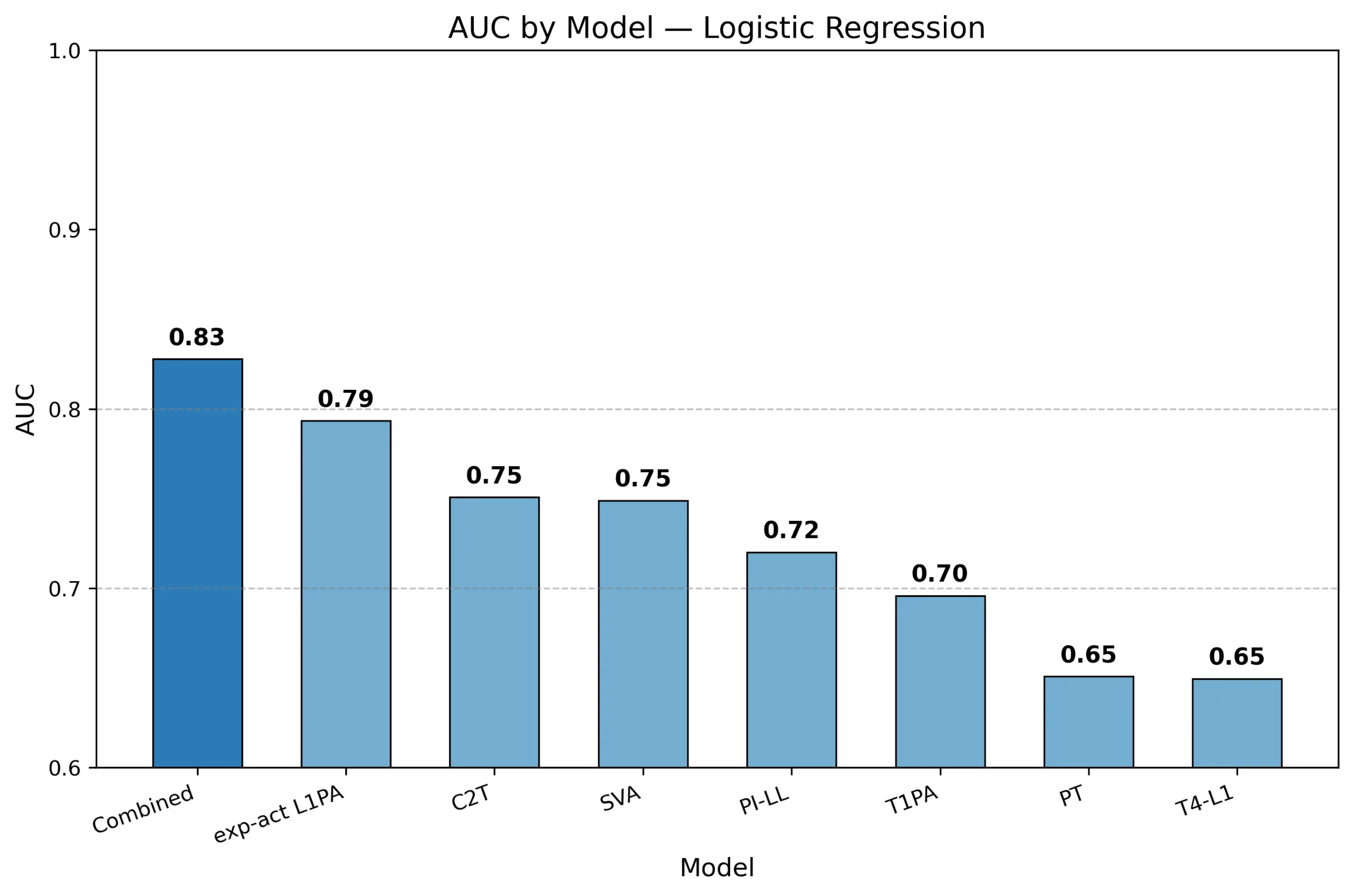
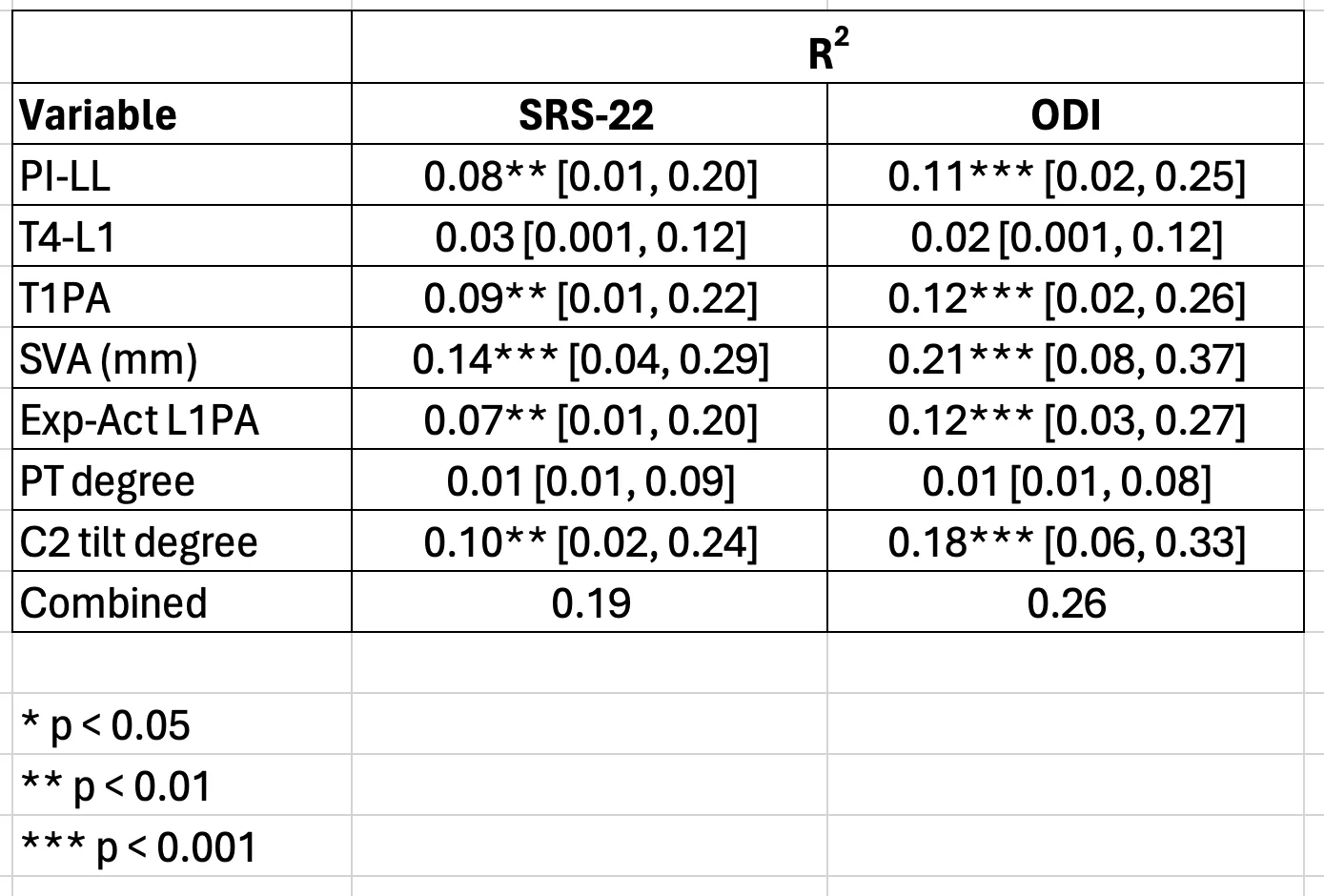
The pairwise correlation between the 7 radiographic parameters and pre-operative PROMs are reported in Figure 1. Notably, all 7 variables were significantly correlated with ODI and SRS-22, except for PT and T4-L1PA. The multivariate logistic regression model using each parameter (and the combined model with all parameters) is reported in Figure 2. The combined radiographic parameters yielded an AUC of 0.83. Of the single parameter models, the three most predictive radiographic parameters were the expected minus actual L1PA, C2T, and SVA with AUCs of 0.79, 0.75, and 0.75 respectively.
Although most metrics individually correlate with pre-operative PROMs, the combined predictive power of all variables is superior to any one variable alone. Of the radiographic sagittal alignment parameters, deviation from the expected value of L1PA was most correlated with disability. Future research is needed to assess how these parameters can be used to classify deformity types and severities.
Figures and tables
As submitted with the abstract. Tap a figure to open it at full size.