
Trauma
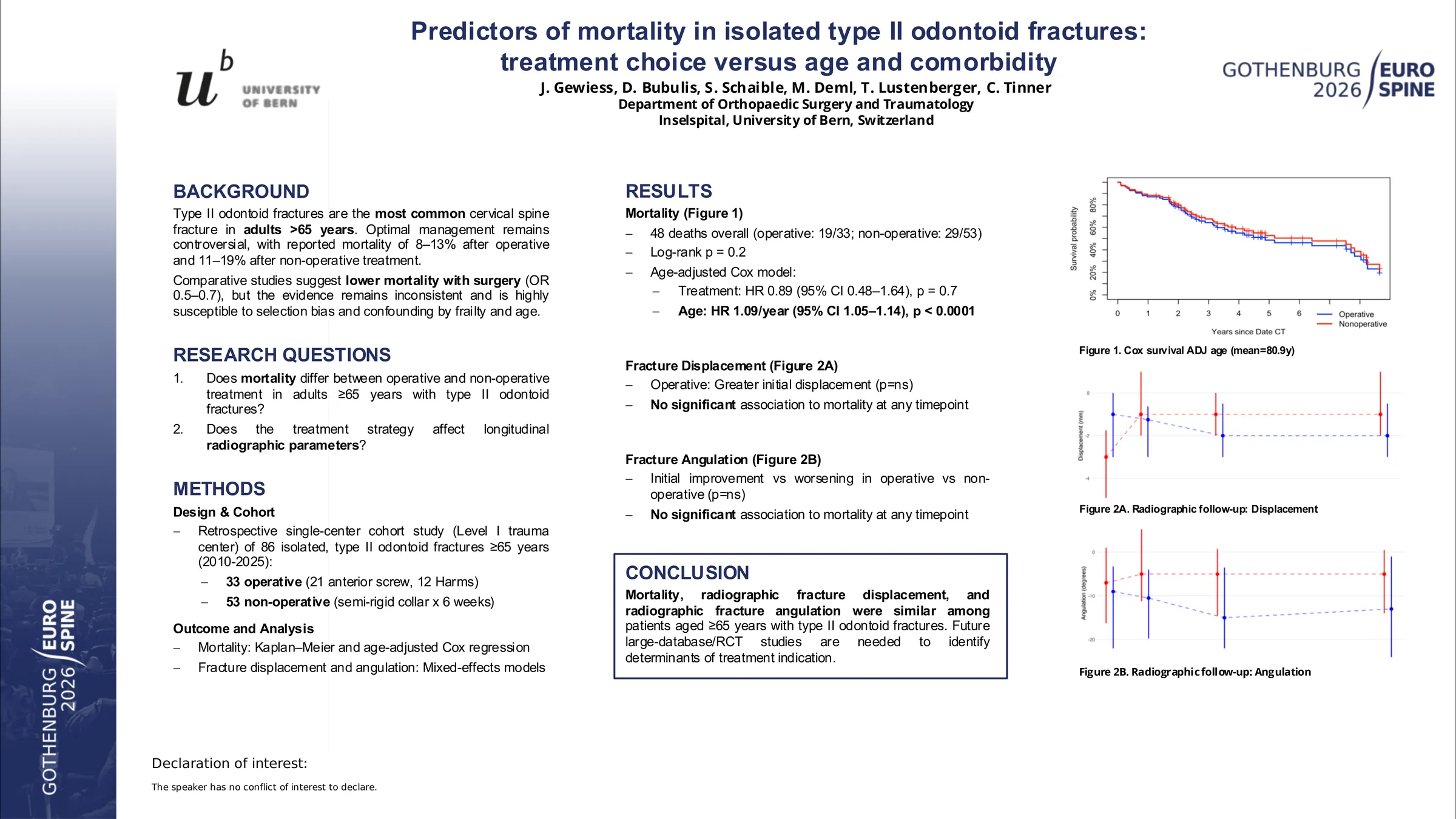
Predictors of mortality in isolated type II odontoid fractures: treatment choice versus age and comorbidity
- Inselspital, Bern, Switzerland
Abstract
Elevated mortality rates have been reported following nonoperative management of Type II odontoid fractures in older adults. However, treatment selection is often influenced by patient age and medical complexity, which may confound comparisons of outcomes. This study aimed to compare age and comorbidity burden between operative and nonoperative patients older than 65 years with isolated Type II odontoid fractures and to determine how these factors are associated with mortality.
We conducted a retrospective cohort study of 86 patients (33 operative, 53 nonoperative) aged >65 years with Anderson & D'Alonzo Type II odontoid fractures treated at a Level 1 trauma center between 2010–2025. Nonoperative management consisted of rigid cervical collar immobilization for 6 weeks, and operative stabilization included anterior odontoid screw fixation or posterior C1–C2 fusion. Frailty and comorbidity burden were assessed using the Charlson Comorbidity Index (CCI) and Elixhauser Comorbidity Index (ECI). Mortality was determined through electronic medical records linked to social security numbers, with follow-up through February 2026. Kaplan–Meier survival analysis and Cox proportional hazards models were used to compare mortality between groups, including age-adjusted analyses. Baseline CT parameters were evaluated for associations with mortality at prespecified timepoints.
Median age was 82.3 years (IQR 74-87), with operative patients significantly younger (75 vs 82 years, p<0.01). Comorbidity indices were similar between groups (CCI p>0.1, ECI p>0.5). During follow-up, 48 deaths occurred. Kaplan-Meier analysis revealed no statistically significant difference in survival between operative and nonoperative management (log-rank p>0.3). No baseline CT parameters showed significant associations with mortality at 1-month, 3-month, 6-month, 1-year, or 2-year timepoints after multiple testing correction.
Among older adults with isolated Type II odontoid fractures, operative treatment was more frequently performed in younger patients, while comorbidity burden was similar across groups. After adjustment for age, mortality did not differ between operative and nonoperative management. These findings suggest that survival in this population is driven primarily by patient age rather than treatment modality.