
Degenerative Thoracolumbar
Paraspinal Musculature and Adjacent Segment Disease After Lumbar Fusion: A systematic review and meta-analysis of fusion with and without posterior instrumentation
- The Mater Misericordiae University Hospital, Dublin, Ireland
- The Mater Misericordiae University Hospital, Pune, Ireland
Abstract
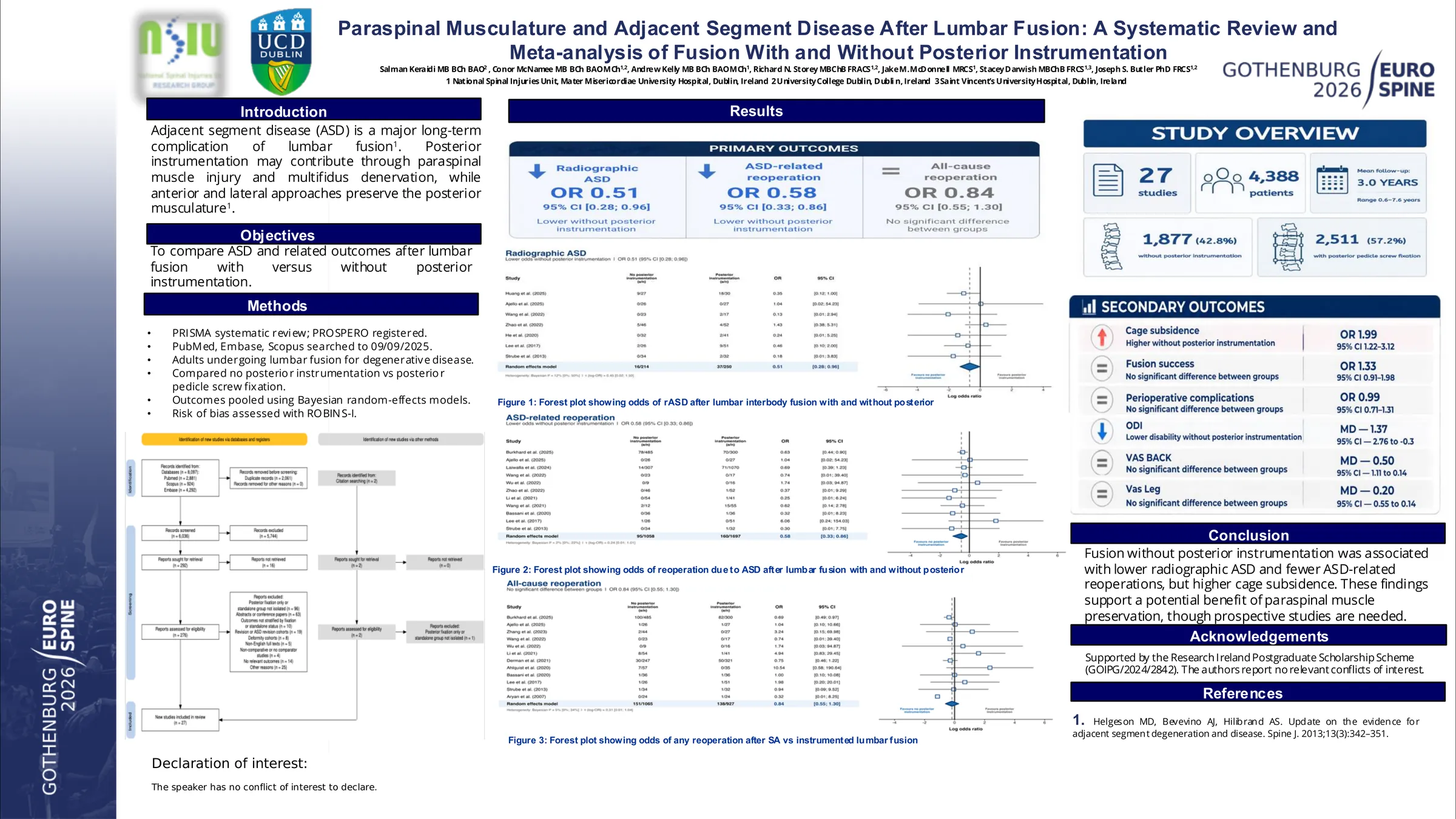
Adjacent segment disease (ASD) is the principal long term complication following lumbar fusion and contributes to pain, disability, and revision surgery. Posterior exposure may injure the paraspinal musculature and promote ASD, whereas anterior, oblique, and lateral interbody approaches avoid posterior dissection and may mitigate this risk. This study compared rates of radiographic ASD (rASD), ASD related reoperation, and secondary outcomes including fusion success, cage subsidence, and patient reported outcomes between standalone anterior, oblique, or lateral interbody fusion (ALIF, OLIF, LLIF/XLIF) and posteriorly instrumented fusion.
This was designed as a systematic review and Bayesian meta analysis of comparative studies including adults aged 18 years or older undergoing lumbar fusion for degenerative pathology. Primary outcomes were radiographic ASD, ASD reoperation, and all cause reoperation. Secondary outcomes included fusion success, cage subsidence, perioperative complications, and patient reported outcomes including Oswestry Disability Index and VAS back and leg pain scores. PubMed, Embase, and Scopus were searched on 09/09/2025 per PRISMA guidelines (PROSPERO CRD420251115394). Comparative studies of standalone versus posterior instrumentation were included. Data extraction and ROBINS I assessment were performed independently by two reviewers. Bayesian random effects models were used for all outcomes, with binomial models for binary and normal likelihoods for continuous outcomes. Analyses were conducted in Python.
Twenty-seven studies (4,388 patients: 1,877 no posterior instrumentation; 2,511 posterior instrumented) met inclusion criteria. Standalone fusion was most commonly ALIF (8 studies), followed by OLIF (6) and LLIF/XLIF (4). Fusion without posterior instrumentation was associated with a significantly lower odds of rASD (OR 0.51, 95%CI 0.28–0.96) and reoperation for ASD (OR 0.58, 95%CI 0.33; 0.86). There was no difference in all-cause reoperation (OR 0.84, 95%CI 0.55–1.30), fusion success (OR 1.33, 95%CI 0.91; 1.98), or perioperative complications (OR 0.99, 95%CI 0.71–1.31). Standalone fusion had higher odds of cage subsidence (OR 1.99, 95%CI 1.22; 3.12). ODI scores were significantly lower (MD -1.37, 95%CI -2.76; -0.03), while VAS back and leg scores did not differ significantly between groups.
Standalone anterior, oblique, and lateral lumbar fusions are associated with reduced rates of ASD and ASD related reoperation compared with posteriorly instrumented fusions. This supports the hypothesis that preservation of the paraspinal musculature mitigates adjacent segment degeneration. Despite higher subsidence, fusion rates and functional outcomes are comparable. Prospective randomised trials are needed to confirm causality.