Tumours & Infection
Cement-augmented pedicle screws reduce screw loosening in elderly patients with osteoporosis undergoing instrumented fusion for pyogenic vertebral osteomyelitis
- Hyogo Medical University, Nishinomiya, Japan
- Hyogo Medical University, Takarazuka, Japan
- Hyogo Medical University, Mukogawa-cho, Nishinomiya, Japan
Abstract
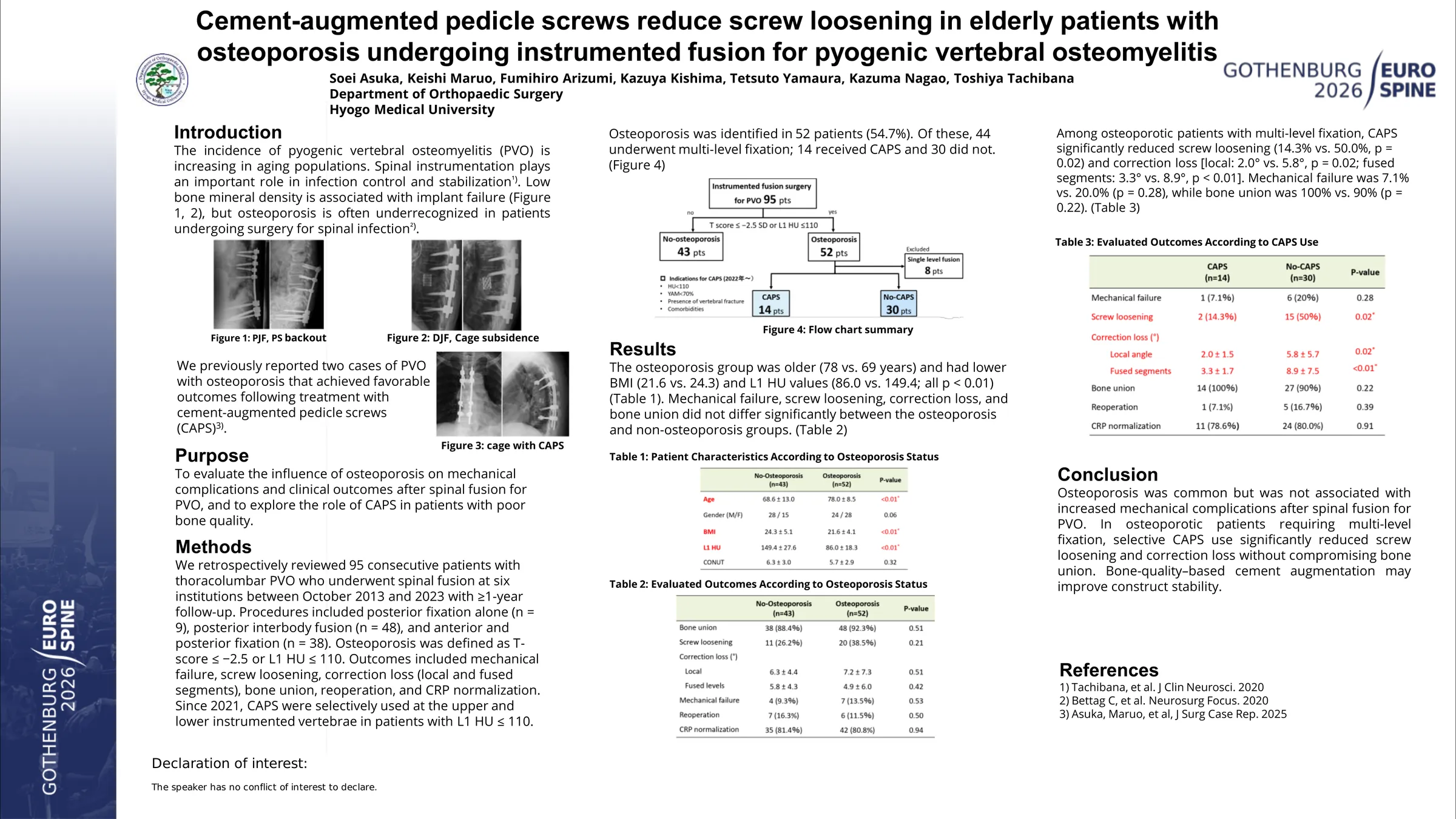
The incidence of pyogenic vertebral osteomyelitis (PVO) is increasing in aging populations. Spinal instrumentation plays a key role in infection control and stabilization, yet osteoporosis is often underdiagnosed in this population. This multicenter retrospective study evaluated the impact of osteoporosis on mechanical complications and clinical outcomes after spinal fusion for PVO, and assessed the role of cement-augmented pedicle screws (CAPS) in patients with poor bone quality.
We retrospectively reviewed 95 consecutive patients who underwent spinal fusion for thoracolumbar PVO at six institutions between October 2013 and 2023 with a minimum 1-year follow-up. A total of 95 patients were enrolled, with a mean age of 73.7 years, and 55% were male. Surgical procedures included posterior fixation alone (n=9), posterior interbody fusion (n=48), and anterior and posterior fixation (n=38). Osteoporosis was defined as either a T score ≤ −2.5 SD or L1 Hounsfield unit (HU) value ≤110. Outcomes compared between osteoporotic and non-osteoporotic groups were mechanical failure, screw loosening, correction loss (local angle and fused segments), and bone union. Since 2021, CAPS were selectively used in patients with L1 HU ≤110. A subgroup analysis was performed within the osteoporosis cohort to compare outcomes between CAPS and non-CAPS cases.
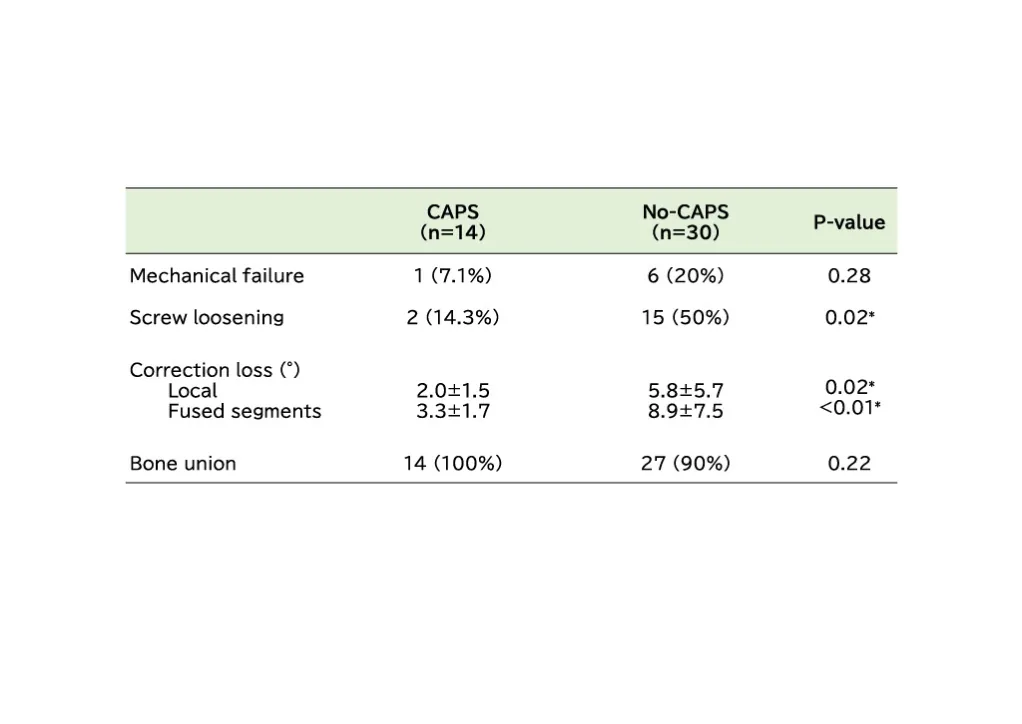
Osteoporosis was identified in 52 patients (54.7%). These patients were significantly older (78 vs. 69 years, p<0.01), had lower BMI (21.6 vs. 24.3, p<0.01), and lower L1 HU (86.0 vs. 149.4, p<0.01). Mechanical failure occurred in 11 patients (12.2%). No significant differences were found between two groups in mechanical failure (13.5% vs.9.3%, p=0.53), screw loosening (38.5% vs. 26.2%, p=0.21), correction loss (local angle and fused segments; 7.2° vs. 6.3°, p=0.51 and 4.9° vs. 5.8°, p=0.42, respectively) and, bone union (92.3% vs. 88.4%, p=0.51). Among 52 osteoporotic patients, 44 underwent multi-level fixation (CAPS 14, no CAPS 30). Screw loosening was significantly lower in the CAPS group (14.3% vs. 50%, p=0.02). Correction loss was smaller in the CAPS group both locally (2.0° vs. 5.8°, p=0.02) and at the fused segment (3.3° vs. 8.9°, p<0.01). Mechanical failure tended to be lower (7.1% vs. 20%, p=0.28), while bone union was comparable (100% vs. 90%, p=0.22).
Osteoporosis was common in patients undergoing fusion for PVO but was not associated with increased mechanical complications. In osteoporotic patients requiring multi-level fixation, selective use of CAPS reduced screw loosening and correction loss, suggesting improved instrumentation stability.
Figures and tables
As submitted with the abstract. Tap a figure to open it at full size.