
Degenerative Thoracolumbar
Pain management and quality of life after surgical treatment of lumbar pain: a prospective cross-sectional study of a single center
- General Hospital of Nikaia "Agios Panteleimon", Nikea, Greece
Abstract
Lumbar pain is a very frequent worldwide problem with significant socioeconomic consequences. Almost 80% of the population is expected to experience it at some point in their lives and the treatment can be conservative, minimally invasive or surgical. Surgery is recommended when there is compression of neural structures or instability and the duration of the symptoms lasts more than 6 weeks or there are neurological deficits. The aim of this study was to investigate the pain management and the health-related quality of life of patients after lumbar spine decompression.
This was a prospective cross-sectional study. The study sample consisted of all patients who underwent discectomy/laminectomy in our neurosurgical clinic. The patients that underwent spinal fusion or reoperation were excluded. Health-related quality of life was assessed with the short health survey questionnaire (SF-12), the back pain was assessed using the Quebec Back Pain Disability Scale (QBPDS) and the patients' functionality was assessed using the TUG test. All the patients followed the same analgesic protocol.
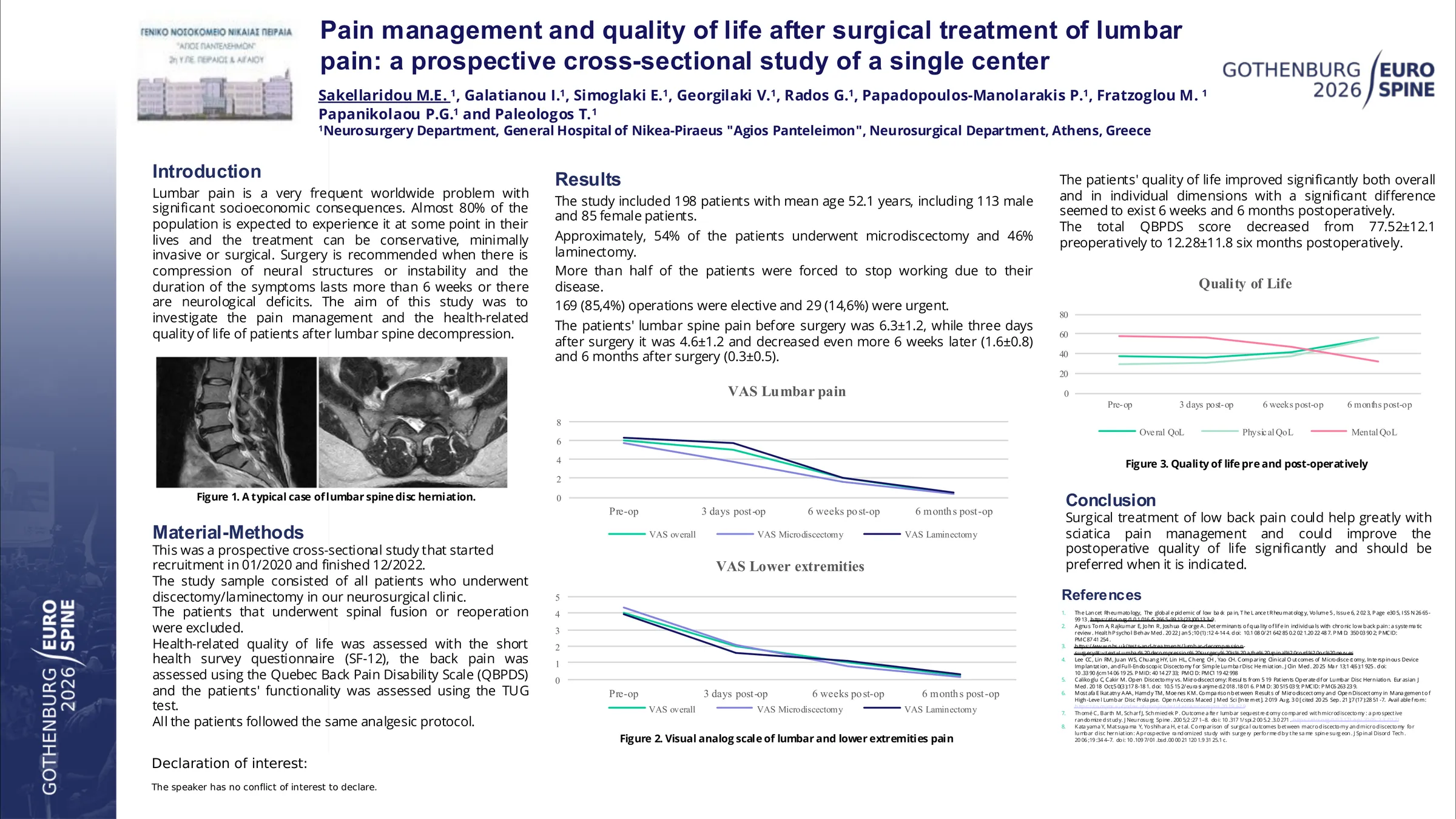
The study included 198 patients with mean age 52.1 years. Approximately, 54% of the patients underwent microdiscectomy and 46% laminectomy. More than half of the patients were forced to stop working due to their disease. The patients' lumbar spine pain before surgery was 6.3±1.2, while three days after surgery it was 4.6±1.2 and decreased even more 6 weeks later (1.6±0.8) and 6 months after surgery (0.3±0.5). The patients' quality of life improved significantly both overall and in individual dimensions with a significant difference seemed to exist 6 weeks and 6 months postoperatively. The total QBPDS score decreased from 77.52±12.1 preoperatively to 12.28±11.8 six months postoperatively.
Surgical treatment of low back pain could help greatly with sciatica pain management and could improve the postoperative quality of life significantly and should be preferred when it is indicated.