
Degenerative Thoracolumbar
MIS-TLIF vs Traditional TLIF: Differences in Clinical and Radiological Outcomes
- Agostino Gemelli University Policlinic, ROMA, Italy
- Catholich University of the Sacred Heart , ROMA, Italy
Abstract
This study compares the efficacy and outcomes of traditional transforaminal lumbar interbody fusion (TLIF) and minimally invasive TLIF (MIS-TLIF) in terms of changes in segmental lordosis, global lumbar lordosis, estimated blood loss, operative time, and clinical outcomes in patients with grade I–II spondylolisthesis.
A retrospective cohort analysis was conducted on 245 patients with grade I–II spondylolisthesis who underwent TLIF (n=147) or MIS-TLIF (n=98), with a minimum follow-up of two years. Demographic data, operative time (OT), estimated blood loss (EBL), postoperative drainage volume (PDV), length of hospital stay (LOS), complications, and radiological and clinical outcomes were assessed. Radiological evaluations included pre- and postoperative measurements of segmental and lumbar lordosis.
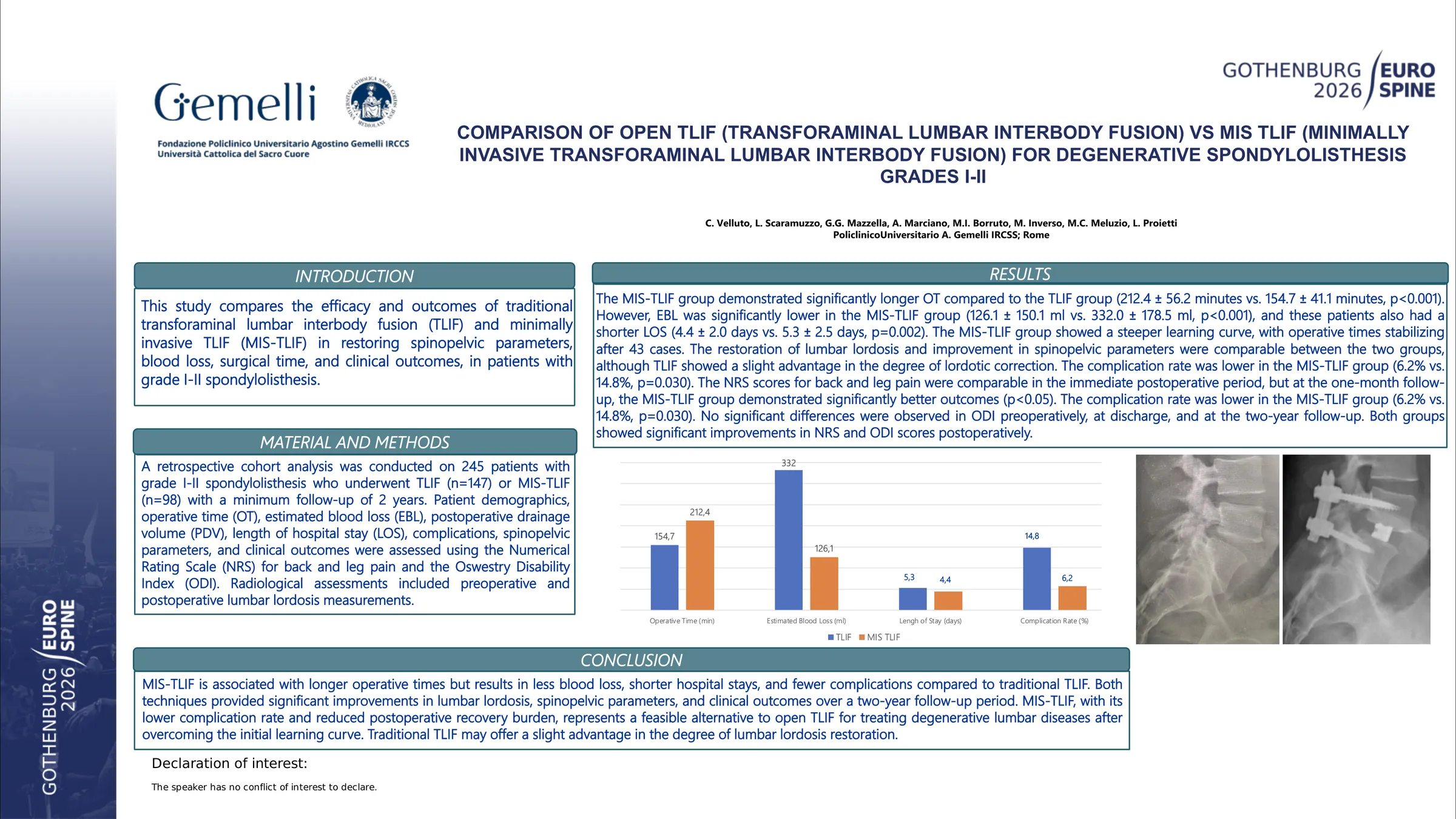
The MIS-TLIF group showed a longer OT compared with the TLIF group (202.4 ± 56.2 minutes vs 154.7 ± 41.1 minutes, p<0.001). However, EBL was significantly lower in the MIS-TLIF group (126.1 ± 150.1 ml vs 332.0 ± 178.5 ml, p<0.001), and these patients also had a shorter LOS (4.4 ± 2.0 days vs 5.3 ± 2.5 days, p=0.002). The MIS-TLIF group demonstrated a steeper learning curve, with operative times stabilizing after 43 cases. Restoration of lumbar lordosis and improvement in spinopelvic parameters were comparable between groups, although TLIF showed a slight advantage in the degree of lordotic correction. The complication rate was lower in the MIS-TLIF group (6.2% vs 14.8%, p=0.030). NRS scores for low back and radicular pain were comparable in the immediate postoperative period, but at one-month follow-up the MIS-TLIF group demonstrated significantly better outcomes (p<0.05). No significant differences in ODI were observed preoperatively, at discharge, or at two-year follow-up. Both groups showed significant improvements in NRS and ODI scores postoperatively.
Both techniques provided significant improvements in lumbar lordosis, spinopelvic parameters, and clinical outcomes at two-year follow-up. MIS-TLIF, due to its lower complication rate and reduced postoperative recovery burden, represents a valid alternative to open TLIF in the treatment of degenerative lumbar disorders, when appropriately indicated. Traditional TLIF may offer a slight advantage in the degree of lumbar lordosis restoration.