Degenerative Thoracolumbar
Observational clinical study evaluating performance and safety endpoints after lumbar dynamic stabilization surgery (2 years of follow-up results)
- Asklepios Stadtklinik Bad Wildungen, Edertal, Germany
- CHU Bordeaux Pellegrin Hospital, Bordeaux, France
- University Hospitals Pitié Salpêtrière, Paris, France
- Silkeborg Regional Hospital, Silkeborg, Denmark
- Clinique Saint Charles - Lyon, Lyon, France
- Clinique du Dos, Bordeaux-Terrefort, Bruges, France
Abstract
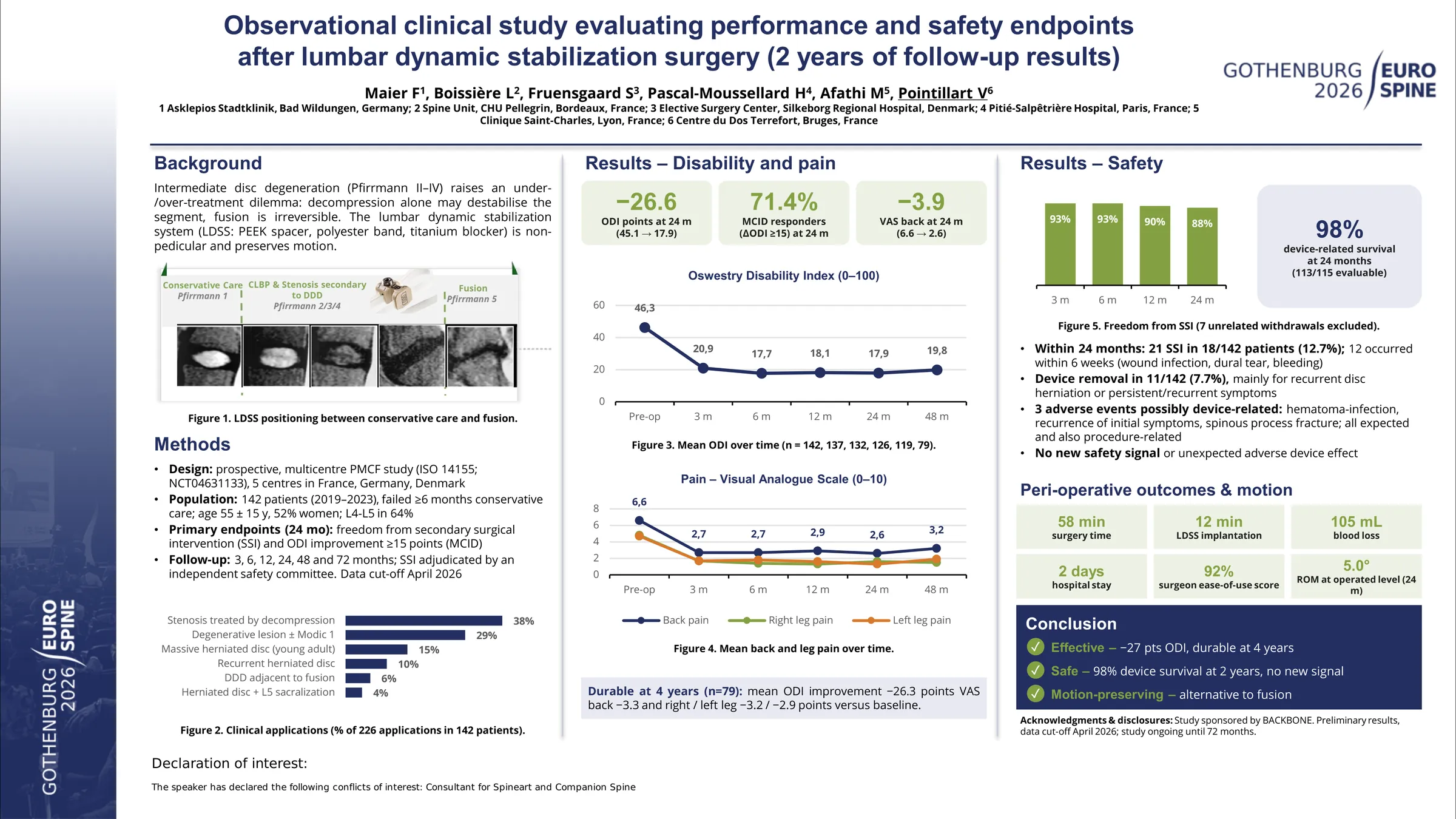
This study evaluated the safety and performance of a lumbar dynamic stabilization system (LDSS) designed to stabilize the treated level while preserving motion. The device comprises three main components: a PEEK spacer, a polyester band and a titanium-based blocker. LDSS is an alternative solution to conservative treatment, more invasive procedures and irreversible surgical options to treat patients with low-back pain associated with intermediate degenerative lesions. The results are shown for patients who have been followed for two and four years.
This prospective and interventional study included 142 patients operated with LDSS with low-back pain caused by intermediate degenerative lesions (Pfirmann II, III, IV) in 5 European centers (NCT04631133). The clinical applications are lumbar canal stenosis treated by decompression (38%), degenerative lesions with/without Modic 1 (29%), massive herniated disc in young adults (15%), recurrent herniated disc (10%), degenerative disc disease at a segment adjacent to fusion (6%) or herniated disc accompanying a L5 sacralization (4%). Data showed results for 137 patients at 24 months follow-up and 97 patients who had reached their 48 months follow-up visit at the time of analysis. The total follow-up period will be 72 months. Patient reported outcomes (PROs) such as Oswestry Disability Index (ODI), back and leg pain (Visual Analogue Scale) were reported before surgery and at all timepoints. Secondary surgical intervention were prospectively collected.
A mean improvement of 27 points was observed in the ODI at the 24-month follow-up for patients with available PROs (119/137). ODI success rate was 71.4% of patients. Back and leg pain was reduced by 3.9 and 4.2 points at 24-month follow-up compared to pre-operative visit. The results were consistent regardless of the clinical application. The percentage of patients taking analgesics decreased by 47% after 24 months. Similar results were observed between PROs and analgesic taken at 24 and 48 months post-surgery.
After 24-month follow-up, 20 patients have secondary surgical intervention (SSI), leading to implant removal in 11 of them. Most are due to the procedure (18/20), while only two are related to the device (2/20).
This study confirms the improvement in patients' quality of life with a low rate of adverse events two years after surgery. These favorable outcomes continue for available patients after 4 years. LDSS may resolve the undertreatment/overtreatment dilemma for stenosis patients by granting a suitable choice to decompression alone which may further destabilize the segment & irreversible fusion procedure, when the lumbar disc is not entirely collapsed.