
Basic Science & Economics
Novel locking screws increase the anti-rotation torque of pedicle screws significantly – An in vitro study
- Ulm University Medical Centre, Ulm, Germany
- Assaf Harofeh Medical Centre, Zerifin, Israel
Abstract
Posterior implant systems without cross connector entail a higher risk of screw loosening due to rotation around the longitudinal axis of pedicle screws. To prevent this risk, a novel approach has been developed comprising two smaller screws additionally inserted into the pedicle to lock the primary pedicle screw and thereby increase its resistance against rotational movement. The aim of this in vitro study was to evaluate the anti-rotation capacity of the novel locking screws.
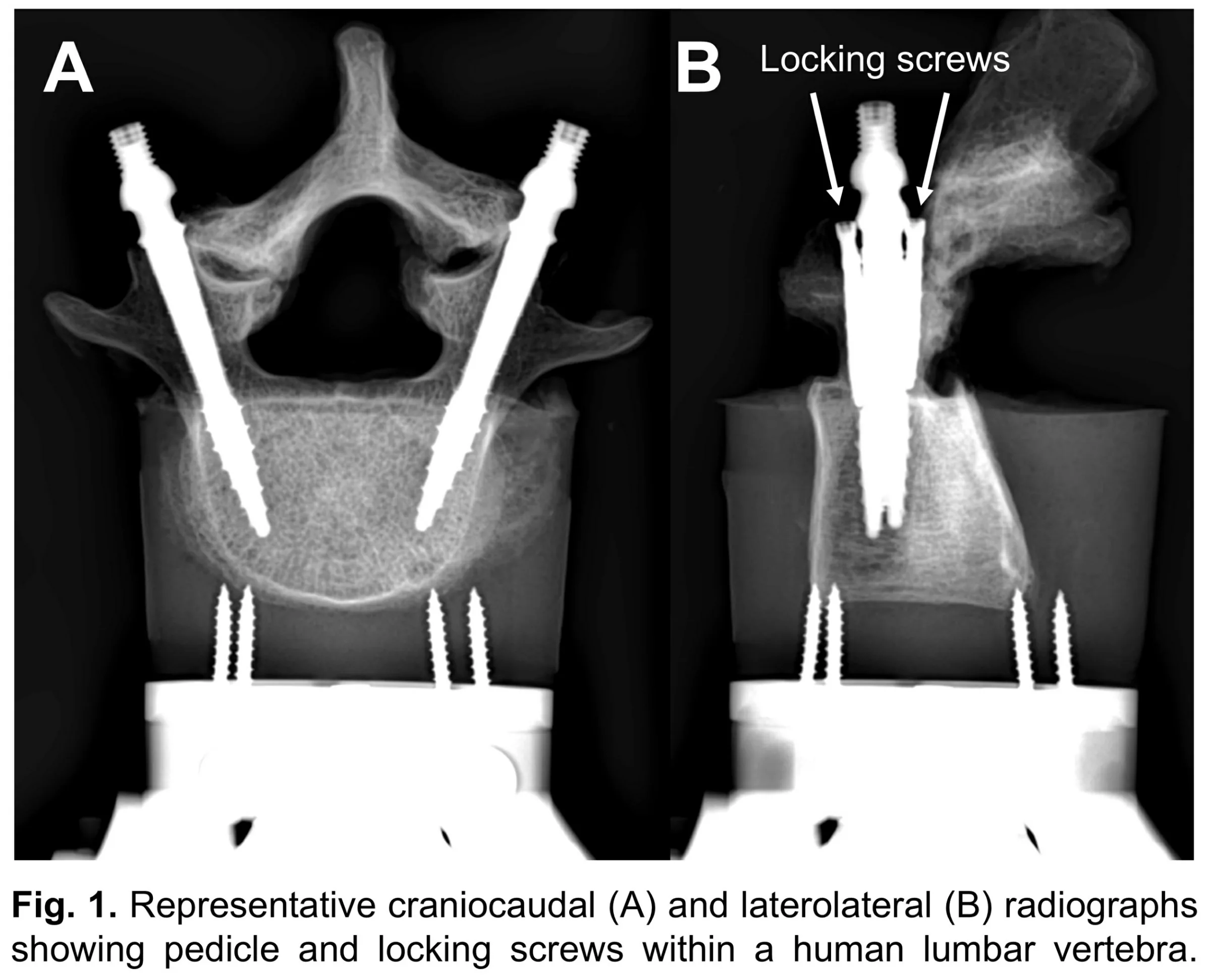
21 fresh frozen non-osteoporotic lumbar vertebrae (L3-L5) from 14 human donors (45 ± 9 years; 5 female / 9 male) were included. Pedicle screws with a diameter of 6.5 mm and a length of 45 mm were implanted by an experienced spine surgeon with two locking screws each (Fig. 1). In the main group (n = 32), pedicle screws were tested solely with locking screws. In a control group (n = 10), pedicle screws were tested first without and subsequently with locking screws. Insertion torques were quantified using a custom-made screwdriver equipped with strain gauges. Removal torques were determined displacement-controlled (1 °/s) in a spine tester allowing pure moment loading. Radiographs were performed to verify adequate screw positions prior to testing and to check for pedicle fractures after testing. Data were statistically evaluated using the non-parametric Friedman and Mann-Whitney U tests as well as Pearson correlation analysis.
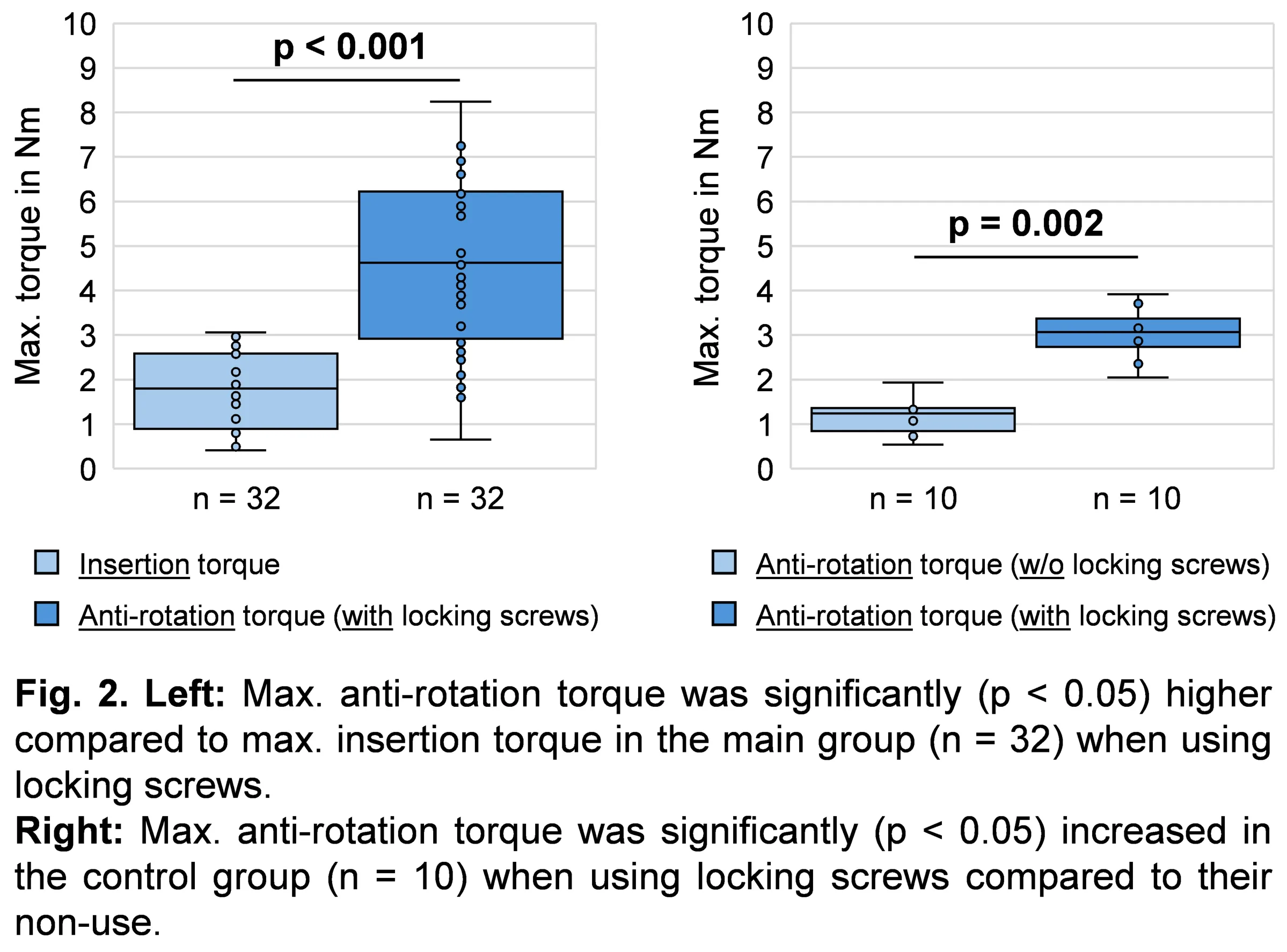
In the main group, the use of locking screws led to significantly higher anti-rotation torque compared to the respective insertion torque (p < 0.05) with a median torque increase by 2.7-fold from 1.8 Nm to 4.6 Nm (Fig. 2 left). Significant (p < 0.05) high linear correlations were found between insertion and anti-rotation torque (r = 0.658) and between insertion torque and bone mineral density (r = 0.598). Significant medium linear correlation (p < 0.05, r = 0.385) was identified between anti-rotation torque and bone mineral density. In the control group, the use of locking screws significantly increased the anti-rotation torque compared to testing without locking screws (3.1 Nm vs. 1.2 Nm, p < 0.05, Fig. 2 right). Pedicle width and height did not significantly correlate with insertion and anti-rotation torques, respectively (p ≥ 0.05). Following screw removal, 19 longitudinal pedicle fractures were detected, which did not significantly affect the anti-rotation torque (p ≥ 0.05).
In this in vitro study, novel locking screws were found to increase the resistance of pedicle screws against torque by about three times compared to the insertion torque, justifying their clinical use from a biomechanical point of view. As the variations in individual anatomy and screw entry points might be critical for correct positioning of pedicle and locking screws, preoperative planning and robotic assistance in screw implantation can be seen as mandatory to increase the anti-rotation torque and to reduce the risk of pedicle fractures.
Figures and tables
As submitted with the abstract. Tap a figure to open it at full size.