Basic Science & Economics
In vivo-like long-term compressive loading affects intervertebral disc swelling and flexibility – An ex vivo study
- Ulm University Medical Centre, Ulm, Germany
- University of Health Sciences, Bochum, Bochum, Germany
- Charité – University Medicine Berlin, Berlin, Germany
- German Sport University, Cologne, Germany
- Sahlgrenska University Hospital, Gothenburg, Sweden, Sweden
- University of Birmingham, Birmingham, UK, United Kingdom
- Johnson Space Center, Houston, United States of America
- Aeromedical Centre, Helsinki, Finland
Abstract
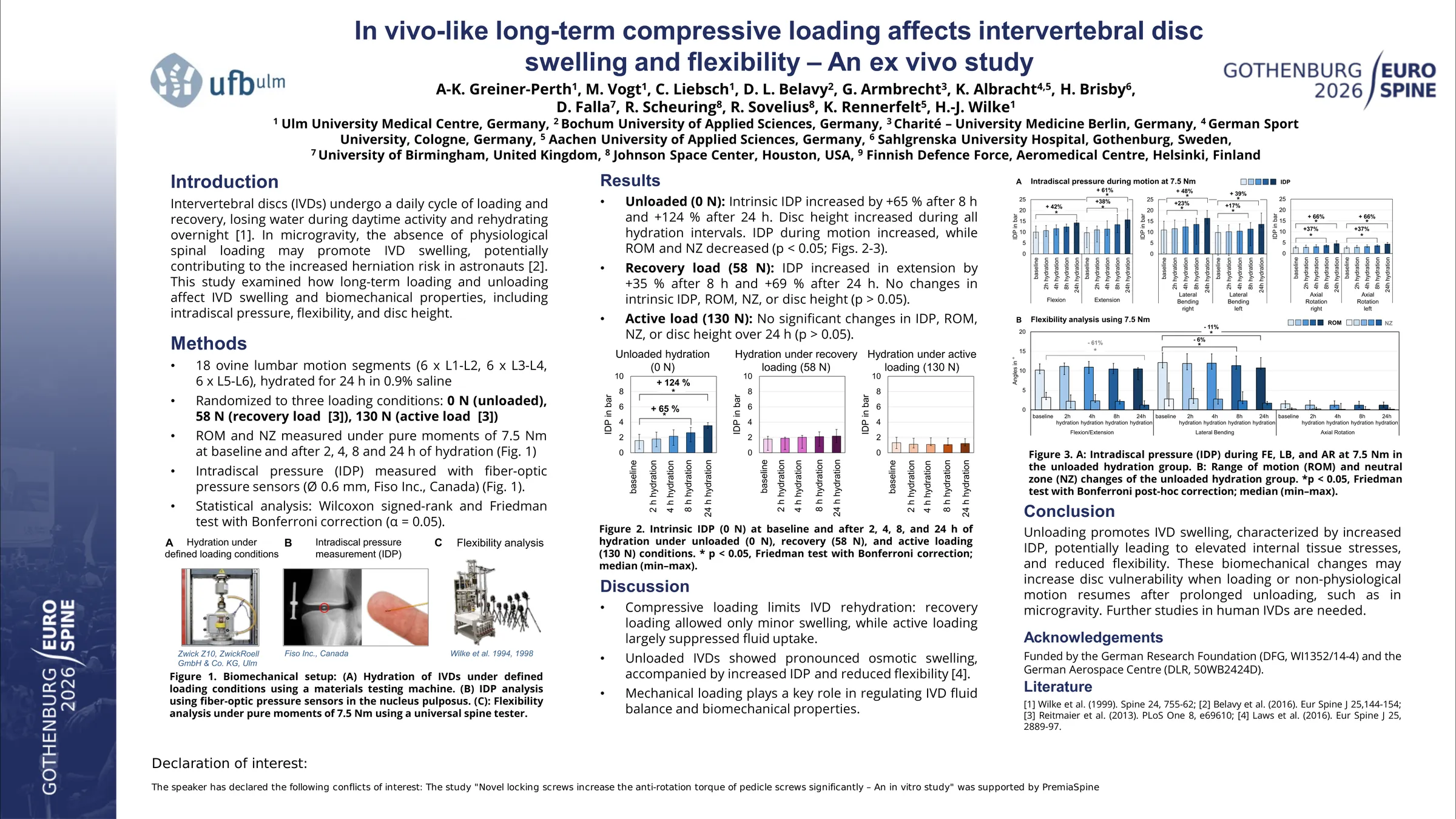
The water content of intervertebral discs (IVD) follows a circadian pattern, decreasing under daytime mechanical loading and recovering overnight1. In the absence of loading, such as in microgravity, more IVD swelling can occur, potentially a reason for increased risk of disc herniation in astronauts2. However, specific effects of compressive loading on IVD swelling behaviour and resulting biomechanical properties remain unclear. This study examined how IVD swelling is affected by in vivo-like long-term compressive loading and how this affects intradiscal pressure (IDP), range of motion (ROM), neutral zone (NZ), and IVD height (IDH).
To ensure standardized testing of non‑degenerated IVDs, 18 ovine lumbar motion segments (6xL1-L2, 6xL3-L4, 6xL5-L6) were hydrated in 0.9%-saline solution for 24h and randomised regarding segmental level to investigate the following loading conditions: 0 N (unloaded), 58 N (in vivo recovery load in sheep)3, and 130 N (in vivo active load in sheep)3. Flexibility testing was performed using pure moments of 7.5 Nm in a spine tester at five time points: prior to hydration (baseline) and after 2h, 4h, 8h, and 24h of hydration. IDH was determined before and after each hydration interval at 130 N using a materials testing machine. IDP was continuously recorded using fibreoptic pressure sensors implanted in the nucleus pulposus. Wilcoxon test and Friedman test with Bonferroni correction were performed (α=0.05).
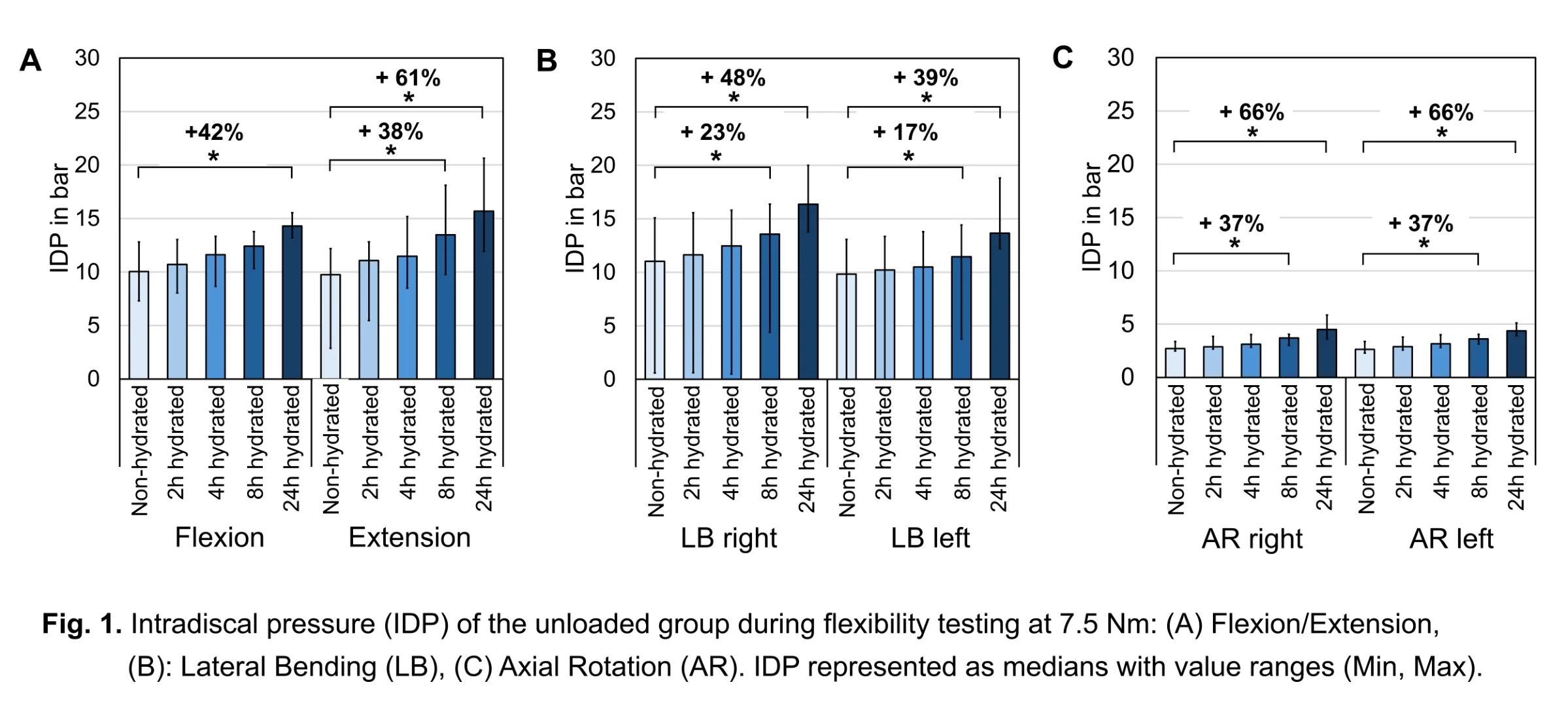
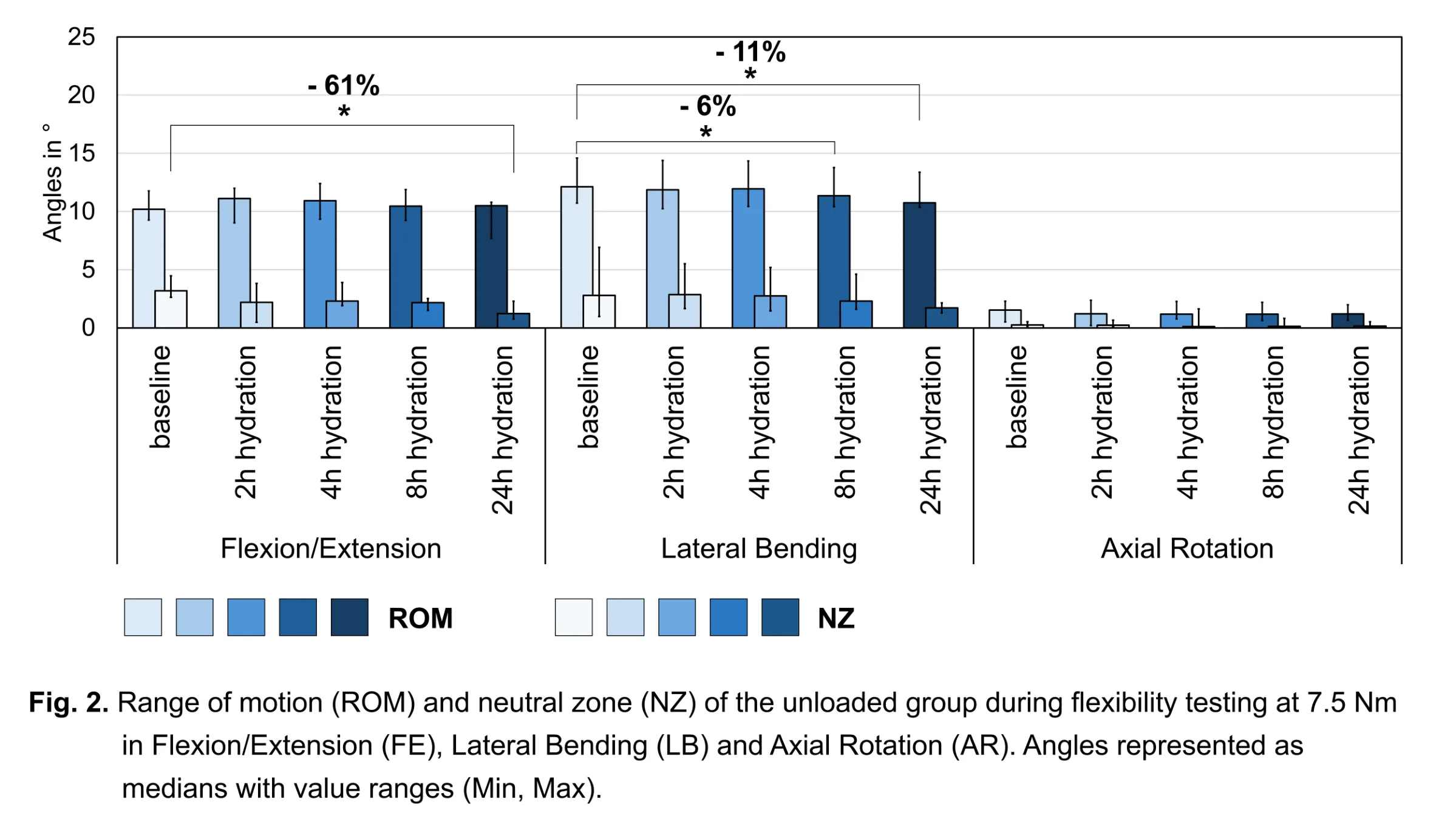
In the unloaded group, median intrinsic IDP increased significantly by +65% after 8h and by +124% after 24h of hydration (p<0.05). Median IDH rose significantly at all timepoints (p<0.05). During flexibility testing, IDP increased significantly in flexion after 24h and in all other motion directions after 8h and 24h of hydration (p<0.05, Fig.1). ROM was significantly reduced in lateral bending after 8h and 24h, while NZ decreased in flexion/extension after 24h (p<0.05, Fig.2). In the recovery load group, median IDP increased in extension by +35% after 8h and by +69% after 24h (p<0.05), while there were no significant changes in other motion directions, ROM, NZ or IDH (p>0.05). No significant changes were observed in any parameter in the active load group (p>0.05).
Lumbar ovine IVDs show limited hydration under recovery loads, while active compressive loading suppresses fluid uptake, indicating that sustained compressive load inhibits rehydration. In the absence of external load, IVDs undergo significant osmotic swelling, leading to increased IDP and reduced flexibility. As IDP reflects discal stress, pronounced swelling under unloading conditions may contribute to the elevated herniation risk observed in astronauts. Future studies shall validate these findings in human cadaveric IVDs.
References: [1] Wilke et al. (1999). Spine 24, 755-62; [2] Belavy et al. (2016). Eur Spine J 25,144-154; [3] Reitmaier et al. (2013). PLoS One 8, e69610.
Figures and tables
As submitted with the abstract. Tap a figure to open it at full size.