
Degenerative Thoracolumbar
Central Cage Placement Is Not Optimal: Association Between Cage Position, Neurological Recovery, and Subsidence in UBE-ELIF
- Seirei Hamamatsu General Hospital, Hamamatsu, Japan
Abstract
Unilateral Biportal Endoscopic Extraforaminal Lumbar Interbody Fusion (UBE-ELIF) achieves indirect decompression through restoration of disc height without direct canal decompression. Postoperative enlargement of the spinal canal and symptom improvement have been reported. Age and cage subsidence may affect outcomes, but the independent effect of cage position remains unclear. This study evaluated whether coronal and sagittal cage position is associated with neurological improvement and subsidence in patients treated with bilateral cage insertion.
Sixty-two patients (33 men, 29 women; mean age 65.7 years) who underwent single-level UBE-ELIF for lumbar spinal stenosis or degenerative spondylolisthesis between December 2019 and August 2024 were retrospectively reviewed. Minimum follow-up was one year. Mean operative time was 171.8 minutes and blood loss was 35.2 ml. Transient postoperative leg numbness occurred in four patients, and one required direct decompression for cauda equina syndrome.
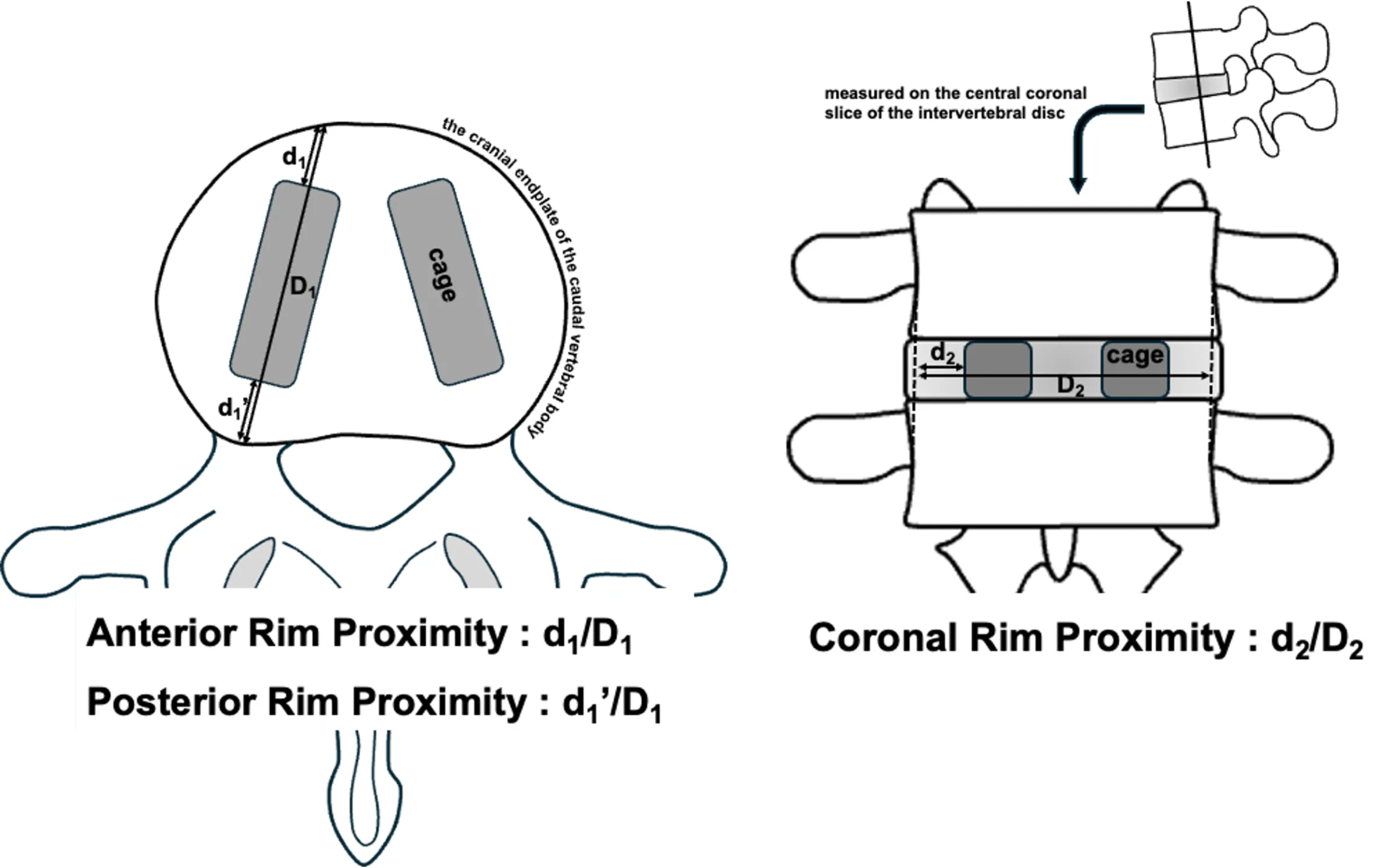
Clinical outcomes were assessed using the Numerical Rating Scale (NRS) for low back pain, leg pain, and numbness. Radiological parameters included disc height, ligamentum flavum thickness, disc bulging, Schizas grade, and spinal canal area. Cage position was quantified using Coronal Rim Proximity (CRP), Anterior Rim Proximity (ARP), and Posterior Rim Proximity (PRP). Subsidence was defined as ≥2 mm displacement in the early postoperative period and at one year. Wilcoxon signed-rank and Spearman correlation tests were used (p < 0.05).
Significant improvement was observed in disc height, ligamentum flavum thickness, disc bulging, Schizas grade, spinal canal area, and all NRS scores. Right CRP showed a negative correlation with improvement in leg pain (ρ = −0.392, p = 0.002) and numbness (ρ = −0.285, p = 0.029), indicating less improvement with medial placement. Left CRP and left PRP showed positive correlations with early and one-year subsidence (ρ = 0.27–0.36, p < 0.05). Cage position was not associated with canal area enlargement or change in Schizas grade.
Cage position in UBE-ELIF was associated with neurological recovery and subsidence. Medial placement was linked to smaller symptom improvement and higher subsidence risk. Slightly lateral placement may be preferable when feasible.
Figures and tables
As submitted with the abstract. Tap a figure to open it at full size.