
Tumours & Infection
Cervical Versus Lumbar Pyogenic Spondylitis: Differences in Clinical Characteristics and Microbiological Spectrum
- Tottori University, Yonago, Japan
Abstract
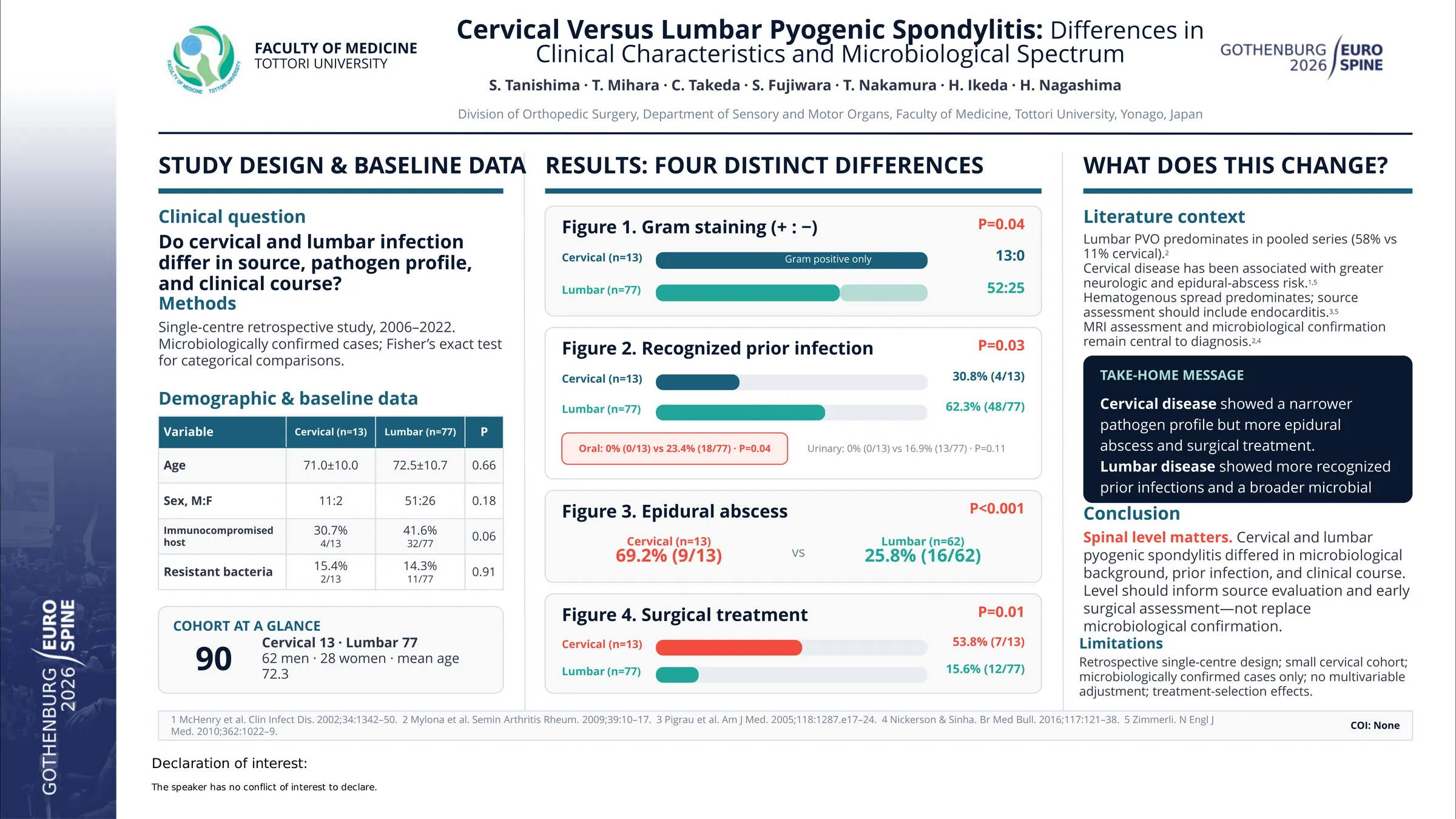
Pyogenic spondylitis most commonly affects the lumbar spine, whereas cervical involvement is relatively uncommon. We hypothesized that preceding infection patterns, causative organisms, and clinical course differ between cervical and lumbar infections. This study aimed to compare the clinical characteristics and microbiological profiles of cervical and lumbar pyogenic spondylitis.
We retrospectively reviewed 90 patients (62 men and 28 women; mean age 72.3 years) with microbiologically confirmed pyogenic spondylitis treated at our institution between 2006 and 2022. Thirteen patients had cervical involvement and 77 had lumbar involvement. We compared age, sex, history of diabetes mellitus or malignancy, time from symptom onset to definitive diagnosis, organism classification, presence of resistant organisms, preceding infection, and surgical intervention between the two groups. Categorical variables were analyzed using Fisher’s exact test.
There were no significant differences in age, sex distribution, or prevalence of diabetes mellitus or malignancy between groups. Preceding infection was significantly more frequent in the lumbar group (30.1% vs 62.3%, P=0.03). Urinary tract infections, commonly observed in lumbar cases, were not identified in the cervical group. Infections caused by oral commensal bacteria were significantly less frequent in the cervical group.
Lumbar infections demonstrated a broader microbiological spectrum, including gram-positive cocci, gram-positive bacilli, and gram-negative bacilli, whereas all cervical cases were caused by gram-positive cocci (P=0.04).
Surgical intervention was performed significantly more frequently in cervical cases than in lumbar cases (46.1% vs 15.6%, P<0.001).
Cervical and lumbar pyogenic spondylitis exhibit distinct differences in preceding infection patterns, causative organisms, and treatment course. These findings suggest that the underlying pathogenesis may differ according to spinal level and should be considered in diagnostic evaluation and therapeutic decision-making.