
Complications & Epidemiology
Intraoperative and Postoperative Complications After Stand-Alone L5-S1 ALIF: Retrospective Review of 176 Single-Center Cases
- Hospital for Special Surgery, New York, United States of America
- Hospital for Special Surgery Main Hospital, New York, United States of America
- Hospital for Special Surgery Main Hospital, Zürich, United States of America
- Universitätsklinik Balgrist, zurich, Switzerland
Abstract
Stand-alone L5-S1 anterior lumbar interbody fusion (ALIF) carries vascular, neurological, urological, and bowel-related risks. However, complication data are limited, and stability-related complications remain debated. This study evaluates intraoperative and postoperative complications occurring within 12 months after isolated stand-alone L5-S1 ALIF.
A retrospective analysis was performed of patients who underwent isolated stand-alone L5-S1 ALIF within 10 years. Exclusion criteria included: combined anterior-posterior surgery, prior fusion at the level L5-S1, as well as presence of a fracture, infection or tumor at the index level. Aside from demographic data, the following were collected: indication for surgery, estimated blood loss (EBL), operative time, length of stay (LOS), intraoperative and postoperative complications through 12 months. Index-level revisions were analyzed for initial indication, revision reason, and revision procedure.
A total of 175 patients (103 F, 72 M; mean age 50.2 ± 13.2 years; BMI 26.8 ± 5.3) underwent isolated stand-alone L5-S1 ALIF. Primary indications were degenerative disc disease (DDD) (137/175, 78.3%), degenerative spondylolisthesis grade I (13/175, 7.4%), isthmic spondylolisthesis grade I (12/175, 6.9%) and II (2/175, 1.1%), junctional distal breakdown (8/175, 4.6%), degenerative scoliosis (2/175, 1.1%), and Bertolotti’s syndrome (1/175, 0.6%). Mean EBL was 57.7 ± 83.9 mL, operative time 103.6 ± 21.6 minutes, and LOS 1.8 ± 1.2 days. Intraoperative events were limited to venous bleeding (small <500 mL: 2/175, 1.1%; large >500 mL: 1/175, 0.6%), without postoperative sequelae. Postoperative complications included 1 cauda equina syndrome (0.6%), 1 S1 endplate fracture (0.6%), 1 sacral stress fracture (0.6%), 2 delayed union (1.1%), 2 paralytic ileus (1.1%), 7 constipation (4.0%), 5 urinary retention (2.9%), 1 retrograde ejaculation (0.6%), 1 wound infection (0.6%), and 1 new-onset radiculopathy (0.6%). Five revisions occurred: 1 urgent hemilaminectomy for postoperative cauda equina syndrome and 4 requiring additional posterior stabilization: 3 decompressions with posterolateral fusion L5-S1 for delayed union (n=2) and sacral stress fracture (n=1), and 1 posterior fusion L5-S1 with iliac fixation for S1 endplate fracture (n=1). Revisions requiring posterior stabilization occurred in 2/14 patients (14.3%) with isthmic spondylolisthesis grade I-II compared with 2/161 patients (1.2%) without isthmic spondylolisthesis.
To date, this is the largest single-center cohort of isolated stand-alone L5-S1 ALIF, showing a favorable safety profile with no relevant intraoperative complications, low postoperative complications, and 12-months revision rate of 2.9%. However, stability-related failures requiring additional posterior stabilization demonstrate the need for careful patient selection and preoperative counselling, particularly for isthmic spondylolisthesis.
Figures and tables
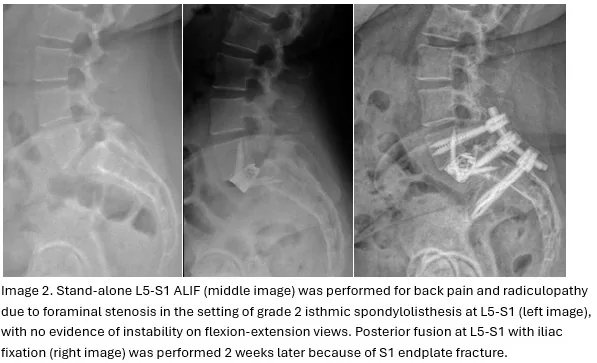
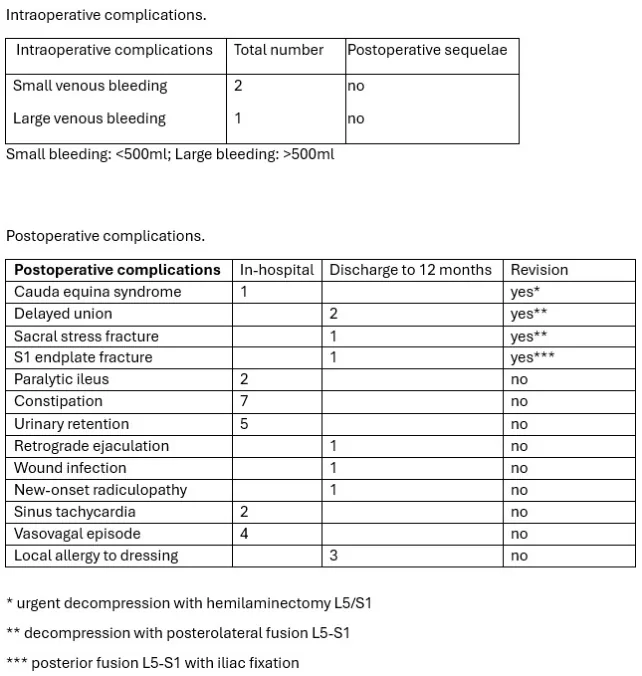
As submitted with the abstract. Tap a figure to open it at full size.