
Tumours & Infection
No difference in perioperative results between posterior instrumentation with and without interbody cage and debridement in primary lumbosacral spondylodiscitis in adults – a single center experience
- Klinikum Rechts der Isar, Munich, Germany
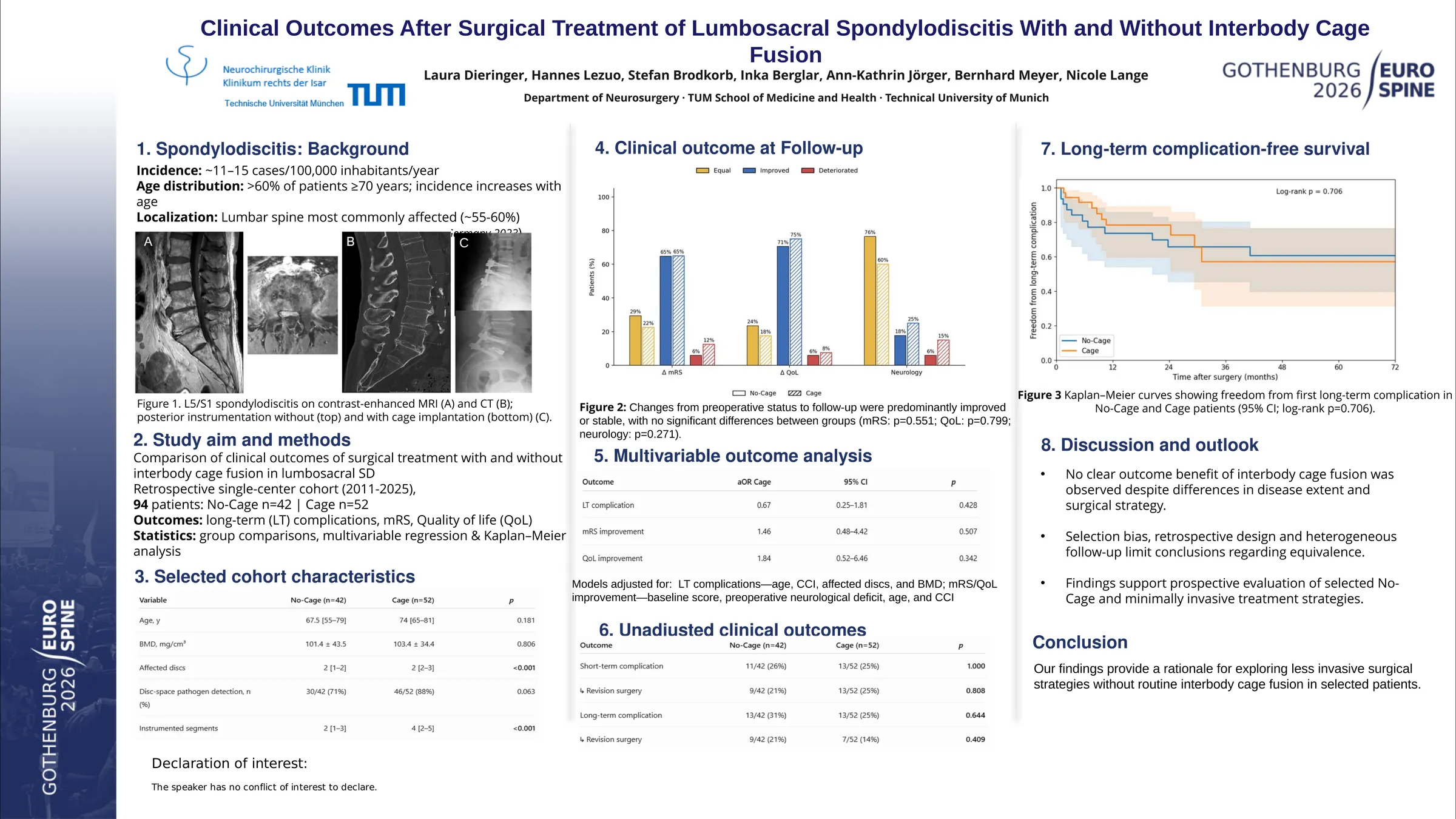
Abstract
Spondylodiscitis is a severe infection of the intervertebral disc and adjacent vertebral bodies, predominantly affecting elderly patients and associated with high morbidity and mortality. Its incidence has increased markedly in recent decades, largely due to demographic aging, increasing multimorbidity and immunosuppression. Surgery is the gold standard of treatment with antibiotics over a few months. Despite existing guidelines, treatment strategies vary considerably, particularly regarding the extent of surgical debridement and the need for interbody fusion.
We retrospectively analyzed 132 adult patients surgically treated for lumbosacral spondylodiscitis between 2011 and 2025. Diagnosis was established by imaging findings and histopathological confirmation. Inclusion criteria comprised age ≥18 years, survival during the index hospitalization, and surgical treatment with spinal stabilization and interbody fusion with or without cage implantation; patients undergoing vertebral body replacement were excluded. Clinical outcomes were assessed postoperatively and at follow-up using the modified Rankin Scale (mRS) and quality of life (QoL; 1 = very poor, 5 = very good). Secondary endpoints included complication rates, microbiological pathogen detection, and length of hospital stay. Univariate statistical analyses were performed.
A total of 106 patients, 63 men and 43 women with a mean age of 69 (CI: 66-72)years were included. Preoperatively, median mRS was 3 (IQR 3–4) and QoL score was 2 (IQR 2–3) in the entire cohort. A single-stage surgical approach was performed in 46.2% (n = 49), while 53.8% (n = 57) underwent a staged approach requiring at least one additional procedure after stabilization. Baseline characteristics, including age, sex, Charlson Comorbidity Index, BMI, mRS, and QoL, did not differ significantly between groups. The number of stabilized segments was significantly higher in staged procedures with median 4 (IQR 3–5) vs. 2 (IQR 1-3) in single-stage surgery (p < 0.001). Pathogen detection rates did not differ significantly between groups (51% vs. 38.6%; p > 0.05). Length of hospital stay was significantly shorter in the single-stage group (22 vs. 37 days; p < 0.001). Long-term complication rates were comparable between single-stage and staged approaches (33.3% vs. 28.1%; p = 0.6). FU was available in over 80% of patients, with no significant differences in long-term functional outcome or quality of life (median mRS 2 vs. 2; p = 0.96; QoL 3 vs. 3; p = 0.34).
A staged surgical approach for lumbosacral spondylodiscitis places a substantial physical and psychological burden on patients, particularly the elderly, requiring multiple general anesthetics and prolonged hospitalization. We can show that one-staged procedures are not inferior to a staged procedure regarding postoperative outcome. Both had a general improvement in neurology and functionality.