
Degenerative Thoracolumbar
Ambulatory endoscopic lumbar decompression in geriatric patients: a prospective feasibility and outcomes study
- Hospital Pellegrin Bordeaux, Bordeaux, France
- Hospital Pellegrin, Bordeaux, France
Abstract
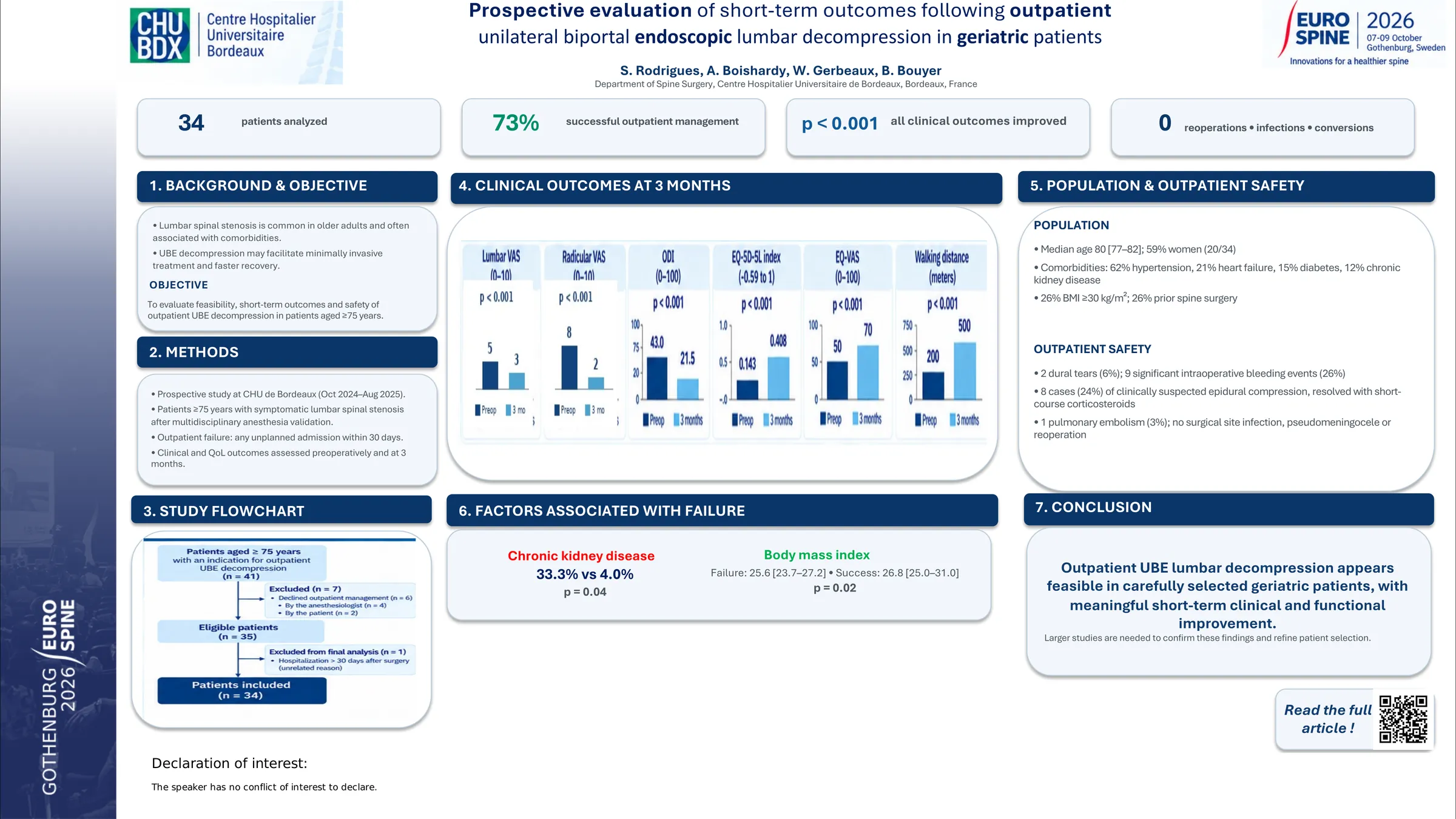
Outpatient spine surgery is expanding, yet its feasibility and safety in geriatric patients remain insufficiently documented. Endoscopic lumbar decompression may facilitate ambulatory management through tissue-sparing approaches and faster recovery. This prospective study evaluated the feasibility, clinical effectiveness, and safety of outpatient endoscopic lumbar decompression in patients aged ≥75 years.
A prospective non-interventional study included consecutive patients aged ≥75 years undergoing planned outpatient endoscopic lumbar decompression for degenerative lumbar stenosis. Outpatient success was defined as absence of inpatient admission within 30 days. Sociodemographic, comorbidity, surgical, and patient-reported outcomes (lumbar and radicular VAS, ODI, EQ-5D-5L, EQ-VAS, SF-36, walking distance, IADL) were collected preoperatively and at 3 months. Non-parametric tests were used with significance set at p < 0.05.
Thirty-four patients were analyzed (mean age 80 ± 4 years; 59% female). Outpatient management was successful in 73% (25/34). Nine patients (27%) required hospitalization, mainly on the day of surgery due to insufficient recovery in the post-anesthesia care unit or logistical reasons. Chronic kidney disease was more frequent in the failure group (33.3% vs 4.0%; p = 0.04), whereas BMI was higher in the success group (28.0 ± 4.0 vs 25.3 ± 2.4 kg/m²; p = 0.02).
Significant improvements were observed at 3 months across all major outcomes: lumbar VAS −2.0 points (p < 0.05), radicular VAS −5.2 (p < 0.05), ODI −21.5 (p < 0.05), EQ-5D-5L index +0.30 (p < 0.05), EQ-VAS +17.6 (p < 0.05), SF-36 PCS +2.9 and MCS +6.5 (both p < 0.05), and walking distance +300 m (p < 0.05). No surgical-site infections, no conversions to open surgery, and no reoperations occurred during follow-up.
Outpatient endoscopic lumbar decompression is feasible in selected patients aged ≥75 years, with meaningful improvements in pain, function, and quality of life and a favorable safety profile. Advanced age alone should not be considered a contraindication to outpatient spine surgery. Most failures were related to early postoperative recovery or logistics, suggesting that optimization of perioperative pathways may further increase ambulatory success in this growing population.