
Degenerative Thoracolumbar
Five-Year Outcomes of Minimally Invasive Interspinous Fixation versus Open Direct Decompression for Lumbar Spinal Stenosis: A Multi-Center Randomized Controlled Trial in the United Kingdom
- Leeds Teaching Hospitals NHS Trust, Leeds, United Kingdom
- University of Leeds, Leeds, United Kingdom
- Musgrove Park Hospital, Taunton, United Kingdom
- Dudley Group NHS Foundation Trust, Dudley, United Kingdom
- Bradford Teaching Hospitals NHS Foundation Trust, Bradford, United Kingdom
- Spinal Simplicity, Overland Park, United States of America
- Comprehensive Specialty Care, Edmond, United States of America
- The Spine and Nerve Center of the Virginias, Charleston, United States of America
Abstract
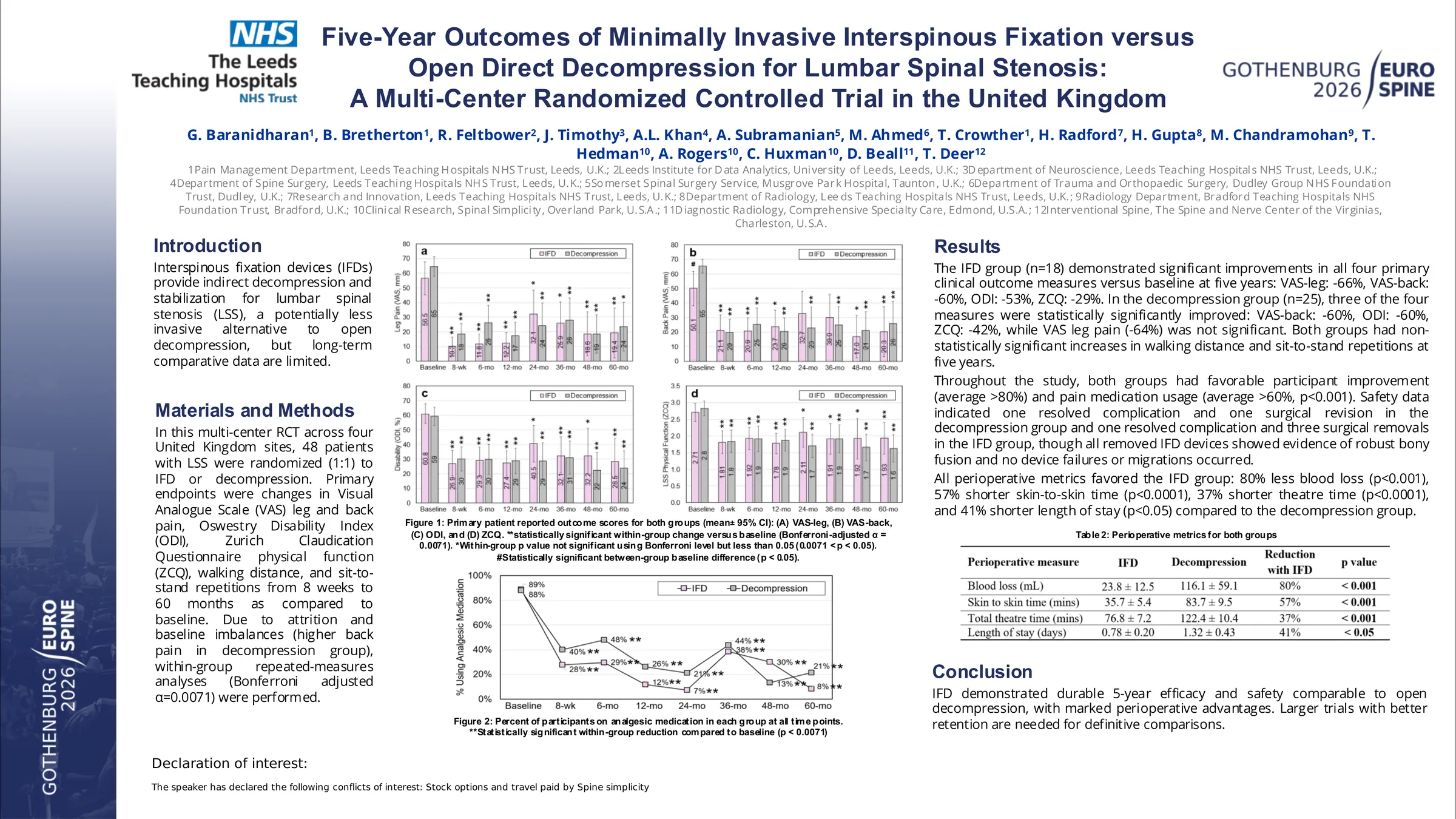
Interspinous fixation devices (IFDs) provide indirect decompression and stabilization for lumbar spinal stenosis (LSS), a potentially less invasive alternative to open decompression, but long-term comparative data are limited.
In this multi-center RCT across four United Kingdom sites, 48 patients with LSS were randomized (1:1) to IFD or decompression. Primary endpoints were changes in Visual Analogue Scale (VAS) leg and back pain, Oswestry Disability Index (ODI), Zurich Claudication Questionnaire physical function (ZCQ), walking distance, and sit-to-stand repetitions from 8 weeks to 60 months as compared to baseline. Due to attrition and baseline imbalances (higher back pain in decompression group), within-group repeated-measures analyses (Bonferroni-adjusted α=0.0071) and an exploratory clinical composite success (CCS) analysis based on minimum clinically important difference (MCID) responders were performed.
At 5 years, the IFD group (n=18) demonstrated significant improvements in all four primary clinical outcome measures versus baseline at five years: VAS-leg: -66%, VAS-back: -60%, ODI: -53%, ZCQ: -29%. In the decompression group (n=25), three of the four measures were statistically significantly improved: VAS-back: -60%, ODI: -60%, ZCQ: -42%, while VAS leg pain (-64%) was not significant. Both groups had non-statistically significant increases in walking distance and sit-to-stand repetitions at five years. Throughout the study, both groups had favorable participant improvement (average >80%) and pain medication usage (average >60%, p<0.001). Safety data indicated one resolved complication and one surgical revision in the decompression group and one resolved complication and three surgical removals in the IFD group, though all removed IFD devices showed evidence of robust bony fusion and no device failures or migrations occurred. All perioperative metrics favored the IFD group: 80% less blood loss (p<0.001), 57% shorter skin-to-skin time (p<0.0001), 37% shorter theatre time (p<0.0001), and 41% shorter length of stay (p<0.05) compared to the decompression group.
IFD demonstrated durable 5-year efficacy and safety comparable to open decompression, with marked perioperative advantages. Larger trials with better retention are needed for definitive comparisons.