
Adult Deformity
More is better! Multicenter analysis of failure rates and risk factors between bilateral single and multiple pelvic fixation in adult spinal deformity surgery
- Hoag Hospital - Newport Beach, Newport Beach, United States of America
- University of California, Irvine, Irvine, United States of America
- ELSAN Polyclinique Jean Villar, Clinique du Dos, Bordeaux-Terrefort, Pessac, France
- Duke University, Durham, United States of America
- University of Colo, Aurora, United States of America
- Scripps, San Diego, United States of America
- UCI, Irvine, United States of America
- Northwel, New York, United States of America
- University of Alber, Edmon, Canada
- Mayo Clinic, Rochester, United States of America
- Vanderbilt University Medical Center, Nashville, United States of America
- The University of Oklahoma, Oklahoma City, United States of America
Abstract
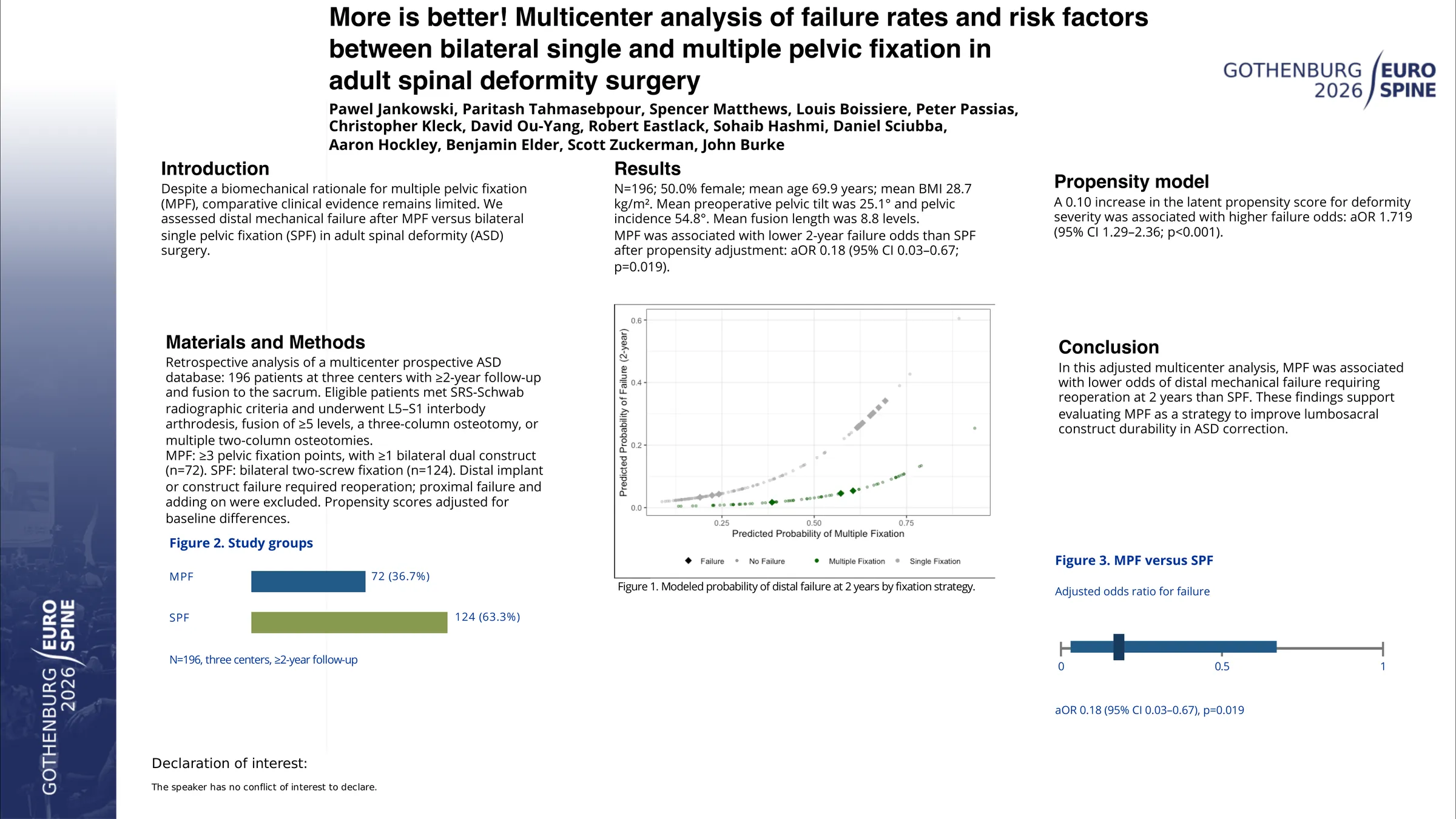
Despite biomechanical rationale supporting multiple pelvic fixation (MPF), clinical evidence remains limited. We compared MPF versus single bilateral pelvic fixation (SPF) outcomes in 196 ASD patients across three centers to evaluate lumbosacral junction stability. We postulated that multiple pelvic fixation (MPF) in long-segment adult spinal deformity (ASD) surgery significantly reduces mechanical failure requiring reoperation compared with single bilateral pelvic fixation (SPF).
This was a retrospective analysis of a multicenter prospective ASD database. 196 ASD patients from three centers with ≥2-year follow-up underwent fusion to the sacrum meeting established ASD radiographic SRS-Schwab criteria. All patients underwent L5-S1 interbody arthrodesis, multilevel fusion (≥5 levels), three-column osteotomy, or multiple two-column osteotomies. MPF (≥3 pelvic fixation points with ≥1 bilateral dual construct) was compared to SPF (bilateral two-screw fixation). Failure was defined as distal implant/construct failure requiring reoperation excluding proximal failure/adding on. Propensity scores adjusted for demographic, operative, and radiographic variables given preferential use of fixation strategy in patients with greater deformity.
From 196 patients 50.0% were female, mean age/BMI was 69.9 years/28.7 kg/m². Mean pre-op PT/pelvic incidence was 25.1°/54.8°. Mean length of fusion 8.8 levels, with average of 2.72 pelvic screws (avg. diameter 8.71mm, avg. length 82.04mm; 49.5% S2AI, 44.9% Iliac, 5.6% both). Seventy-two patients (36.7%) received MPF, and 124 (63.3%) received SPF. Compared with SPF, MPF was associated with an 82.4% reduction in failure risk at 2 years (adjusted OR 0.18; 95% CI 0.03–0.67; p=0.019), adjusting for propensity score which accounts for differences in age, BMI, and severity of deformity. A 0.10 increase in the latent propensity score accounting for deformity severity was associated with a 72% increased probability of failure (adjusted OR 1.719; 95% CI 1.29 – 2.36; p < 0.001).
In ASD patients, MPF significantly reduces mechanical failure at 2 years compared with SPF, even after adjustment for baseline severity of deformity. These findings support the use of MPF constructs to improve lumbosacral stability along with mechanical and clinical durability in patients undergoing corrective surgery.
Figures and tables
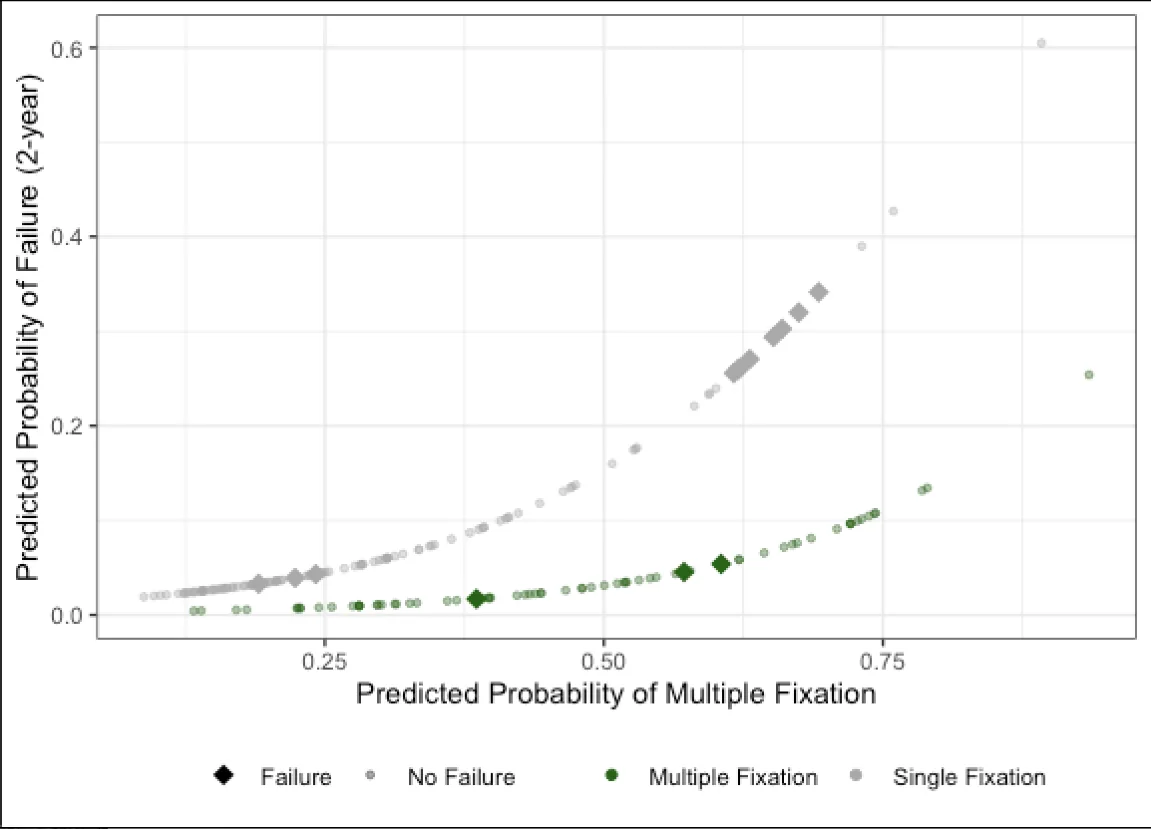
As submitted with the abstract. Tap a figure to open it at full size.