Growing Spine
Impact of a Comprehensive Education Approach and Technological Improvement on Brace Quality and Treatment Outcomes in Adolescent Idiopathic Scoliosis: A Controlled Longitudinal Study
- , Banja Luka, Bosnia and Herzegovina
- ISICO, Milan, Italy
- Scolio Centar, Novi Sad, Serbia
- Faculty of Sports and Physical Education, University of Novi Sad,, Novi Sad, Serbia
- Institute for physical medicine, rehabilitation and orthopedic surgery "dr Miroslav Zotovic", Banja Luka, Bosnia and Herzegovina
Abstract
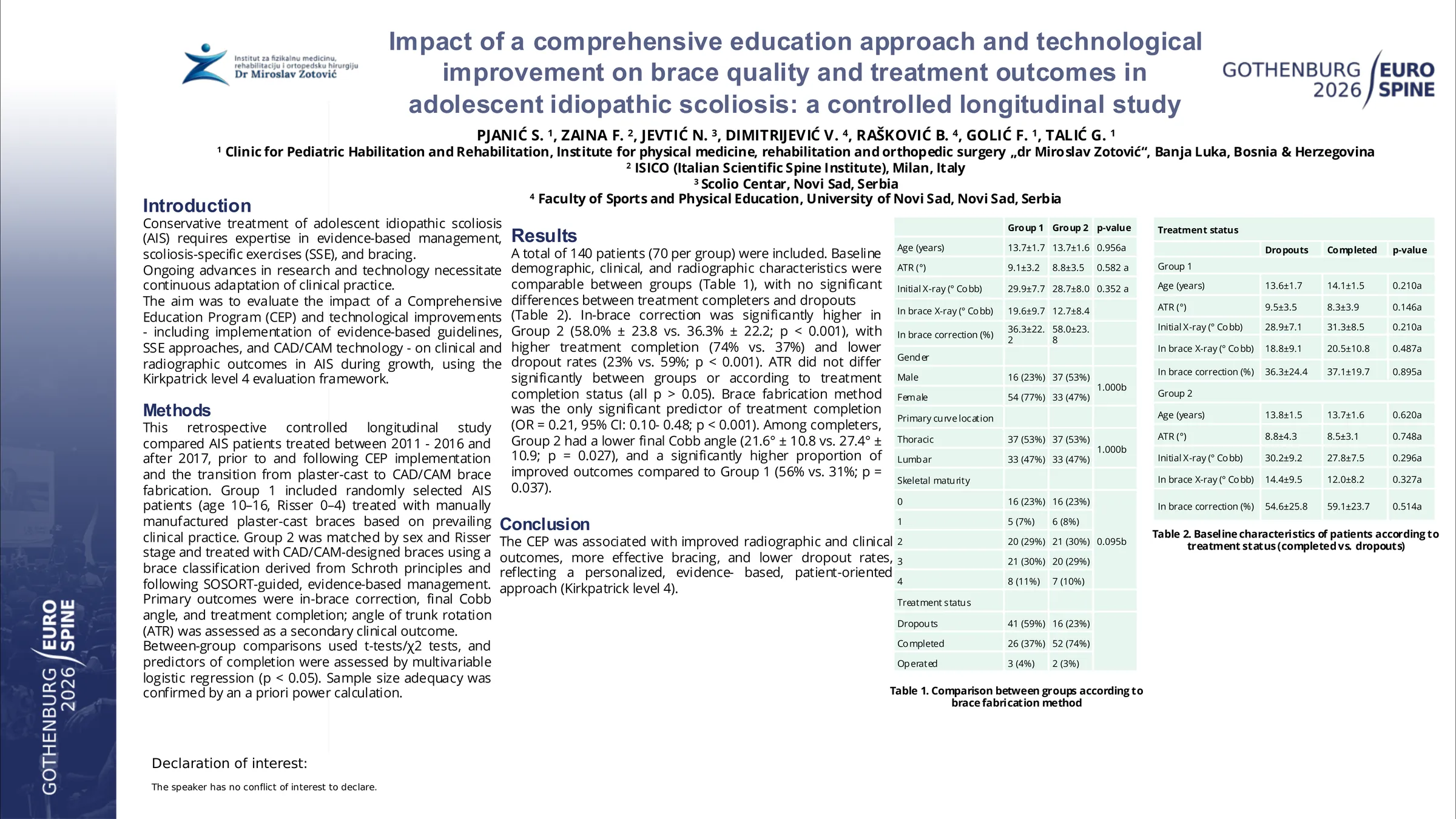
Conservative treatment of adolescent idiopathic scoliosis (AIS) requires expertise in evidence-based management, scoliosis-specific exercises (SSE), and bracing. Ongoing advances in research and technology necessitate continuous adaptation of clinical practice.
The aim was to evaluate the impact of a Comprehensive Education Program (CEP) and technological improvements—including implementation of evidence-based guidelines, SSE approaches, and CAD/CAM technology—on clinical and radiographic outcomes in AIS during growth, using the Kirkpatrick level 4 evaluation framework.
This retrospective controlled study compared AIS patients treated between 2011–2016 and after 2017, prior to and following CEP implementation and the transition from plaster-cast to CAD/CAM brace fabrication. Group 1 included randomly selected AIS patients (age 10–16, Risser 0–4) treated with manually manufactured plaster-cast braces based on prevailing clinical practice. Group 2 was matched by sex and Risser stage and treated with CAD/CAM-designed braces using a brace classification derived from Schroth principles and following SOSORT-guided, evidence-based management. Primary outcomes were in-brace correction, final Cobb angle, and treatment completion; secondary outcomes were clinical results. Between-group comparisons used t-tests/χ² tests, and predictors of completion were assessed by multivariable logistic regression (p < 0.05). Sample size adequacy was confirmed by an a priori power calculation.
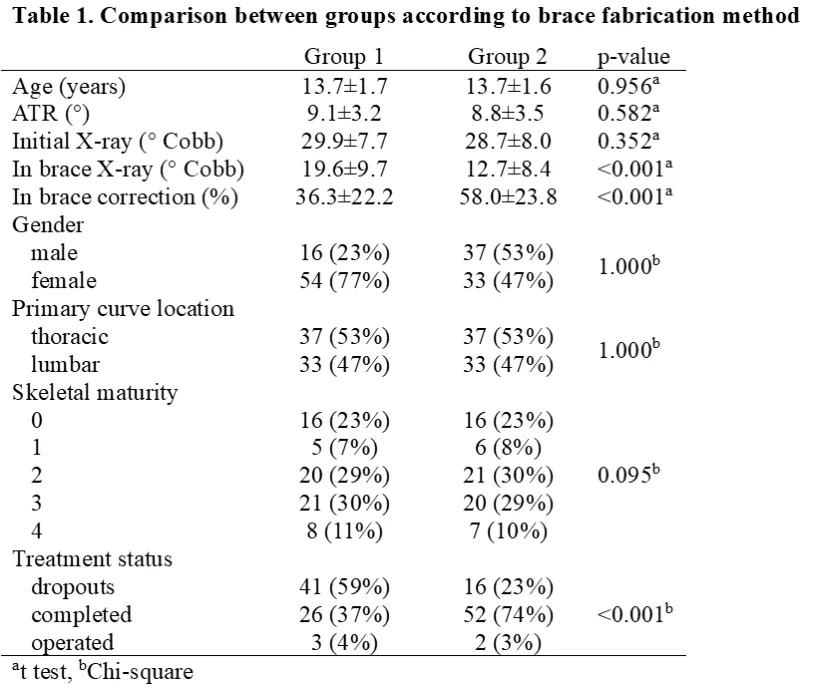
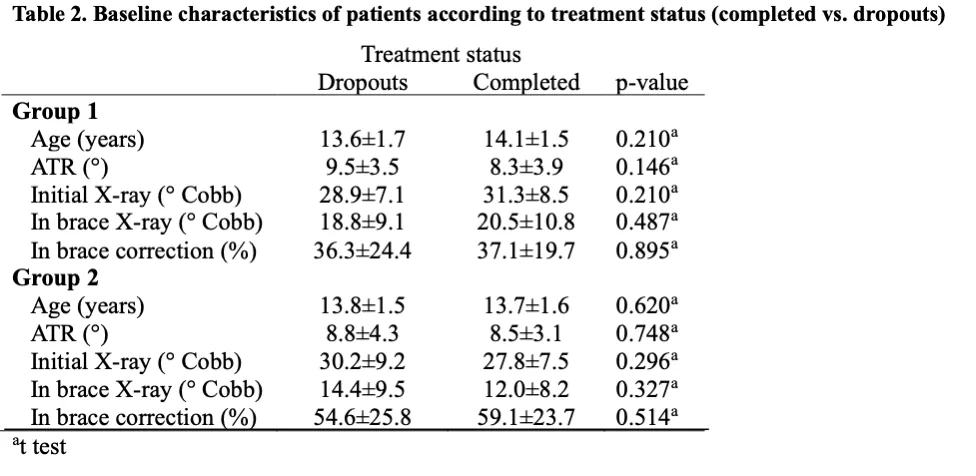
A total of 140 patients (70 per group) were included. Baseline demographic, clinical, and radiographic characteristics were comparable between groups (Table 1), with no significant differences between treatment completers and dropouts (Table 2). In-brace correction was significantly higher in Group 2 (58.0% ± 23.8 vs. 36.3% ± 22.2; p < 0.001), with higher treatment completion (74% vs. 37%) and lower dropout rates (23% vs. 59%; p < 0.001). Brace fabrication method was the only significant predictor of treatment completion (OR = 0.21, 95% CI: 0.10–0.48; p < 0.001). Among completers, Group 2 had a lower final Cobb angle (21.6° ± 10.8 vs. 27.4° ± 10.9; p = 0.027), and a significantly higher proportion of improved outcomes compared to Group 1 (56% vs. 31%; p = 0.037).
The CEP was associated with improved radiographic and clinical outcomes, more effective bracing, and lower dropout rates, reflecting a personalized, evidence-based, patient-oriented approach (Kirkpatrick level 4).
Figures and tables
As submitted with the abstract. Tap a figure to open it at full size.