
Cervical & Neural Pathologies
Incidence, Severity, and Clinical Relevance of Bony Osteolysis Following Anterior Cervical Discectomy and Fusion Using Stand alone Titanium Cages
- Norfolk and Norwich University Hospital, Oswestry, United Kingdom
- Norfolk and Norwich University Hospital, Norwich, United Kingdom
Abstract
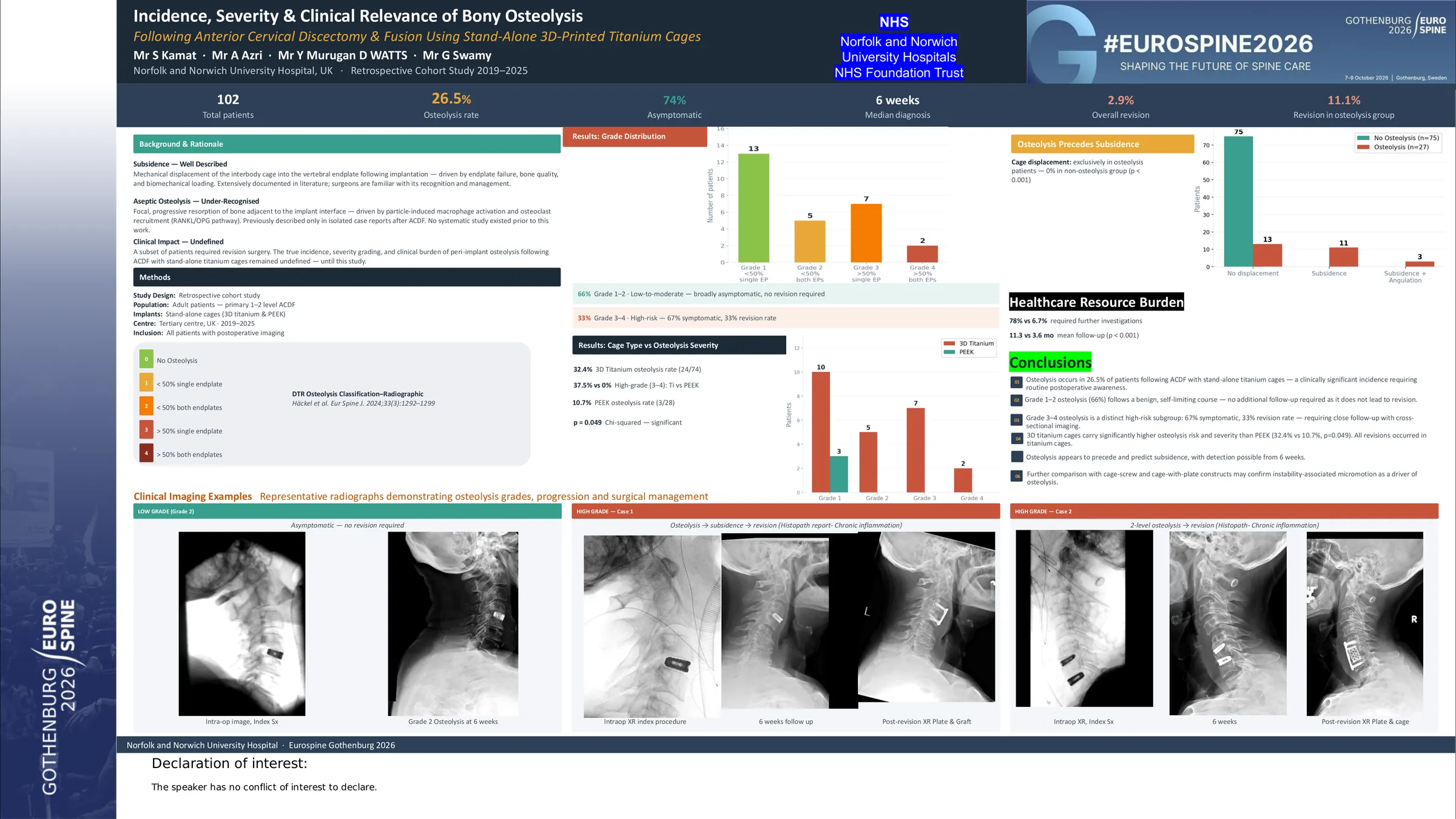
Subsidence following anterior cervical discectomy and fusion (ACDF) has been extensively reported in the literature. In contrast, aseptic osteolysis, while described in isolated case reports, has not been systematically studied. Our department observed an increasing number of patients demonstrating radiographic osteolysis following ACDF using standalone titanium cages, with a small number requiring revision surgery, prompting further investigation into this phenomenon. This study evaluates the incidence, severity, and clinical implications of osteolysis following ACDF using stand-alone Titanium cages.
A retrospective cohort study was conducted of adult patients undergoing primary one- to three-level ACDF using stand-alone cages at a tertiary center in UK From 2019-2025. All patients with available postoperative imaging were included. Osteolysis was defined as progressive focal radiolucency adjacent to the implant and graded according to severity. Demographic, surgical, radiographic, and clinical outcome data were collected. Outcomes were compared between patients with and without osteolysis.
A total of 102 patients were included. Radiographic osteolysis was identified in approximately 21% of patients. The majority of cases were low- to moderate-grade (Grade 1–2), with a smaller proportion demonstrating high-grade cavitary changes (Grade 3). The overall revision surgery rate was 2.9%. All revision procedures occurred in patients with osteolysis, while no patients without osteolysis required revision during the follow-up period. Patients with osteolysis required increased postoperative surveillance, including additional clinic visits and cross-sectional imaging. Short-term fusion rates and clinically significant subsidence were not adversely affected.
This study at our center showed that Osteolysis following ACDF with stand-alone titanium cages occured in approximately one-fifth of patients and is associated with an increased likelihood of revision surgery, with all revisions in this cohort occurring in patients with osteolysis. Although most cases are low grade and clinically asymptomatic, osteolysis results in additional follow-up and imaging, increasing the burden on healthcare resources. Awareness of this phenomenon is important for postoperative surveillance, patient counselling, and implant selection. Further longitudinal studies are required to determine its long-term clinical and economic impact.
Figures and tables
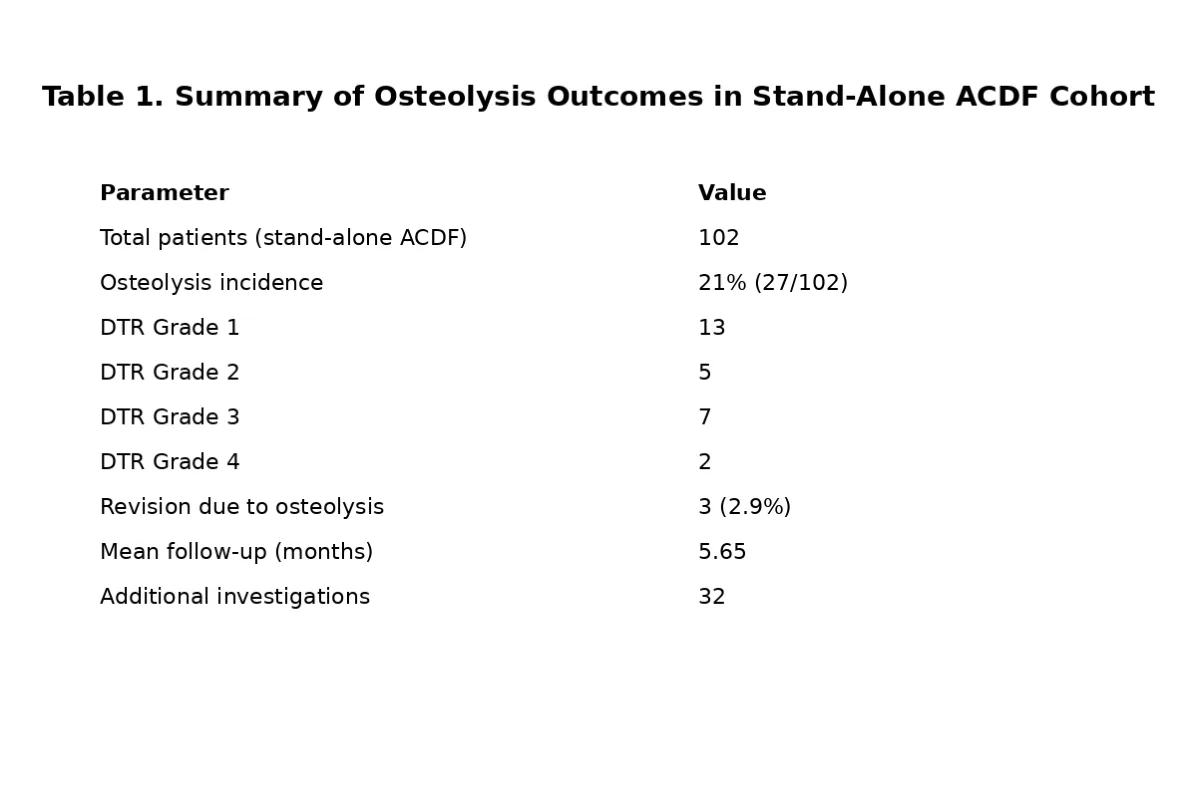
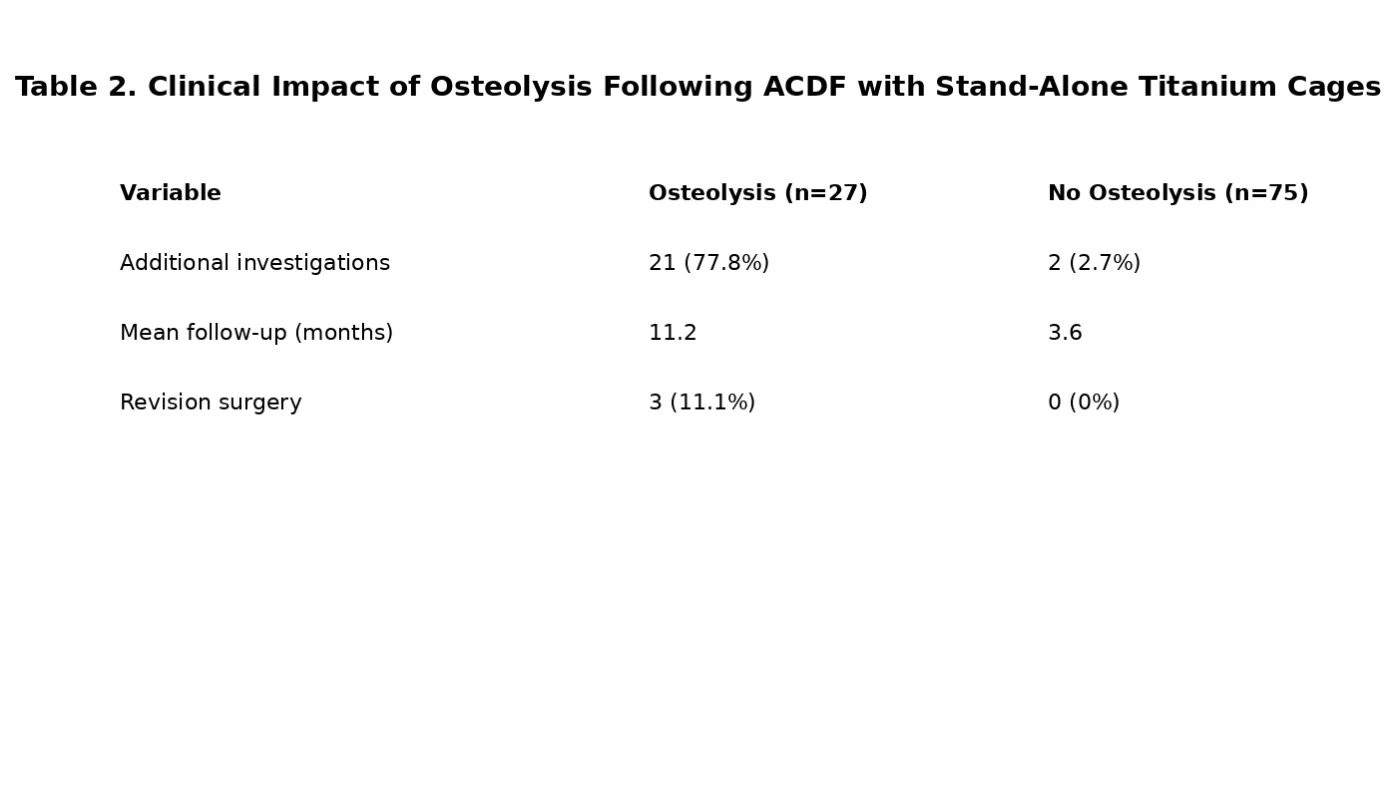
As submitted with the abstract. Tap a figure to open it at full size.