
Degenerative Thoracolumbar
Minimally Invasive Anterior Approach to the Thoracolumbar Junction via the Lumbocostal Triangle (LCT): A Technical Note and Perioperative Outcomes
- Shunyokai Central Hospital, Kimotsuki, Japan
Abstract
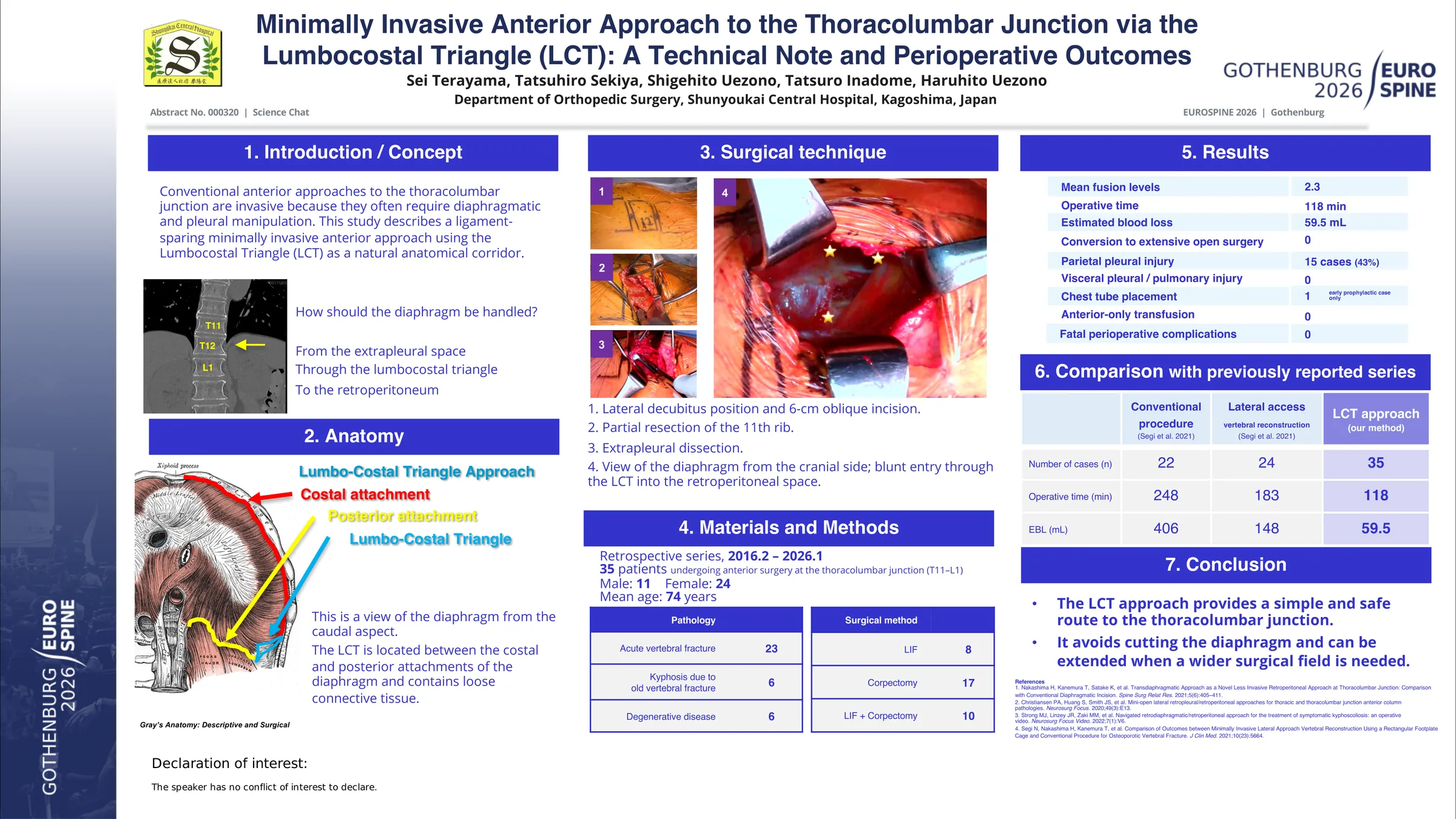
Anterior approaches to the thoracolumbar junction are inherently invasive due to diaphragmatic and pleural manipulation. To minimize morbidity, we utilize the lumbocostal triangle (LCT)—a natural anatomical corridor between the lumbar and costal attachments of the diaphragm. This study describes the "ligament-sparing" LCT surgical technique and reports its perioperative safety and surgical feasibility compared to conventional methods.
This retrospective study included 35 consecutive patients (11 males, 24 females; mean age, 74 years) who underwent anterior surgery for the thoracolumbar junction (T11-L1) utilizing the LCT approach between February 2016 and January 2026. Pathologies included fresh osteoporotic vertebral fractures (n=23), kyphosis due to old fractures (n=6), and degenerative diseases (n=6). Cases requiring extensive adult spinal deformity correction were excluded. Surgical Technique: In the lateral decubitus position, partial rib resection is followed by extrapleural dissection. The LCT is identified from the cranial side of the diaphragm. This avascular space is bluntly dilated to reach the retroperitoneal space. The hallmark of this "ligament-sparing" concept is establishing cranio-caudal communication without transecting the diaphragmatic muscle parenchyma. Furthermore, when wider exposure is required (e.g., for corpectomy), the surgical field can be easily expanded by transecting the medial and lateral arcuate ligaments extending to the diaphragmatic crus. Perioperative parameters and surgical complications were evaluated retrospectively.
The approach was successfully performed in all 35 cases without conversion to extensive open surgery. The mean fixed levels were 2.3. The mean operative time was 118 minutes, and the mean estimated blood loss was 59.5 mL. Although minor intraoperative parietal pleural tears occurred in 15 cases (43%), no visceral pleural or lung parenchymal injuries were observed. Prophylactic chest tube placement was required in only 1 early case, while others were managed with standard closed suction drains. No anterior-procedure-related transfusions or perioperative fatal complications occurred, demonstrating the high safety of this approach.
Compared to previous reports of conventional open or transdiaphragmatic approaches, the LCT approach significantly reduces operative time and blood loss, routinely eliminating the need for chest drains. By preserving the diaphragmatic muscle parenchyma while offering easy surgical field expandability, the LCT approach serves as a highly safe and viable minimally invasive option for the thoracolumbar junction based on precise anatomical understanding.