
Complications & Epidemiology
Long-Term Impact of Adolescent Idiopathic Scoliosis Surgery Using Harrington Instrumentation on Quality of Life
- Valdoltra Orthopaedic Hospital, Ankaran, Slovenia
Abstract
Harrington instrumentation was the first widely adopted technique for the surgical correction of adolescent idiopathic scoliosis (AIS). While effective for coronal-plane correction, it has been superseded by modern systems because of long-term complications, particularly sagittal malalignment and flatback syndrome. This study aimed to evaluate the long-term impact of AIS surgery using Harrington instrumentation on health-related quality of life (HRQoL) and to analyse associations between radiographic parameters and patient-reported outcomes, with a minimum follow-up of over 25 years.
This single-centre observational cohort study included 142 patients with AIS who underwent surgical correction with Harrington instrumentation between 1971 and 1997. At long-term follow-up, all patients underwent a standardised clinical examination and standing full-spine radiographs in posteroanterior and lateral projections. Spino-pelvic and global sagittal alignment parameters were measured using Surgimap software (Globus Medical, Inc., Audubon, Pennsylvania, USA). HRQoL was assessed using the Oswestry Disability Index (ODI), Scoliosis Research Society–22r (SRS-22r), and EQ-5D-5L questionnaires. Correlations between radiographic parameters, extent of instrumentation, and HRQoL outcomes were analysed using appropriate parametric and non-parametric statistical tests (p ≤ 0.05).
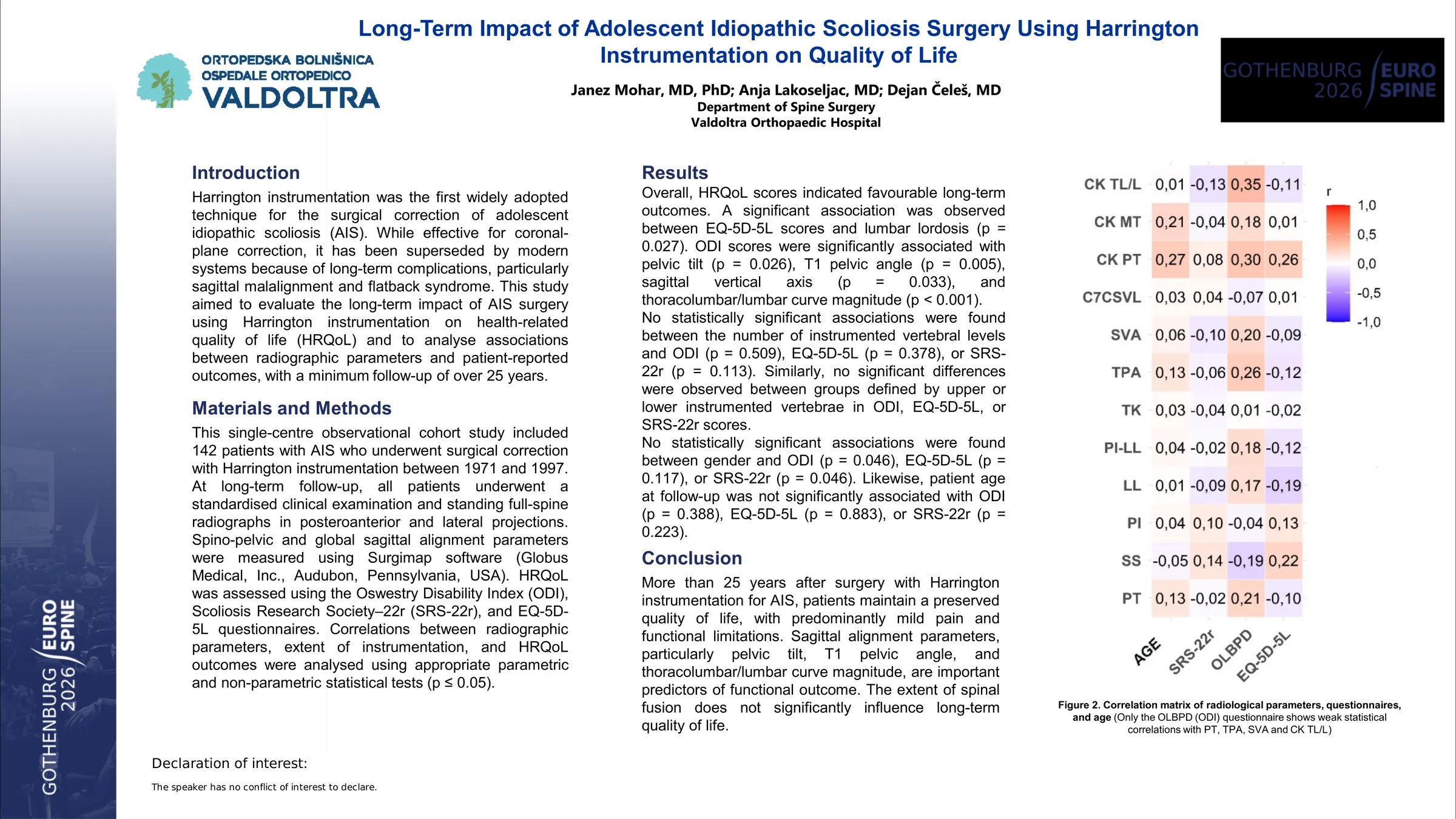
Overall, HRQoL scores indicated favourable long-term outcomes. A significant association was observed between EQ-5D-5L scores and lumbar lordosis (p = 0.027). ODI scores were significantly associated with pelvic tilt (p = 0.026), T1 pelvic angle (p = 0.005), sagittal vertical axis (p = 0.033), and thoracolumbar/lumbar curve magnitude (p < 0.001).
No statistically significant associations were found between the number of instrumented vertebral levels and ODI (p = 0.509), EQ-5D-5L (p = 0.378), or SRS-22r (p = 0.113). Similarly, no significant differences were observed between groups defined by upper or lower instrumented vertebrae in ODI, EQ-5D-5L, or SRS-22r scores.
No statistically significant associations were found between gender and ODI (p = 0.046), EQ-5D-5L (p = 0.117), or SRS-22r (p = 0.046). Likewise, patient age at follow-up was not significantly associated with ODI (p = 0.388), EQ-5D-5L (p = 0.883), or SRS-22r (p = 0.223).
More than 25 years after surgery with Harrington instrumentation for AIS, patients maintain a preserved quality of life, with predominantly mild pain and functional limitations. Sagittal alignment parameters, particularly pelvic tilt, T1 pelvic angle, and thoracolumbar/lumbar curve magnitude, are important predictors of functional outcome. The extent of spinal fusion does not significantly influence long-term quality of life.